You must have heard of the phrase “the house always wins” in online casinos.
But what does this mean?
The idea comes down to a simple concept called house edge.
Some may confuse the idea of house edge with a trick or a hidden fee. It is actually a mathematical advantage that is built into every casino system. It is because of this system that casinos can run. It ensures that the casino can pay out wins while remaining profitable.
This glossary aims to break it down.
What is House Edge?
It is a probabilistic advantage that an online casino has over players in any game. It is expressed as a percentage and indicates the portion of total wagers that a casino is expected to retain on average over time.
In simpler terms: It shows how much a casino earns on average, not from a single bet or player but across thousands of wagers.
For example, if a game carries a 3% house edge, the casino is expected to keep roughly $3 out of every $100 bet over the long run.
It must be understood that this doesn’t mean every player loses $5 every time.
Players either win, lose, or walk away. But if we look at the bigger picture, the math of this may be slightly inclined in favour of the house.
Why Does House Edge Exist in Online Casinos?
Online casinos are businesses, and there are certain requirements that they need to cover to stay sustainable.
Some of their necessities include –
- Game development and software license
- Payment processing
- Affiliate commissions
- Customer support
- Compliance and regulatory costs
Instead of charging fees upfront from the players, casinos build margins directly in accordance with the odds and payouts of every game.
This way, the experience doesn’t feel unfair, is transparent, and keeps it exciting. All this while ensuring that the casino remains profitable over time.
House Edge Vs Return to Player
Before understanding house edge’s work, it is important to first differentiate it from another important element called return to player (RTP).
RTP shows the amount that the game must pay back to the player. House edge, on the other hand, is the small amount that the casino gets to keep.
If a slot has 96% RTP, then the house advantage is the remaining 4%. Together, they always add up to 100%.
If RTP is the number that faces the player, then house edge is the casino’s side of the same equation.
How Does it Work in Practice
It does not necessarily have an equal impact on every bet. You might –
- Win big on your first spin
- Get a lucky streak at the blackjack table
- Cash out early with profits
This is because the system works on long-term probability and not short-term outcomes.
Casinos don’t rely on a certain player losing on a certain day. They rely on the fact that –
- Players keep playing
- Bets add up
- Probabilities even out with time
This is why casinos celebrate big wins publicly while remaining profitable.
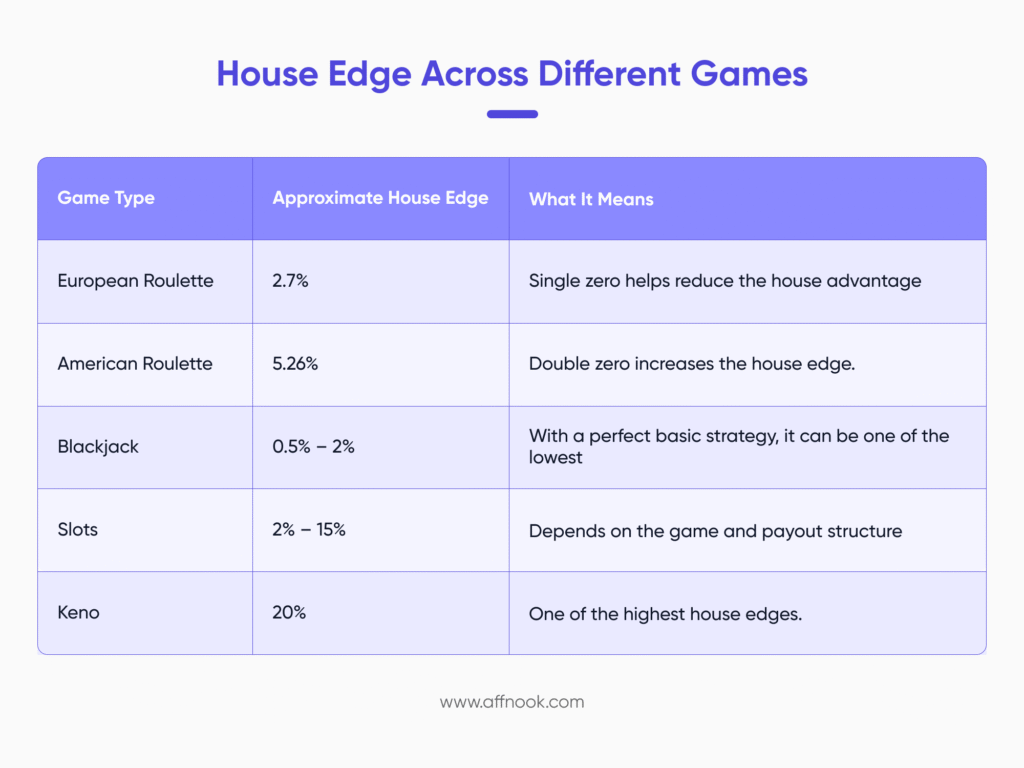
House Edge Across Different Games
Not all casino games function equally. Some give the house a much bigger advantage than others. They vary on the basis of –
- Game rules
- Number of possible outcomes
- Payout ratios
- Player decision-making
Common Misconceptions About House Edge
It means the game is rigged
This is wrong because licensed online casinos use certified random number generators (RNGs). As the number generation is random, the outcomes are also random. The advantage, hence, comes from payout design and not manipulation.
It guarantees a loss in every session
This, too, is incorrect. Players often win significantly. The house edge system is only applied when the results are averaged over time.
A betting system can eliminate the house advantage
Betting systems cannot completely remove the system. It can be slightly reduced with the help of some strategies in skill-based games, but it cannot be reversed permanently.
Why House Edge Matters in iGaming
For players, it –
- Sets realistic expectations
- Helps in the selection of games
- Supports responsible play
This ensures that online casinos do not function on assumptions or myths. It clarifies that casinos are meant for entertainment and do not always guarantee profit. Through this, they can manage money, as the players know that losses can be expected over time.
When players understand the working of this system, they gamble with awareness and not emotion. This encourages a sense of responsibility in them.
For affiliates and operators –
- It clearly explains casino profitability.
- This helps in the creation of transparent and educational content.
- Removes misconceptions and builds a sense of trust with the users..
Having a proper understanding of house edge reduces confusion and unrealistic expectations. All in all, this benefits the entire iGaming system.
Conclusion
House edge is not about winning or losing bets; it is more about how the online casinos are structured to function.
As the players understand that the system is a built-in part of the game design, they are positioned to –
- Choose games thoughtfully
- Manage risks realistically
- Engage with online casinos in an informed way
This awareness does not detract from the experience but promotes a more balanced and responsible approach to gameplay.
For an industry that functions through profitability, transparency around systems like that of house edge makes the iGaming sector grow sustainably.
Help Centre
Does a Lower house edge Guarantee Better Results?
No, but it improves the theoretical odds. A lower edge means:
- Losses accumulate more slowly over time
- Bankroll lasts longer
- The expected value is less negative
However, even low-edge games can result in losses, and no casino game offers a zero house edge. Luck and variance still dominate short-term play
Is house edge the same for all online casino games?
No, it varies by game type, rules, and payout structure. Games like blackjack and European roulette usually have lower house edges, while slots, keno, and lottery-style games often have significantly higher house advantages.
Why is understanding house edge important for affiliates and platforms?
Understanding house edge helps affiliates and platforms set realistic expectations, create transparent content, and build long-term trust with users. It supports responsible gaming narratives and improves credibility in competitive iGaming and affiliate ecosystems.
How does house edge affect a player’s chances of winning?
House edge does not determine individual outcomes but influences long-term results. A lower edge means better theoretical odds for players, slower bankroll loss over time, and a higher chance of sustaining longer play sessions.