The online gambling industry is projected to reach $103 billion in revenue by 2025, climbing to an estimated $169 billion by 2030. While this growth represents a significant opportunity for operators, access to this market will only be available if operators can obtain an online gambling business license.
For the majority of operators, the licensing process is the most complex, expensive, and time-intensive component of launching an iGaming business.
The problem is not that licensing is impossible; rather, most operators simply do not understand what the online gambling licensing process requires until they’re already in it.
Factors of concern include:
- incorrect jurisdiction,
- underestimated costs,
- incomplete documentation, and
- reactive compliance,
which are common challenges for operators at all levels of operation and rank.
This guide details five common challenges that operators encounter in obtaining and maintaining a licensed online gambling business, along with practical strategies to navigate each challenge without limiting your launch or your future growth opportunities.
Challenge 1 — Choosing the Right Jurisdiction
Online gambling regulations vary significantly across countries and even within regions — the US alone has state-level laws where some permit online gambling, and others prohibit it entirely. This fragmentation makes jurisdiction selection far more than a cost comparison.
Choosing a jurisdiction is the most important step in obtaining an online gambling business license and is also the most commonly rushed. Making the wrong choice can restrict both your access to payment processors and limit your player trust and market reach, even before you get your first user.
Malta Gaming Authority (MGA)
The MGA is the benchmark for EU-facing operators. An MGA license will enable you to access all European payment processors as well as access financial institutions in Europe. The turnaround time for approval is typically between four and six months, depending on the complexity of the application.
Curacao Gaming Control Board (GCB)
The easiest jurisdiction entry for operators targeting developing markets or building a low-cost operation. Annual license fees sit at approximately NAF 120,000 (approximately €58,200), with approvals processing within eight weeks per phase. Lower credibility with mainstream European banks, but significantly faster to market.
UK Gambling Commission (UKGC)
An online gambling business license issued by the UKGC is non-negotiable for opening an online casino in the UK. The application fee for the license is £370. The compliance requirements are high and create unmatched market integrity and credibility.
How to approach it:
Define your ideal player base first, then work backwards to which jurisdiction gives you the market access and the minimum level of compliance you can perform.
The majority of operators use Curacao to launch and establish an operational history, then go after MGA or UKGC jurisdictions as you scale. This balances the need for speed to market with the long-term regulatory position.
Challenge 2 — High Application Costs and Hidden Fees
The application fees are only the tip of the iceberg. For most operators, it’s the costs that come after that cause real budget strain.
The starting cost of an MGA application fee is €5,000. However, the total costs incurred in the first year (including legal costs, compliance set-up, and technical audit fees) usually range from €120,000 to €250,000. Securing an online gambling business license costs significantly more than the application fee suggests — and most operators find that out too late.
What operators commonly miss:
Minimum share capital requirement of €40,000–€100,000, depending on the type of licence (actual cash must be held in the business).
System certification and technical audits start from €10,000 up to €50,000, depending on how complex the platform is.
Legal and consulting fees range from €40,000 to €80,000. Operators that attempt to apply for a licence without professional assistance can typically expect delays of over 6 months. This makes delays cost more than professional advice.
Recurring compliance contributions — For B2C operators, an annual licence fee of €25,000 is the baseline, along with progressive compliance fees based on the gross gaming revenue of the business.
How to control costs:
Budget for both your application fee and your total licensing costs. Engage specialist iGaming legal counsel before submission, not after your first rejection. Startups should note that applying for an online gambling business license under MGA’s B2C category qualifies them for a 12-month moratorium on compliance contributions — a meaningful runway when cash flow is tight in year one.
Challenge 3 — Regulatory Complexity and Documentation
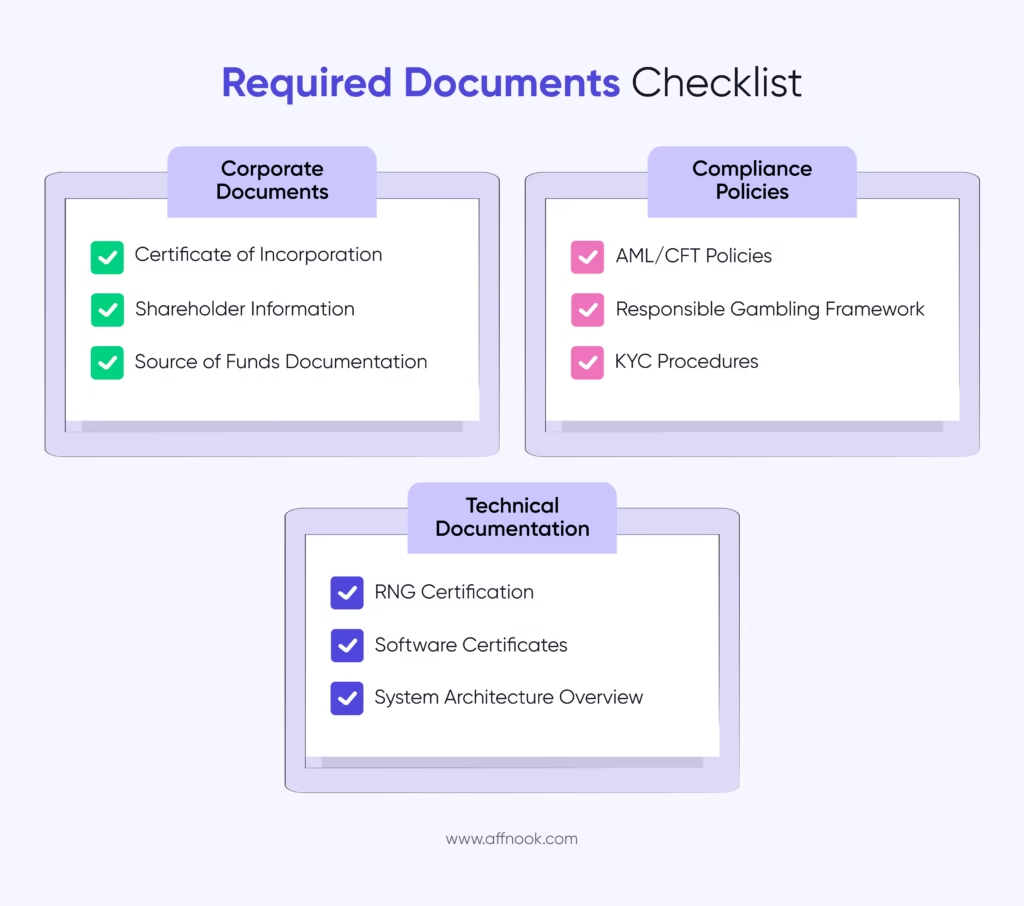
Regardless of jurisdiction, every online gambling license application requires a core set of documents:
- Certificate of Incorporation
- Business Plan
- AML or CFT Policies
- Responsible Gambling Policies
- KYC Procedures
- Software Certificates
- RNG Certification
- System Architecture Overview.
Each jurisdiction will add its respective layer of additional documents.
The complex nature of this process is not only in the number of documents required from each applicant; it also includes the accuracy of the documents submitted. Failing to submit complete, accurate, or consistent documentation is the leading cause of delayed or rejected applications.
Where operators are typically lacking:
Generic rather than jurisdiction-specific AML or CFT policies — Regulators expect to see proactive and technically sophisticated prevention systems, not reactive reporting frameworks.
Treating responsible gambling frameworks as checkbox items rather than operational systems — regulators reviewing your online gambling business license application expect self-exclusion tools, deposit limits, and behavioural monitoring to be fully functional at submission, not planned for later.
Technical documentation — Independent audit verification of RNG testing and transaction data must be stored and maintained as required for jurisdictional approval prior to operational use.
Financial documentation — Incomplete, inconsistent formatting of source of funds documentation, audited financial reports, and shareholder background checks across entities.
Navigating this system:
Establish individual documentation checklists for each jurisdiction ahead of time, not while in process. Regulators don’t expect exhaustive detail, but they do expect clarity on ownership of responsibilities, the measures taken to mitigate risk, and the handling of exceptions.
Engage a compliance consultant early and treat your AML and responsible gambling policies as operational infrastructure, not one-time submissions.
Challenge 4 — Approval Delays
Typically, the timeframe for licensing is unpredictably long. Operating licenses can take anywhere from 3 months to over a year, with the average sitting around 6 months across major jurisdictions.
For operators pursuing an online gambling business license, every additional month of waiting means development costs and payroll continue without a single player acquired.
What causes delays:
Submitting incomplete applications — This is the most frequent and preventable reason which triggers queries from regulatory agencies, causing the filing process to halt.
Jurisdictional backlog — Regulators process applications in bulk so they can manage multiple pending applications at once.
With Curaçao’s ongoing LOK Regulatory Reform creating uncertainty in the timelines, the method for determining the fee amounts, and the scope and method of on-site inspections, all parties that looked to Curaçao due to timing are finding out that their assumption was incorrect.
Mid-process documents requests — It is common for the regulators to request additional information, either of a financial or technical nature, after an application is submitted. This can add several weeks to the overall processing time.
Slow response to regulator queries — An extended response time on your part will only increase the amount of time required to obtain your approval from the regulator.
How to minimize delays:
Make sure you complete all parts of your online gambling business license application at once. Take advantage of pre-application consultations where offered. After rejection, ask for specific reasons for rejection to assist with future applications (many jurisdictions require a waiting period between initial and subsequent applications).
Add an additional 90 days to your project schedule beyond the projected approval window.
Challenge 5 — Ongoing Compliance and Renewal Costs
Obtaining a license is only the first step. The ongoing financial obligation of remaining licensed is often underestimated by new operators when launching their new business.
The license fee is the entry ticket. The compliance stack is the season pass — and most operators budget for the ticket and wonder why they can’t get past the gate.
Ongoing compliance costs include:
- GLI or iTech Labs testing for RNG recertification costs from $8,000 – $12,000 per year
- KYC or AML platform — Onfido, Jumio, or Sumsub costs start from $500/month for subscription models (Sumsub) or $1-3 per verification for usage-based pricing
- For established MGA operators, annual compliance costs range from €225,000 to €400,000, covering regulatory fees, compliance personnel, audits, and legal expenses.
How to manage it:
From day one, you should include your compliance costs in your operating budget, not at the time of the first renewal. Every online gambling business license comes with recurring compliance obligations that don’t shrink as you grow; they scale with you.
Operators who work with compliance-integrated platforms, such as Affnook, avoid manual reporting overhead that quietly drains internal resources as the business scales. You need to treat your compliance infrastructure as a fixed operating cost, rather than a variable operating cost — it doesn’t shrink as you grow, it scales with you.
Scaling Across Multiple Jurisdictions
Having a license in one jurisdiction allows for expansion within the next jurisdiction. Unfortunately, every jurisdiction adds another layer of compliance, which means there will be new applications, renewals, reporting and different AML structures which may not align across multiple jurisdictions.
Operators who scale successfully treat multi-jurisdictional compliance as a function, not a task and often use several proven processes to accomplish it:
- Prioritize markets with mutual recognition agreements — when expanding your online gambling business license portfolio, prior licensing history can serve as partial evidence of compliance in certain jurisdictions, reducing documentation overhead for second or third applications.
- Build a centralized compliance function early — Having all licensing requirements, renewal calendars, and contact information for all markets in one team is much more efficient than having them managed separately by individual teams across different markets.
- Use tools that support geo-compliance natively — Each of your affiliates has a different set of rules for how to acquire new players and operate your marketing. Having software, like Affnook, that can enforce these rules will save you time in the manual compliance process when it comes to expanding your business.
Conclusion
Licensing is complicated, but the operators that struggle with licensing the most are not the operators that have impacted hard regulatory environments, but rather the ones that view licensing as an obstacle to overcome instead of as foundational infrastructure.
An online gambling business license isn’t a one-time achievement. It’s an ongoing operational commitment that touches every part of your business — payments, affiliates, player trust, and market access.
The most frequent errors are easily preventable: allowing pricing to drive jurisdictions, underfunding the full cost of licensing (and shortchanging themselves), submitting incomplete documentation, and treating compliance as an annual checkbox versus an ongoing operational process.
Once an operator has received a license, incorporating player acquisition growth also increases the operational demands on the operator. However, by utilizing a platform such as Affnook, which by design allows for geo-compliance, affiliate partnerships across multiple countries, regulation reporting and other compliance-related functions, the total investment an operator has made to obtain a license translates directly into growth and not additional manual overhead.
Help Centre
What are the biggest challenges in obtaining an online gambling business license?
Obtaining an online gambling business license often involves strict regulatory requirements, high compliance costs, and lengthy approval timelines. Operators must also meet jurisdiction-specific rules, making it essential to plan documentation, legal support, and technical audits in advance.
How long does it take to get an online gambling business license approved?
The time it takes to get an online gambling business license will vary by jurisdiction, from as little as a couple of weeks to many months. The biggest reasons for delays are usually that your application has missing information, compliance problems, or regulatory agencies dragging their feet in doing due diligence on your application
What documents are required for an online gambling business license application?
Usually, operators will need to provide the following information: Company registration documents, financial records, KYC information, software certifications or compliance documentation and AML policies. By providing accurate and complete application submissions, operators reduce the chances of receiving an application delay, while also improving the likelihood of receiving a license.
How can operators overcome compliance challenges in online gambling licensing?
Operators can overcome the hurdles of compliance by working with professional lawyers, having good anti-money laundering and responsible gambling systems and selecting the best jurisdiction. The use of compliant technology platforms also makes it easier to comply with ongoing reporting and regulatory compliance.
Which jurisdictions are easiest for getting an online gambling business license?
Operators will commonly seek out jurisdictions such as Malta and Curaçao to obtain an online gaming license because of relatively straightforward processes. However, how easy it is to obtain a permit will depend on an operator’s business objectives, target market, and the degree of regulatory credibility required with each jurisdiction.