Volume is noisy in iGaming affiliate marketing. Quality is quiet.
Dashboards glorify clicks. Campaigns focus on registrations. Cost per acquisition is the subject of debate in teams. However, the metrics do not represent the most important question:
“Are we recruiting the right players?”
In controlled iGaming economies where the pressure to comply is strong, and the value of its players is the defining factor of profitability, targeting volume without considering intent can cause the margins to be washed away within a short time. Bonus abuse increases. KYC failure rates spike. Early churn rises. Support costs inflate.
Industry data shows that only 6.19% of active players come from new acquisitions, meaning over 93% of revenue is generated by retained users, highlighting why traffic quality and player lifetime value matter more than raw acquisition volume.
This is where traffic quality scoring is necessary.
It is not a mere performance metric. It is a systematic model that iGaming brands, operators, and affiliate networks utilize to evaluate, quantify, and rank the value of incoming traffic depending on behavior, intent, compliance, and long-term performance of players.
Simply put, it provides answers to one important question:
Is this traffic contributing to sustainable growth, or is it silently killing us?
What Is Traffic Quality Scoring?
Traffic quality scoring is a data-driven approach to affiliate traffic assessment beyond on-the-nose metrics like clicks, registrations, or even first-time deposits (FTDs).
Rather than inquiring, How much traffic did we get? It inquires:
- What is the level of engagement of these players?
- How long do they stay active?
- Do they pass KYC smoothly?
- Do they exhibit bonus abuse?
- What is their long-term net revenue?
- Do they comply with the rules of jurisdiction?
A quality score can subsequently be assigned to every traffic source, campaign, or affiliate partner using weighted indicators of performance.
The score assists operators in ranking partnerships, spending more effectively, and mitigating risk.
Why Traffic Quality Scoring Matters in Regulated iGaming
Scale frequently dominated scrutiny in early iGaming development cycles. Today, that approach is risky.
Regulators are stricter. The costs of player acquisition are increasing. Margins are very reliant on retention and lifetime value.
Low-quality traffic may result in:
- High bonus exploitation
- Fraudulent registrations
- Multi-accounting
- Low retention rates
- Negative net gaming revenue (NGR)
- Increased compliance exposure
High traffic quality scoring system secures operators by not emphasizing immediate conversions, but profitability and compliance in the long term.
In the case of affiliate networks, it also brings about transparency and trust among partners.
Core Components of Traffic Quality Scoring
A detailed model in iGaming normally reviews several tiers of performance data.
1. Engagement Metrics
These determine the interactions of players with the platform:
- Session frequency
- Session duration
- Games played
- Feature usage
- Time between registration and first deposit
Poor engagement is often a signal of low-intent traffic—a problem that operators increasingly address through structured lead-quality improvement strategies.
2. Financial Performance Indicators
These are determinants of long-run worth:
- First-Time Deposit (FTD) conversion rate
- Average deposit size
- Deposit frequency
- Net Gaming Revenue (NGR)
- Player Lifetime Value (LTV)
High-quality traffic would bring long-term sustainable revenues, not temporary peaks.
3. Retention & Churn Signals
Retention is the test of quality.
Key signals include:
- Day 7/Day 30 retention rates
- Repeat deposit behavior
- Ongoing gameplay activity
Traffic that churns right after getting a bonus reduces overall ecosystem value.
4. Compliance & Risk Indicators
In regulated markets, quality has to incorporate risk profiling.
This may include:
- KYC pass rates
- Geolocation consistency
- Device fingerprint duplication
- Suspicious deposit patterns
- Chargeback rates
Compliance friction can be associated with traffic that has some implicit costs.
5. Behavioral Patterns
Advanced models incorporate:
- Bonus abuse probability
- Multi-account detection
- Behavioral anomaly detection
- Pattern clustering across affiliates
Behavioral scoring separates the legitimate recreational players and opportunistic actors.

How Traffic Quality Scores Are Calculated
There is no general formula. Operators develop their scoring models depending on their risk-taking, business model, and regulatory environment.
Nevertheless, the majority of systems have a weighted scoring system:
- Give performance measures.
- Assign weight to each indicator (e.g., the weight of retention could be more than the weight of the click volume).
- Normalize performance data.
- Generate a composite score.
For example:
- 30% retention
- 25% revenue performance
- 20% compliance health
- 15% engagement
- 10% fraud risk
These affiliates or campaigns are then classified into tiers as:
- High Quality
- Moderate Quality
- Monitor Closely
- High Risk
This hierarchical classification allows making smarter decisions.
Benefits of Traffic Quality Scoring
For iGaming brands and operators:
- Minimizes unnecessary acquisition expenses.
- Enhances profitability in the long term.
- Minimizes regulatory risk.
- Favors smarter affiliate negotiation.
- Optimizes player lifecycle.
For affiliate networks:
- Establishes trust with operators.
- Promotes quality traffic measures.
- Enhances the duration of partnerships.
- Distinguishes between serious affiliates and arbitrage-oriented affiliates.
Quality scoring makes affiliate marketing strategic instead of transactional.
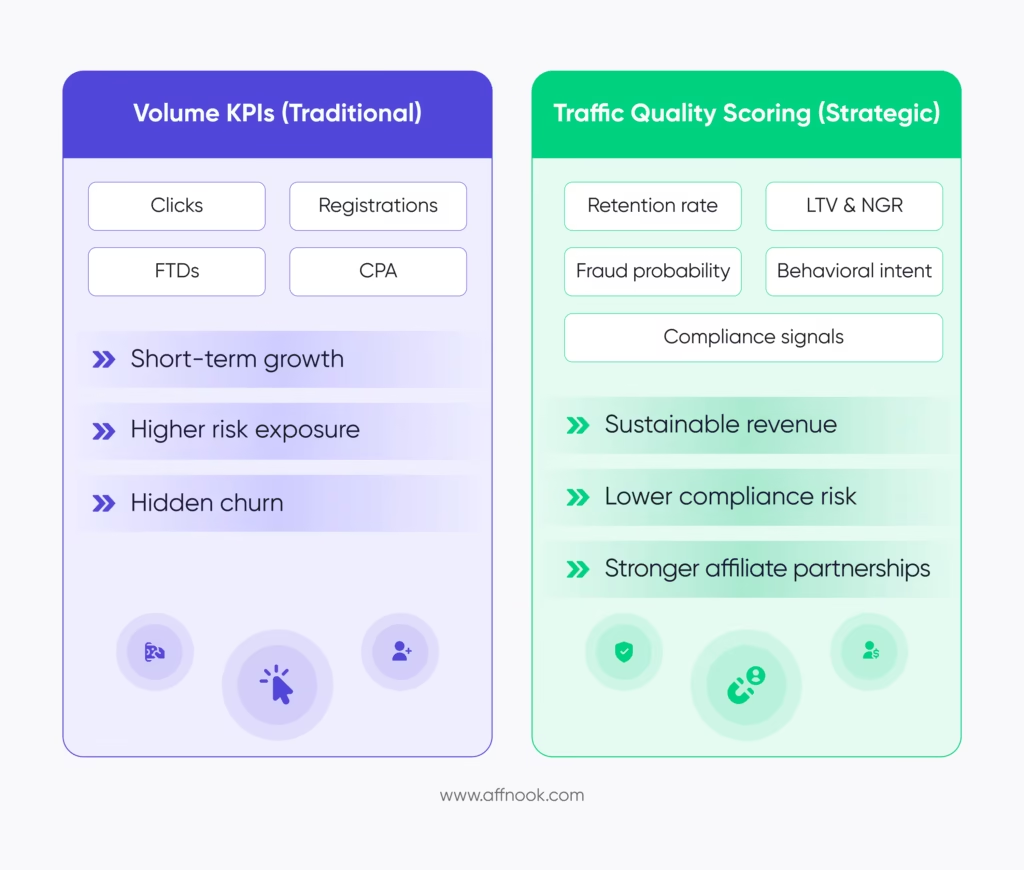
Traffic Quality Scoring vs. Volume-Based KPIs
Traditional KPIs focus on:
- Click-through rate
- Cost per acquisition
- FTD numbers
Traffic quality scoring moves the emphasis to:
- Revenue sustainability
- Behavioral integrity
- Risk exposure
- Long-term player value
KPIs based on the volume can distort the perception of performance. Quality scoring corrects it.
Sustainable growth in regulated iGaming markets relies more on retention curves than registration spikes.
Common Mistakes in Traffic Quality Scoring
Even advanced operators are capable of using scoring models incorrectly.
Frequent errors include:
- Overweighting FTDs and underweighting retention.
- Neglecting post-bonus player behavior.
- Inability to revise scoring standards as markets change.
- Failure to provide performance information to affiliates.
- Reliance on scoring as a disciplinary measure and not as an optimization tool.
Traffic quality scoring must be dynamic, transparent, and improvement-driven.
How Technology Supports Traffic Quality Scoring
Contemporary affiliate networks are dependent on real-time analytics providers to measure and analyze performance data.
These platforms integrate:
- Player behavior tracking
- Fraud detection algorithms
- Automated anomaly alerts
- Cross-channel attribution mapping
Predictive modeling is the future of traffic quality scoring, as it involves intelligent systems to predict traffic risk and stop it before it happens.
The Strategic Shift: From Acquisition to Qualification
The iGaming industry no longer needs to compete just in terms of attention. It is fighting for qualified attention.
This shift is reflected in traffic quality scoring.
Instead of asking: “How much traffic did we buy?”
The question now in the minds of forward-thinking operators is: “How much of this traffic has any right to remain?”
This is a minor but significant shift that transforms the whole situation, including the negotiations with the affiliate, to the budgeting and adherence policy.
Final Thoughts
Traffic quality scoring is not a trend. It is an inevitable development in iGaming affiliate marketing.
With increasing regulation and rising acquisition costs, brands and operators are no longer able to treat all traffic equally. Sustainable growth requires organized analysis, quantifiable benchmarks, and ongoing optimization.
The affiliates that do well in this environment will be those that place importance on transparency, behavioral integrity, and value creation over the long term.
Traffic is ubiquitous in modern iGaming. Quality is not.
Help Centre
1. How does Traffic Quality Scoring work in iGaming affiliate marketing?
Traffic Quality Scoring evaluates affiliate traffic based on retention, revenue performance, compliance signals, and fraud risk. Instead of measuring only clicks or FTDs, it assigns weighted scores to determine whether traffic drives sustainable, long-term value for operators.
2. Why is Traffic Quality Scoring important for regulated iGaming markets?
In regulated markets, operators must balance growth with compliance and player protection. Traffic Quality Scoring helps identify high-risk traffic, reduce bonus abuse, improve KYC pass rates, and ensure acquisition strategies align with regulatory and profitability requirements.
3. What metrics are included in a Traffic Quality Scoring model for online casinos?
A typical model includes retention rates, lifetime value (LTV), net gaming revenue (NGR), deposit behavior, KYC success rates, chargebacks, and fraud indicators. These combined metrics provide a holistic view of player quality beyond surface-level acquisition data.
4. How can affiliate networks improve traffic quality for iGaming operators?
Affiliate networks can improve quality by monitoring behavioral patterns, filtering low-intent traffic sources, prioritizing compliant content strategies, and optimizing campaigns based on long-term player performance rather than short-term registration volume.
5. What is the difference between Traffic Quality Scoring and traditional CPA-based affiliate tracking?
Traditional CPA tracking focuses on conversions such as registrations or FTDs. Traffic Quality Scoring evaluates post-conversion behavior, retention, compliance, and revenue sustainability, helping operators prioritize affiliates that generate profitable and low-risk players.