With the increased regulation and competitiveness of iGaming markets, KYC (Know Your Customer) is no longer a back-office compliance demand, but rather a pillar of sustainable development.
To operators, this dictates who is allowed to play, deposit, and withdraw legally.
In the case of affiliates, it defines the quality of traffic, approval rates, and long-term collaborations.
Actually, international scams and identity-related losses amount to tens of billions of dollars each year to digital business, and controlled iGaming markets are one of the most inspected sectors when it comes to player authentication and money integrity. With stricter regulation, Know Your Customer is not simply a matter of compliance anymore; it is a matter of trust, profitability, and survival.
This guide dissects all that iGaming brands and operators should learn about KYC, particularly in an affiliate-based purchase setting.
What Is KYC (Know Your Customer)?
Know Your Customer is a procedure of checking the identity of a player before accessing some iGaming services—usually deposits, withdrawals, or gameplay above a specified limit.
In iGaming, it ensures that:
- Players are what they say they are.
- Players are of legal age.
- Funds are honest and trackable.
- Operators are in compliance with AML (Anti-Money Laundering) and local laws.
In all regulated jurisdictions of iGaming, KYC is required.
Why KYC Exists in iGaming
KYC is intended to safeguard three major stakeholders:
1. Regulators
Regulators require Know Your Customer to:
- Prevent money laundering.
- Fight fraud and identity theft.
- Enforce age restrictions.
- Observing responsible gambling behavior.
2. Operators
For operators, Know Your Customer:
- Minimizes chargebacks and bonus abuse.
- Eliminates multi-accounting and arbitrage.
- Guarantees licenses and access to the market.
- Enhances the player lifetime value through bad actor filters.
3. Players
For legitimate players, Know Your Customer:
- Ensures safer platforms.
- Secures balances and withdrawals.
- Develops confidence in licensed operators.
Core Components of KYC in iGaming
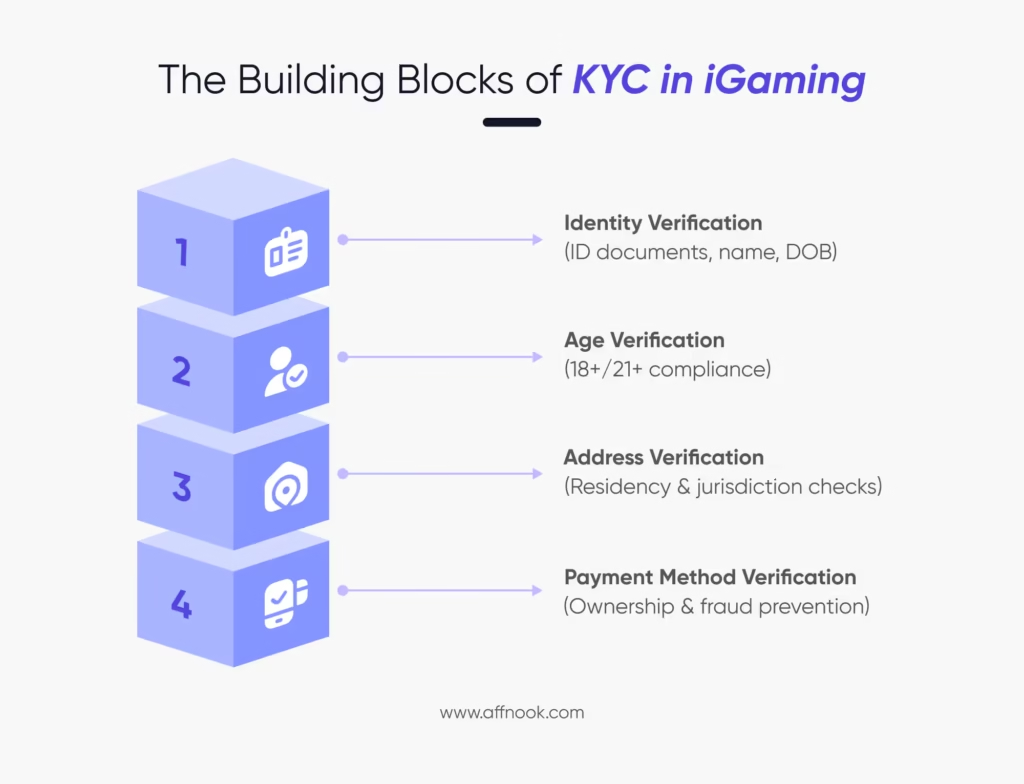
Most KYC processes consist of the following elements, even though the implementation depends on the jurisdiction:
Identity Verification
Players are normally expected to provide:
- Government-issued ID (passport, national ID, driver’s license)
- Full legal name
- Date of birth
This validates the identity and legality of the player.
Address Verification
To verify residency and jurisdictional eligibility, operators may request:
- Utility bills
- Bank statements
- Formal government documents
This is particularly crucial in country-specific or geo-restricted licensing regimes.
Age Verification
Age verification will make sure players are of legal age to gamble, which is normally 18 or 21, depending on the market.
Most regulators insist on verifying the age prior to deposit or withdrawals.
Payment Method Verification
Operators often verify:
- Ownership of methods of payment.
- Uniformity between identity documentation and payment details.
This helps prevent:
- Stolen card usage
- Third-party payment abuse
- Money laundering risks\
Financial Risk Checks and Player Activity Limits
In contemporary controlled iGaming markets, Know Your Customer is becoming more than an identity check to a financial risk evaluation.
Regulators have come to expect that operators should not only know the identity of a player, but also that the player has a risk of being financially abused by the level of gambling activity they engage in.
Financial risk checks are meant to evaluate:
- The extent to which a player spends on gambling based on financial conditions.
- Indications of unsustainable losses or violence.
- Possible signs of economic insecurity.
Depending on these checks, operators can be asked to:
- Limit deposits or gambling.
- Limit entry to some products.
- Demand more source-of-funds information.
- Interfere with responsible gambling.
These protective measures are becoming more integrated into KYC and continuous monitoring methodologies, particularly in markets that have robust consumer protection systems.
KYC vs AML vs Financial Risk Checks: What’s the Difference?
KYC, AML, and financial risk checks have different yet linked purposes in the compliance of iGaming, although the terms are commonly used interchangeably.
- Know Your Customer is aimed at ensuring that a player is who he claims to be, is of a certain age, and whereabouts.
- AML (Anti-Money Laundering) is concerned with tracking money in order to stop illegal financial activity.
- Financial risk checks determine whether the gambling pattern of a player may impose any financial damage.
Know Your Customer will help in monitoring AML and financial risks by:
- Setting up authenticated identities.
- Enabling tracking of transactions.
- Funding affordability and risk evaluation in the long run.
A combination of these measures creates a comprehensive compliance framework that safeguards players, operators, and regulators equally.
When Does KYC Happen in iGaming?
The timing of Know Your Customer depends on the market and the policy of the operator:
Pre-Registration KYC
- Before creating an account, verification is done.
- Popular in jurisdictions that are highly regulated.
- Deters fraud at an early stage but may also reduce conversion.
Post-Registration KYC
- Checking before withdrawals
- Most common model
- Balances UX and compliance
Tiered KYC
- Light checks initially
- Improved verification based on deposit limits, withdrawals, or risk indications.
Tiered KYC is also gaining popularity as operators want conversion efficiency as well as compliance.
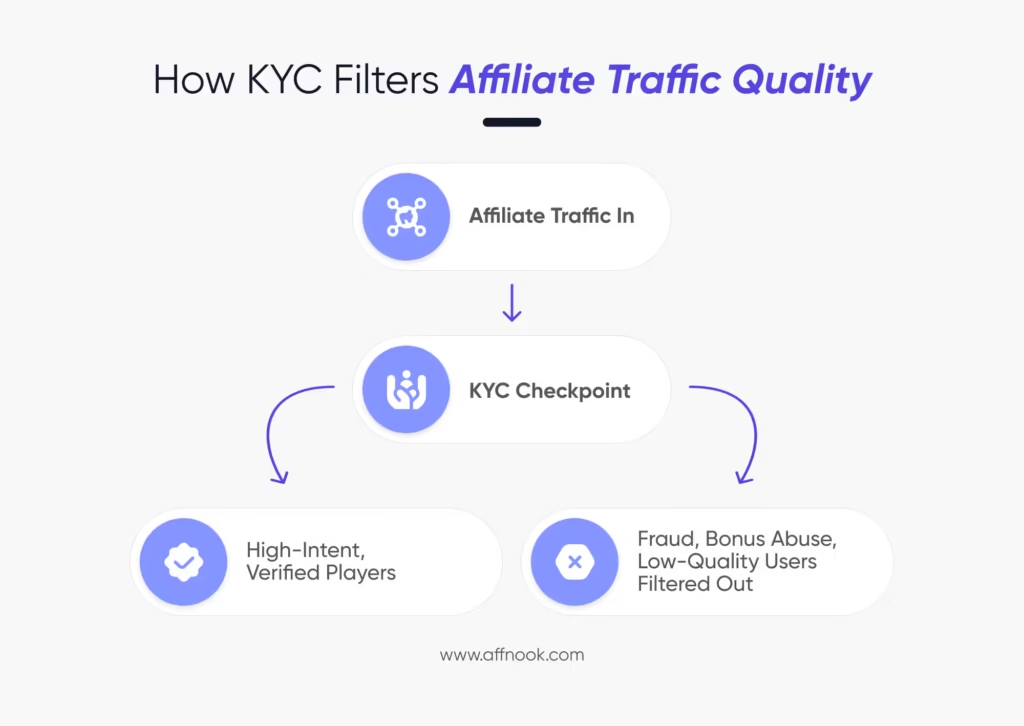
Why KYC Matters for Affiliate Traffic Quality
In the case of affiliate-based acquisition, Know Your Customer is a filter of traffic quality.
As an operator, I would have to provide:
- Low-quality traffic: high KYC failure rates.
- High rejection of documents: possible abuse of incentives.
- Recurring identity problems: potential fraud rings.
Affiliates that submit players who fail this risk:
- Commission reversals
- Traffic downgrades
- Suspensions or terminations of accounts
In controlled markets, the Know Your Customer pass rate is an implicit KPI.
Common KYC Challenges in Affiliate Marketing
Incentivized or Low-Intent Traffic
Traffic simply brought by bonuses can consist of:
- Fake identities
- Shared documents
- Players who do not want to undergo verification
Multi-Accounting & Bonus Abuse
Know Your Customer helps identify:
- Duplicate identities
- Recycled documents
- Linked payment methods
These concerns are often related to inadequate affiliate sourcing behaviors.
Jurisdiction Mismatch
Affiliates promoting deals within limited areas usually send:
- Players who do not pass screenings.
- Users blocked in the verification.
- Traffic that raises compliance flags.
How Good KYC Improves Operator Performance
Once it is done properly, it:
- Minimizes losses due to fraud.
- Enhances the effectiveness of withdrawal.
- Enhances player trust.
- Safeguards long-term licensing.
Operators that have simplified Know Your Customer processes tend to realize:
- Increased retention of verifiable players.
- Lower operational costs.
- Improved relationships with regulators.
KYC is not only a cost centre, but a risk management and growth tool.
The Future of KYC in iGaming
KYC is being transformed at an exponential rate, both by regulation and technology.
Key trends include:
- Identity checks on automation.
- Biometric verification (liveness detection, facial recognition).
- AI-driven fraud scoring.
- Document validation in real time.
The standard of Know Your Customer will not be relaxed as markets such as Brazil, North America, and certain parts of Europe continue to mature.
Operators and affiliates that innovate early will enjoy a competitive advantage.
Conclusion
In the modern controlled iGaming environment, KYC is inevitable—however, it is priceless.
To operators, it conserves licenses, income, and reputation. In the case of affiliates, it isolates long-term engagements and short-term gains.
With trust, compliance, and player value being the key conditions of success in an industry, Know Your Customer is no longer a regulatory necessity; it is a strategic asset.
Help Centre
1. What is Know Your Customer in iGaming, and how does it work for online casinos?
KYC in iGaming is the process of verifying a player’s identity, age, and location using documents and data checks. It helps online casinos comply with regulations, prevent fraud, and ensure responsible gambling.
2. Why is KYC (Know Your Customer) mandatory for regulated iGaming operators?
KYC (Know Your Customer) is mandatory for regulated iGaming operators to meet AML and responsible gambling requirements. It reduces risks related to fraud, underage gambling, and money laundering, and protects operators from fines or license suspension.
3. How does KYC (Know Your Customer) impact player experience and conversion rates in iGaming?
While KYC (Know Your Customer) adds friction, streamlined verification improves trust and long-term retention. Modern iGaming operators use automated KYC tools to reduce drop-offs, speed up onboarding, and balance compliance with user experience.
4. What documents are required for KYC (Know Your Customer) verification in online gambling?
KYC (Know Your Customer) verification in iGaming typically requires government-issued ID, proof of address, and payment method verification. Some markets may also require source-of-funds checks depending on player risk profiles and transaction limits.
5. Why should iGaming affiliates understand KYC (Know Your Customer) requirements?
iGaming affiliates must understand KYC (Know Your Customer) to set accurate player expectations, reduce churn, and align with compliant operators. Promoting transparent KYC practices helps improve player trust, brand credibility, and long-term affiliate revenue.