Roulette is one of the most recognizable casino games in the world. The wheel spins, the ball drops and the winning number decides the final result. It’s the basic appeal.
It is also so popular because it is incredibly simple to understand, easy to explain and relevant to both land-based and online gaming.
Roulette, for iGaming operators, affiliate managers and casino brands, is a category of iGaming that brings in beginner players, live casino users and search-led traffic. It offers useful insight into player intent, source quality, device type and first-time deposits.
For operators using an iGaming affiliate marketing platform, that matters. Affnook helps iGaming brands manage affiliate performance, tracking, payouts and fraud checks from one place.
What Does Roulette Mean?
Roulette comes from the French word for “little wheel.” It is a casino game where players bet on where a spun ball will land and the bet can be on a single number, a color or a wider group of numbers.
At the most basic level, the game has three parts. A wheel, a betting layout and chips. That is all a new player needs to begin. But the version being played can bring some differences too like the European roulette has one zero and the American roulette has one zero and one double zero. This can end up changing the odds and increasing the house advantage.
This is also why it is often discussed with house edge. The game itself is straightforward but the calculation behind it is not. And that affects how much the casino is expected to retain over time.
How Does Roulette Work?
Let’s make it simple to understand, a game round begins when players place their chips on the table, now they can bet on a single number, a group of numbers, a color or a broader outcome such as odd, even, high or low. Once the betting closes the wheel starts spinning and the ball moves in the opposite direction. The ball slows down and finally lands in one pocket. Winning bets are paid according to the payout rules and losing bets are collected.
Online roulette works in a similar way, but the game is powered by a software or presented through live dealer streaming. Licensed online games use certified systems and published payout tables so that players can see all possible outcomes before they place a bet. In Brazil, for example, online games under fixed-odds rules must show payout tables and use random outcomes before the bet is placed.
What Are The Main Roulette Bet Types?
Bets can be broadly classified into 2 groups:
1. Inside Bets
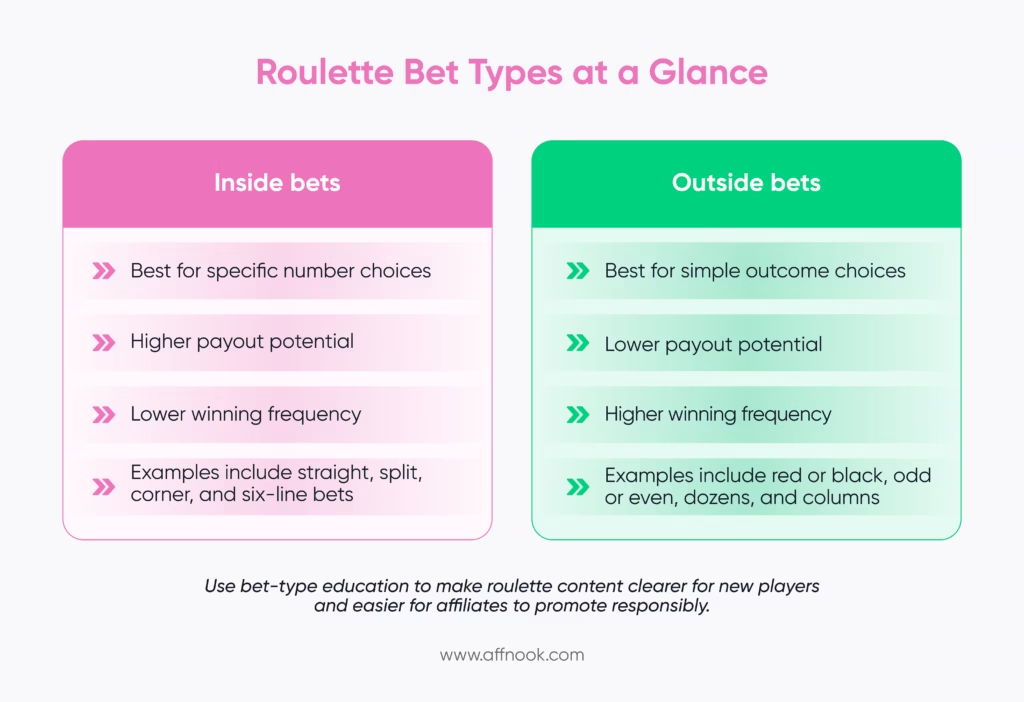
Inside bets are placed on specific numbers or smaller number groups and are riskier because fewer outcomes can win.
A straight bet covers one number. A split bet covers two. A street bet covers three. A corner bet covers four. A six-line bet covers six numbers.
These bets are useful to explain because they show why some roulette payouts look attractive but win less often. For beginners, that often becomes their first lesson in how the game works.
2. Outside Bets
Outside bets cover broader outcomes which include red or black, odd or even, high or low, dozens and columns.
These bets usually pay less because they cover more possible results and are easier for new players to understand, which makes them useful in beginner-focused casino content. For affiliates, outside bets are easy to explain in guides, landing pages and comparison articles.
Why is Roulette Considered Important in iGaming?
Roulette is simple enough for casual players but still valuable for operators because it generates intent.
A lot of players understand it within seconds specifically in live casino formats where the experience is familiar and that helps with acquisition and engagement, since players can get curious and take action very quickly.
For operators, it can support both retention and traffic analysis. It helps in understanding which sources are bringing real players and which ones are only bringing clicks.
For affiliates, roulette is a strong content topic because it is easy to search for and easy to explain. SEO still matters a great deal and so do social channels and so content can work across glossary pages, simple game explainers, short videos and comparison pieces.
Around 62% of affiliate-driven traffic comes from mobile devices, so pages should be quick to load, easy to read and clear about the next step.
What Roulette Rules Should Operators Check by Market?
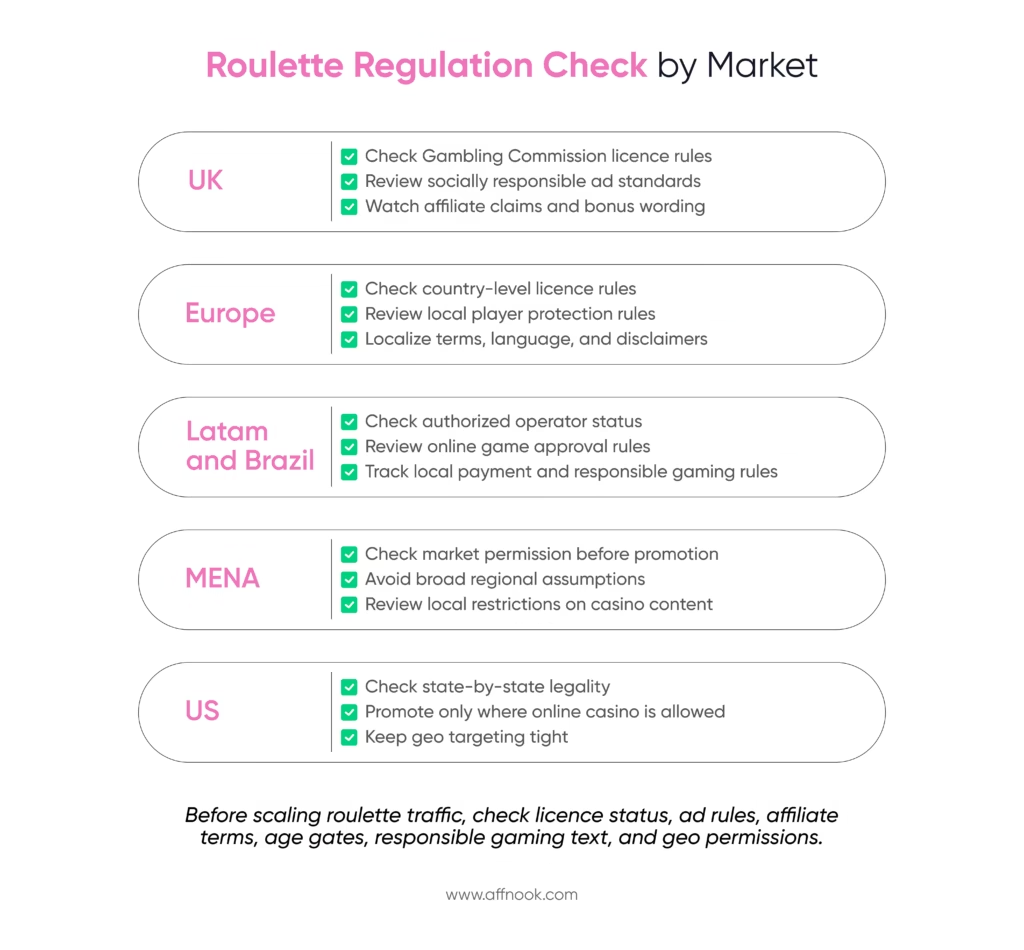
Roulette promotion should always match the market because what is valid and legal in one region may be restricted or completely banned in another.
Let us take a look at a real life situation to understand better. In Great Britain gambling businesses must follow the Gambling Commission’s licence conditions and gambling ads must remain socially responsible under the UK advertising codes. Across Europe, there is no single rulebook for all countries. Each country sets its own online gambling framework and operators usually need to review licensing and consumer protection rules market by market.
In another instance, Brazil regulates fixed-odds betting and online games under Laws 13.756 and 14.790 and companies need prior authorization from the Secretariat of Prizes and Betting to operate legally.
In the US, online casino availability is still state-led and as of June 2026, only a limited group of states allow real-money online casino games.
Roulette And Affiliate Tracking
Roulette campaigns need more than traffic volume because the clicks may look healthy on paper but the complete picture is better understood with deposits and retention taken into consideration.
Operators track registrations, first-time deposits, deposit value, repeat activity, chargebacks, device type and geo performance. A tracking token helps associate each click or conversion to the correct affiliate, campaign and source.
This becomes even more important in regulated or competitive markets. If one affiliate sends 5,000 clicks but very few deposits and another sends 500 clicks with stronger first-time deposit quality, the second partner may actually be more valuable.
Good affiliate management also helps you notice weak traffic, suspicious patterns and payout disputes before they turn into bigger problems.
What Mistakes Should Operators Avoid With Roulette Traffic?
The biggest mistake that operators make is treating all roulette traffic as the same, whereas someone who arrives through a beginner guide is likely to behave differently from someone who clicked on a bonus-heavy social ad.
Do not skip house edge education, because clear game explainers can help set expectations and support responsible gaming. Do not send mobile users to slow pages, because mobile gambling already plays a major role in online behavior and poor page speed can really disrupt signups before a player even reaches the table.
Do not let affiliates promote roulette without clear rules, give them approved claims, market limits, bonus terms and tracking links.
What Are Your Next Steps?
Start by matching the game to player intent.
Build content for search, social and mobile journeys and make sure to keep the language simple, the rules clear and the offer aligned with the market.
For operators and affiliate managers, the next step is tracking quality. Look at which affiliates bring deposits, which markets perform well and where fraud or weak traffic appears.
Roulette may be easy to play, but traffic still needs careful measurement, which is why a platform like Affnook is useful, especially when you want easy tracking and a better view of affiliate performance.
Frequently Asked Questions
1. Is roulette easy for new casino players to understand?
It is usually easier to understand than many other casino games because the action is visual. Players can see the wheel, the ball, the numbers and the betting layout which makes it a strong fit for beginner guides and affiliate content. Still, players should understand that different roulette bets carry different odds and no betting pattern removes the house edge.
2. What type of roulette content works best for affiliates?
The strongest content usually answers simple questions like how roulette works, what inside and outside bets mean, how European roulette differs from American roulette and what live dealer roulette offers. Affiliates can also build comparison pages, responsible gaming explainers and mobile-friendly guides.
3. How can operators measure roulette traffic quality?
Operators should measure roulette traffic by outcomes. The main measurable actions include signups, first-time deposits, deposit size, repeat play, geo quality, device split, chargebacks and fraud alerts. Affiliate-level reporting matters too because two partners can send the same number of clicks but produce very different player value.
4. Why is mobile important for roulette campaigns?
Mobile is an important aspect to think of because most affiliate journeys now begin on a phone.
A user may find a guide through search, watch a short social video or click a partner link from a mobile browser and if the page is slow, crowded or unclear, the campaign can lose the player early. Mobile content should be quick to scan, easy to read and simple to act on.