A postback is a server-to-server communication triggered through an action (usually in the case of affiliate marketing, a conversion). An affiliate link click initiates the entire interaction, while a postback is where the entire loop comes to a close with the final engagement being recorded for the purpose of commission payouts. In this article we’ll dig into what it is (in the technical sense) and how it works, in practice.
The original method of learning how users were interacting beyond the click was cookies. They snapped onto the browser automatically and remained there for a set duration, during which all users actions could be observed — broadly.
But this unit of measurement experienced a slow and eventual death due to a simple fact: privacy. While cookies remained in a single browser, whatever happened therein could be watched, recorded and tracked, all without any opt-in or consent form.
GDPR and then CCPA eventually phased this unit out. To take its place, server-to-server tracking was slowly introduced. Anonymity could be maintained, tracking was only initiated to capture conversion events and the chances of failure reduced dramatically. Postback tracking, it seems, benefitted everyone — operators, brands, affiliates and tracking platforms.
But, What is a Postback?
A postback or an API call is a medium for the transfer of data from the client server to the host server directly, mediated by a simple trigger on the client site. How does the client site know the trigger action has occurred? This can be managed through the placement of a webSDK script on the client’s website.
In simple terms, a postback is a server-to-server (S2S) method of tracking conversions in affiliate marketing.
When a user achieves their desired action, such as a purchase, sign-up, or lead submission, it allows affiliates and marketers to track and verify their action accurately, ensuring proper attribution and performance measurement. This method provides accurate tracking without relying on cookies or browser-based tracking methods.
The entire interaction needs to be captured and this is made possible through the use of an iGaming affiliate marketing software, such as Affnook.
What is a Postback URL?
You may be wondering how this entire process of tracking and recording of user interactions actually begins, and that’s something which can be understood through the medium of a special type of URL.
Affiliate or publisher actions can be tracked through the use of the postback URL. This is the link that is used to track conversions between servers. It contains variable parameters that transfer data from the advertiser’s server to the affiliate platform’s server when any conversion occurs. It ensures that conversions are tracked accurately and attributed to the correct affiliate.
What does a Postback URL actually look like? Here’s an example.

This URLs typically contain some factors or parameters attached to their end. These are added at the time of campaign creation by the advertiser to pass conversion data at a later stage. Such units function very similarly to UTM parameters to capture various data points within user-affiliate interactions, such as:
- Click_id to identify the user who clicked the affiliate link.
- Transaction_id: A unique identifier for the conversion.
- Amount or revenue generated from the conversion.
- Status to indicate whether the conversion was successful.
- Browser in use.
- The Operating System being used.
- The Time when the click was registered.
The above mentioned parameters are not exhaustive in nature, and simply indicative of the kind of information processing possible through the use of such a URL.
How Do Postbacks Actually Work in Practice?
- What Happens to Initiate It? When a user clicks on an affiliate link or any advertisement, it redirects the user to the operator or brand’s website. This is normally tracked with a unique identifier in the URL (such as a tracking ID)
- Which Events Count as Triggers to Fire a Postback? If the user accomplishes a specific task on the merchant’s site (e.g., creating a new account on an online gambling website or adding in their first time deposit), it can be considered ‘the’ event which closes the recording loop.
- What Data is Sent via a Postback? Once the event happens, the merchant or tracking platform sends a postback request to the affiliate network or the affiliate’s tracking system. This request usually holds data in this format:
- The affiliate’s special tracking ID (for the purpose of reconciliation)
- The type of event which set it in motion (sign-up, FTD, re-deposit, etc.)
- The transaction details (e.g., amount of deposit made, user particulars like time and date of deposit, size of bet made, etc.)
- Where Does the Collected Data Become Visible? The affiliate management software is where the collected data becomes visible in the form of reports. Consider Affnook, for instance: the data that gets collected becomes visible in real-time (with no lag) and can be analysed based on requirements for operators, sportsbooks, online casinos and so on. On the affiliate side, their personal performance in the form of clicks and conversions gets logged on the publisher panel so that they can review the outcome of their own work.
Why Do Postbacks Matter in Affiliate Marketing?
A postback plays an important role in online gambling affiliate marketing for various reasons. Let’s understand how they enable the process and make it more feasible to run campaigns, check performance and analyse the ROI across marketing divisions.
1. Real-Time Conversion Tracking
Postbacks provide instant feedback when a user completes an action (e.g., a sale, signup, or deposit). This helps affiliates and advertisers optimize campaigns in real time.
2. More Reliable Than Cookies
Unlike cookie-based tracking, which can be blocked by browsers or deleted by users, postbacks rely on server-to-server (S2S) tracking, making attribution evident through them more secure and accurate.
3. Better Attribution and Transparency
Postbacks ensure that affiliates get credited for their conversions correctly. They provide detailed data about the traffic source, user behavior, and conversion path.
4. Improved Campaign Performance
By using postbacks, marketers can analyze data points like device type, geo-location, and ad placement to refine their targeting and boost ROI.
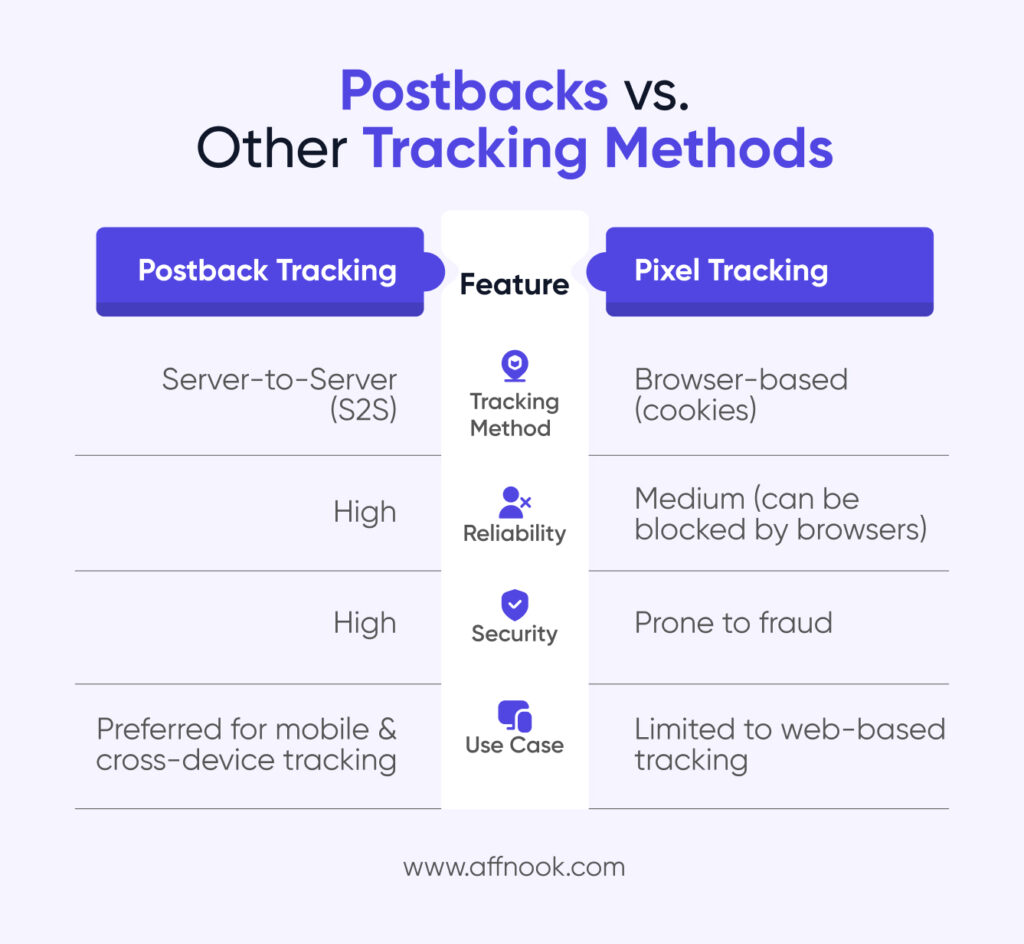
Is There a Typology Evident Within Postbacks?
Postbacks can be categorized based on their function and use case:
- Global Postbacks: Global postbacks help affiliate networks track conversions across multiple advertisers and campaigns using a single postback URL. This simplifies tracking and ensures accurate reporting for all offers in the system.
- Offer-Specific Postbacks: Offer-specific postbacks are set up for individual campaigns to track specific user actions. Advertisers and affiliate managers use them for detailed tracking of each offer. For example, an advertiser promoting a mobile app can set up a postback to track app installs accurately.
- Custom Postbacks: Custom postbacks allow advertisers to track specific details like location, device, or referral source. They’re used by advanced marketers for detailed analytics, such as tracking trial sign-ups versus paid conversions.
How to Set Up a Postback?
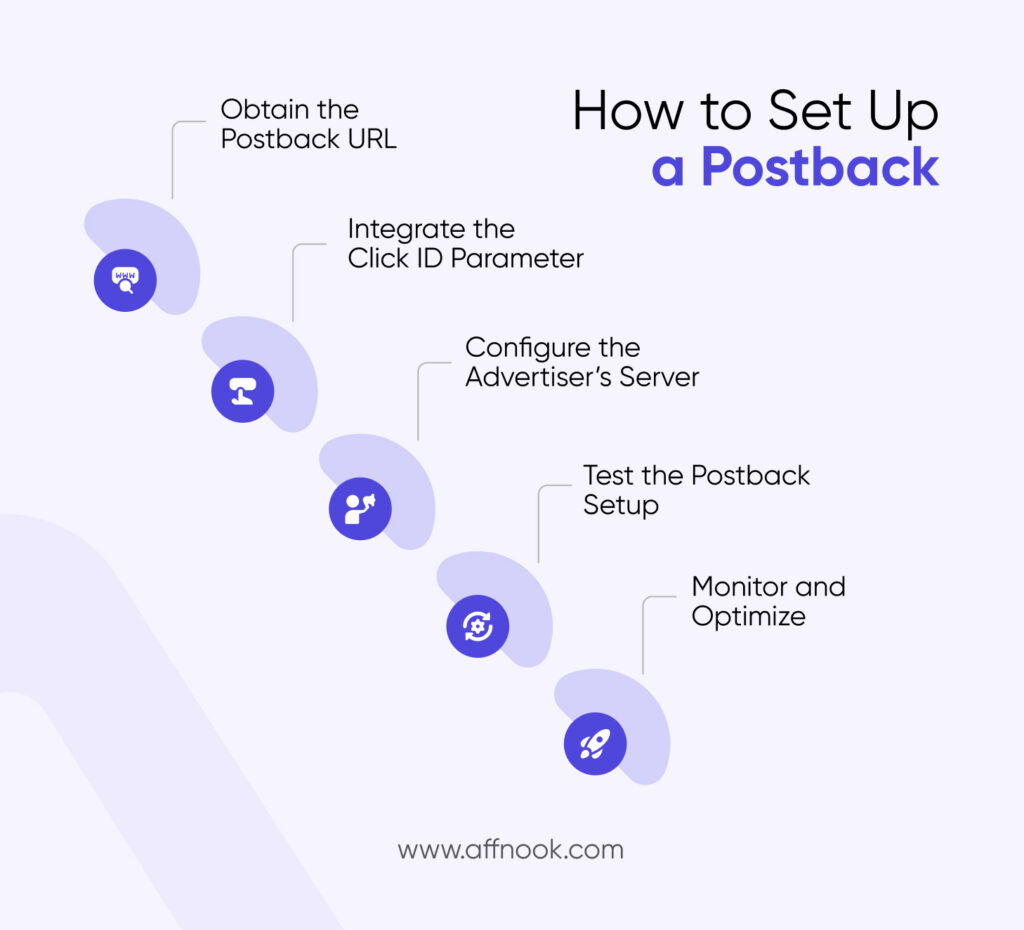
Follow these step-by-step instructions to set up a postback successfully:
Step 1: Obtain the Postback URL
- Connect with your affiliate network or tracking platform to get the postback URL.
- Ensure that it includes dynamic parameters such as {click_id}, {amount}, and {status}.
Step 2: Integrate the Click ID Parameter
- Modify the tracking URL to include the click_id parameter.
- This allows the advertiser to store and later retrieve the click ID when a conversion happens.
Step 3: Configure the Advertiser’s Server
- Implement a system that triggers the postback URL when a conversion occurs.
- Ensure the system extracts the necessary data (e.g., click_id, amount, status) and appends it to the postback URL.
Step 4: Test the Postback Setup
- Use debugging tools or manual testing to send test conversions.
- Verify that the postback is firing correctly and data is being transmitted accurately.
Step 5: Monitor and Optimize
- Regularly check the postback logs for errors or missing conversions.
- Optimize tracking by adjusting parameters or fixing incorrect mappings.
Conclusion
Postback tracking is a powerful tool in performance marketing, offering accuracy, reliability, and security. By implementing and optimizing postbacks, advertisers, and affiliates can ensure seamless conversion tracking, maximizing campaign effectiveness and revenue generation.
To stay competitive in the affiliate marketing space, it’s crucial to set up postbacks correctly, test them thoroughly, and continuously monitor their performance. Whether you’re an advertiser looking to track conversions efficiently or an affiliate network aiming for accurate commission attribution, postbacks provide the ideal solution.
By following best practices, troubleshooting common issues, and leveraging the right tracking parameters, you can enhance transparency, improve ROI, and build stronger partnerships in the digital marketing ecosystem.
FAQs
What is the meaning of ‘postback’?
A postback is a method of collecting data and sending it back through servers to a predefined destination. The vehicle that carries the information is known as a ‘postback’. In affiliate marketing, this vehicle is placed within a link, and acts as the endpoint for completing the entire conversion tracking process.
How is a postback triggered?
When a user commits a specific intended action on the client’s platform or website, such as registering or depositing their FTD, the postback is triggered and the entire data within that interaction (based on the set URL’s parameters) is collected and sent to the server.
What is a click ID?
When a user clicks on an affiliate link, the interaction generated what is known as the click ID. It helps in identifying where, how, why and so on of the user interaction with the link. This acts as the entry point into the entire affiliate marketing tracking process (for iGaming or any other category). From here on, all the required particulars (as set within the campaign) can be fetched.
How does a postback enable affiliate marketing?
Through the means of a postback, tracking (or accurate attribution) without the use of cookies is made possible. It enables server-to-server tracking, which eliminates the need for cookies, and conforms with required privacy laws applicable globally.