Everyone is aware of the physical boundaries that divide one region from another. Every region has its own rules and ways of functioning.
What if these boundaries are not just physical, but also virtual? Such boundaries do exist, and the idea of building of these boundaries is called geofencing.
The concept of virtual boundaries around a place may sound simple, but it is not. If you understand how it works, and why it matters to iGaming operators, affiliates and marketers, you’ll know the enormous strategic weight that it carries.
What is Geofencing?
In general terms, it is the creation of virtual boundaries around a physical geographical area, whether it be a region, state, or country. These boundaries can be set by using technologies such as GPS coordinates, IP addresses, or radio frequency identification.
When devices like smartphones enter or exit from a “fenced” area, a predefined action gets triggered.
You enter a specific location or zone, and something happens. You receive a notification. This could be a –
- System alert
- Marketing message
- Compliance check
Consider them like invisible boundaries drawn on a map. These boundaries do not have to be perfectly shaped. They can be circular,i.e., radius-based, or polygonal,i.e., precise shapes around specific zones.
This gives brands the authority to be flexible and select the area they aim to geofence in accordance with their requirement. It can be as tight as a single retail outlet, or it can be as wide as an entire country.
Who Must Know About Geofencing?
It is not just another nice-to-have buzzword. To be specific to the niche of the iGaming industry, it is essential for several stakeholders, such as:
- Operators and product teams – They should ensure that games and betting services comply with regional licensing rules. Not just that, it will also help them unlock new systems for interactions.
- Growth and digital marketing professionals – They use it to design precise campaigns that are shown to players at the right moment on the basis of physical location, and not just their online behaviour.
- Affiliate managers and affiliate networks – They need to align acquisition strategies with regional access rules, improve offer targeting, and drive more qualified traffic based on location.
- Compliance and legal teams – This is because many markets require operators to verify a player’s presence within the jurisdiction before providing them with access to money betting.
Simplifying the Mechanism of Geofencing
At a foundational level, it involves four major steps –
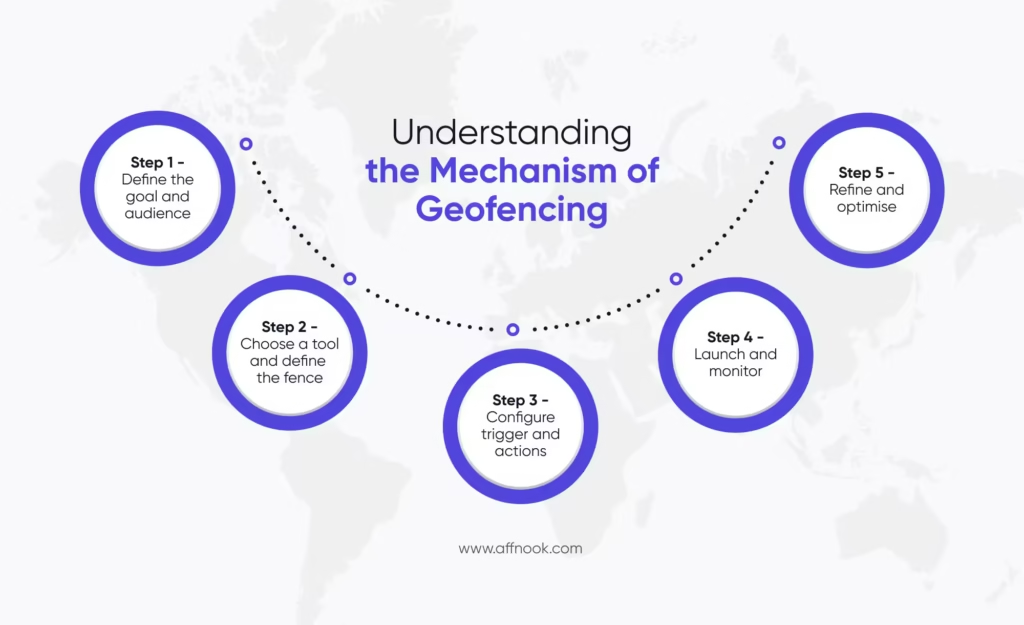
- Define the goal and audience – Set a goal and determine your purpose (marketing, security, asset tracking, etc). Also, understand the audience that you want to reach out to.
- Choose a platform and define the fence- In accordance with the location of the audience that you aim to reach out to, use dedicated tools to create a virtual perimeter.
- Configure trigger and actions – Decide on the event that activates the fence, be it entering, exiting, or dwelling within the area. Following this, you can define the actions that happen when the trigger occurs (e.g., send a push notification, SMS, targeted ad, log an event, or disable tech).
- Launch and monitor – Activate the geofence and campaigns. Further, with the help of analytics, you can track the performance and measure the effectiveness.
- Refine and optimise – Review the performance data and see what works and what doesn’t. Make improvements in the fence size, location, messaging, and timing for better results.
Use Cases that Matter in iGaming
Geofencing does not serve only one purpose. In fact, it plays a strategic role across multiple areas.
Regulatory Compliance
Following regulatory compliance is like a ground rule for iGaming. Online betting is only allowed in those jurisdictions where operators hold a license. One of the most important roles of creating virtual boundaries in iGaming is location enforcement.
With the help of geofencing, operators are able to figure out where a player is actually located within the legally supported boundaries. This must be done before the play or deposit actions are allowed.
For example, there are countries where online sportsbooks operate on a state-by-state basis. What may be allowed in one state may not be allowed in the other. Hence, entering a state might flip the access permission on or off automatically. This ensures full regulatory compliance.
Real Time Engagement and Marketing
What may be relatable for the people of the USA may not be relatable to the people of Spain, and developing a piece of content that appeals to both is an exercise of futility.
Every place has its own contexts and user behaviours, and being shown something completely out of context is an obstruction to the user’s experience.
It is the operator and affiliates’ duty to deliver contextual and location-aware promotions. These can be –
- Welcome bonuses – When a player enters a region where the operator holds a valid local licence.
- Exclusive push notification offers – These can be specific to locations such as that of sports stadiums and events.
- Timed incentives – This is for when a player enters your specific target zone. This makes promotions relevant in real time and creates a sense of urgency, which makes the player act immediately.
All of this ensures that marketing budgets are spent on a highly relevant audience. This increases the efficiency and the ROI of the promotion.
Enhance on Premise Experience
For operators in land-based venues, geofencing adds an omnichannel dimension here by sending event or dining offers to guests when they physically approach the casino property.
Further, they can also trigger loyalty bonuses as players arrive or linger around high-value services.
This also makes virtual fencing a bridge between the physical world and the digital world of iGaming. This drives foot traffic and also ensures retention.
Benefits of Geofencing in iGaming
It is valuable in iGaming because it connects where a user is, with what they are allowed to see, access and receive. When implemented correctly, it delivers benefits across compliance, marketing, and player experience.
Precise Targeting and Higher Engagement
Geofencing allows operators and affiliates to reach players only when they are in relevant locations, such as licensed regions or near hot sports venues.
If the delivered messages align with real-world context, engagements and conversions are more likely to increase, especially when compared to generic campaigns. This is because here, the offers are shown in the right space and at the right time.
For example, a live bet boost is offered only when a user enters a licensed jurisdiction before a popular match, increasing the chance that the player places a wager while intent and relevance are at their peak.
Actionable Data and Insights for Optimisation
The aim is not just to send personalised messages but also to generate rich, location-based analytics. This data could be –
- How many people entered the zone?
- How long did they engage for?
- Which message triggered an action?
Improved Player Experience
As discussed, if used responsibly, geofencing creates smoother, more personalised journeys for players. This reduces the friction and leads to higher trust, satisfaction and long-term retention.
Stronger Regulatory Compliance and Risk Control
It plays an important role in markets where gambling laws vary by state or region.
Players move across borders, and with this, access permissions, too, can change instantly. This reduces the risk of accidental or intentional non-compliance.
If your virtual perimeter system is advanced enough, it will also help you detect the location manipulation attempts with the help of VPNs, proxies, or GPS spoofing. This prevents unauthorised access before it even occurs.
For instance, in a state-regulated market, a player might search for a sportsbook app while travelling, but can only place real money bets when they physically enter a licensed state. The wagering features get automatically disabled if one attempts to cross the border or even mask their location.
Geofencing allows setting real-time location-based rules and maintaining auditable location records. This helps operators reduce regulatory exposure, avoids chances of penalties and address potential compliance issues before they escalate.
Challenges and Considerations
Every technology has its own huddles and challenges
- Privacy and Consent – Users must opt-in to share location data in many regions, and strong privacy practices are both legally required and brand-positive.
- Accuracy Requirements – The precision of location matters, especially at borders. A weak virtual perimeter could misidentify users’ locations. This increases the chances of compliance breaches or frustrated players.
- Tech Limitations – GPS, Wi-Fi, and cellular signals vary by device, environment, and network quality. This suggests that operators need strong solutions that aggregate multiple sources for greater reliability.
Conclusion
Developing an understanding of geofencing is not optional anymore; it is more of a necessity for smoother implementation of an iGaming strategy, as it brings together compliance, engagement, and conversion.
When worked upon with accuracy and responsibility, virtual fencing makes –
- Regulatory compliance stronger
- Targeting efficient
- Enhances player trust
- Bridges the gap between physical presence and digital access
Geofencing enforces rules at a player level, and affiliates and marketing professionals run campaigns in accordance with that. Affnook plays the role of ensuring that happens.
Boundaries are set, and relevant content is shown within those boundaries. Affnook ensures that affiliates, offers, and traffic strategies respect those boundaries, reducing compliance risk, improving efficiency, and supporting sustainable iGaming growth.
Geofencing controls access.
Affnook controls who sends traffic and from where.
Help Centre
How can geofencing improve relationship-based marketing and networking efforts?
Geofencing allows professionals to engage people at the right place and time, such as events, conferences, or business hubs. By delivering contextual messages or offers based on location, it strengthens relevance, improves response rates, and helps build timely, trust-based interactions rather than generic outreach.
What are common use cases of geofencing beyond marketing campaigns?
Beyond marketing, geofencing is widely used for compliance enforcement, attendance tracking, asset monitoring, security alerts, and operational automation. Event organisers, consultants, and service providers use it to manage access, trigger workflows, or collect location-based insights without manual intervention.
Is geofencing legal and safe to use across different countries?
Geofencing is legal in most regions when implemented with user consent and compliant data practices. Laws vary by country, especially around location tracking and privacy. Businesses must follow regulations such as GDPR or local data laws, ensuring transparency, opt-in consent, and secure handling of location data.
What are the key challenges when implementing geofencing technology?
The main challenges include location accuracy, user privacy concerns, signal limitations, and device dependency. Poorly configured geofencing can lead to false triggers or missed actions. Successful implementation requires reliable data sources, clear objectives, consent-first design, and continuous optimisation based on performance insights.