With the global sports betting market projected to be worth $274.78 billion in 2034, operators continue to face a challenge in the form of arbitrage betting (commonly known as “arbing” or “sure bets”).
For operators, these bets decrease the amount of profitability per customer while not providing any long-term value. For affiliates, an understanding of this betting can help distinguish between profitable recreational players and unprofitable margin-seeking players who will quickly be limited.
What is Arbitrage Betting?
Also referred to as arbing, surebets, or miracle bets, arbitrage is a betting technique that takes advantage of the difference in odds offered by bookmakers, thereby allowing you to make a guaranteed profit no matter what the result is (in other words, you will win no matter what happens in the event).
Real-World Example:
Tennis Match: Djokovic vs. Alcaraz
Bookmakers A – Djokovic to win at odds of 2.1
Bookmakers B – Alcaraz to win at odds of 2.05
You have made €200 worth of total bets; €100 at one bookmaker for Djokovic and €100 at another bookmaker for Alcaraz.
If Djokovic wins: €100 × 2.10 = €210 return
If Alcaraz wins: €100 × 2.05 = €205 return
You will have a guaranteed profit of between €5 and €10 (risk-free) regardless of the outcome. In contrast to traditional sports betting (where only one of the two possible outcomes pays out), this type of betting provides a profit on both of the two possible outcomes.
How Arbitrage Betting Works
The Math Behind Arbing:
This type of betting exists when the total of all the underlying outcomes’ implied probabilities is less than 100%.
Formula: (1/Odds A) + (1/Odds B) < 1.00
Steps to Arbitrage:
- Find discrepancies: Look for differing odds on the same event between multiple bookmakers.
- Calculate your stake: Decide how much to wager on both possible outcomes so as to guarantee profits.
- Place your bets quickly: Odds can change very quickly, so make sure that your arbitrage window is open for as long as possible.
- Lock in profit: Regardless of outcome, one winning bet covers both stakes plus profit.
Example Calculation:
Football Match: Team A vs. Team B
Book 1: Team A at 2.20 odds
Book 2: Team B at 2.10 odds
Implied probability: (1/2.20) + (1/2.10) = 0.45 + 0.48 = 0.93
Result: 7% arbitrage opportunity exists (100% – 93% = 7% guaranteed margin)
Types of Arbitrage Betting
Pre-match Arbitrage:
Using odds differences before a match begins. This is a very popular and easy type of arbitrage bet to perform since the odds tend to stay fairly stable.
Live Betting Arbitrage:
Placing bets on an event while it is happening or at an ongoing pace. Live betting carries a higher degree of risk due to the longer approval times associated with the wager being placed and odds changing prior to the completion of the bet.
Cross-market Arbitrage:
Taking advantage of two different markets offering bets on the same event (i.e., over or under goals against what the match score will actually be), where discrepancies create profit opportunities.
Bonus Arbitrage:
Using welcome bonuses or promotional offers from several bookmakers to create a guaranteed profit. Bonus arbitrage is often referred to as “bonus hunting” or “matched betting.”
Why Arbitrage Opportunities Exist
Market Inefficiencies:
Different bookmakers have their own customer risk models, customer betting habits, and liquidity requirements that result in them having different prices for the same event.
Timing Delays:
Odds are not updated instantaneously across all platforms. Bookmakers will update based on breaking news (injuries, weather changes, or changes to lineups) at different rates, creating a temporary opportunity to take advantage of the odds disparity.
Regional Differences:
Different bookmakers who target different regions will use regional preferences for wagering, as well as what they know about the local market, in pricing the same event.
Promotional Offers:
Operators compete for market share through boosted odds, enhanced payouts, and welcome bonuses. This creates opportunities for both deliberate and unintentional arbitrage as the operators compete for your business.
Why Operators Monitor Arbitrage Bettors
Margin Erosion:
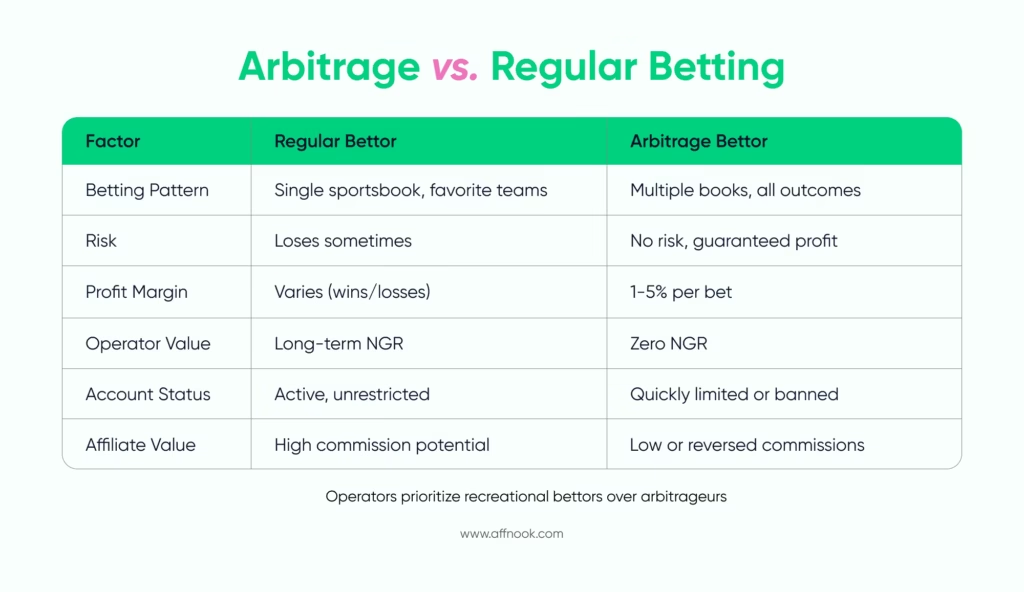
Arbitrage bettors utilize pricing discrepancies to drive the bookmaker’s margins on the markets impacted down to zero.
Non-true Customers:
Arbitrage bettors do not create any long-term value because they will take their winnings and move to the next opportunity, with no interest in recreational betting.
Sign of Odds Issues:
High levels of arbitrage betting activity indicate that there are pricing errors, and the situation should be dealt with as soon as possible.
Account Restrictions:
Arbitrage bettors are often restricted or banned by most operators through various means, such as:
- Stake restrictions (limits placed on maximum betting amounts)
- Delayed bet acceptance (allowing odds to adjust)
- Account suspension or closure
- Removal from bonus and promotional eligibility
Affiliate platforms like Affnook help operators identify and flag low-quality traffic patterns early—so commission reversals on restricted accounts don’t catch you off guard at payout time.
Red Flags Operators Watch:
- Ability to wager across all outcomes of obscure markets
- Consistent, positive gain, with no losing streaks
- Betting patterns matching known arb detection software
- Multiple accounts from the same IP or device
The Affiliate Perspective
Why Affiliates Should Know About Arbing:
Consequences of promoting arbitrage through your affiliate program could include:
- Lower commission rates: Arbers generally provide very little net gaming revenue (NGR) for operators.
- Reduced CPA payouts: Operators often flag and limit “arber” accounts very quickly. They also often reverse affiliates’ commissions on flagged accounts.
- Damaged reputation: Sending low-quality traffic to operators repeatedly can damage the long-term relationship in operating your affiliate program.
Better Strategy:
Instead of focusing on acquiring “arbers” through promotions, focus on acquiring recreational bettors that will generate stable, long-standing revenue for operators and affiliates to establish long-term commission flow.
The Affiliate Network Perspective: Arbing as a Niche Opportunity
While individual operators often restrict arbitrage bettors, some affiliate networks and brands see them as a viable niche when positioned strategically.
Capturing Sharp Bettors:
Experienced arbers are experienced users who have numerous accounts and deposit cash into them frequently. The networks can serve as “smart” betting methods, not just merely gambling venues like regular gambling sites.
Bundle Sign-Up Deals:
By bundling together several operators, an affiliate can create a sign-up package for arbitrage betting opportunities and convert the need for numerous accounts into commission-based traffic.
Marketing Lower Risk:
Messaging around “limiting losses” or “risk-managed betting” appeals to more cautious bettors and frames arbing as a strategy rather than reckless gambling.
The Trade-Off:
Affiliates earn from initial sign-ups (CPA), but long-term revenue share is limited since arbers are often restricted quickly. Success relies on volume, not retention.
Conclusion
Arbitrage betting is a betting strategy that aims to benefit from flaws in the betting market and guarantee you make a profit. However, because of how quickly bookmakers spot people using it, it’s not going to be feasible.
For operators and sports betting affiliates, knowing about sure bets can help them to differentiate between the value-generating recreational customer and an arbitrageur who is cost-draining to the sportsbook (providing zero income for them in the long term).
Help Centre
What is arbitrage betting in sports betting?
Arbitrage betting is a method of making money by placing wagers on all possible outcomes of events at different bookmakers that will yield a profit regardless of the actual outcome, which exploits price differences between sportsbooks.
How do sportsbooks detect arbitrage bettors?
Sportsbooks use software to flag unusual betting patterns: consistent profits with no losses, betting on obscure markets across all outcomes, stake amounts matching known arbitrage calculations, and accounts linked to multiple bookmakers simultaneously.
Is arbitrage betting illegal or against sportsbook rules?
Although there’s nothing inherently illegal about this practice, most sportsbooks have restrictions in place prohibiting it. If your arbitrage betting activity is identified, you can expect to have your account restricted or your stake limited, and at worst, you could be banned entirely from the site.
Why do operators restrict arbitrage bettors if they’re not breaking the law?
Arbitrage bettors exploit pricing errors and generate zero long-term revenue (NGR) for operators. They withdraw winnings immediately without engaging in recreational betting, making them unprofitable customers who drain sportsbook margins.
Can affiliates earn commissions from referring arbitrage bettors?
Affiliates typically earn minimal or reversed commissions from arbitrage bettors because operators quickly restrict these accounts. Since arb bettors generate no sustainable NGR and get banned fast, they provide little long-term value to affiliate partnerships.