Who doesn’t want to earn, and that too from playing games? Now, with the opportunity to become a millionaire solely through betting and winning in these games, the scope and popularity of esports have increased even more.
As per reports, the global esports betting market size is expected to reach over $14 billion by 2026. How did we get here? Why is this form of betting getting so popular? How to understand it better? These questions are relevant to all those who are interested in the idea of esports and betting through this interest. You could be a fan, a first-time bettor, or even someone working in the betting industry itself (affiliate or operator).
Here are some questions you can confidently answer after reading this blog –
- What esports betting is
- How it works
- The games and markets that matter
- How to think about strategy without falling into common traps
- Why integrity is important
What is Esports Betting?
Esports betting is simply wagering real money on the outcomes of competitive iGaming matches. Just like bets are placed on sports games like football or cricket, bets are placed on online video games like CS GO, League of Legends, and Dota 2 that are often multiplayer.
But the question that arises here is, why esports? The answer lies in just how much opportunity the industry now offers, both for players and for bettors watching them. And esports players do not just play as a hobby, they are professionals, and it is a serious job for them. They train for hours and then compete for the rewards that the industry offers them. This could be –
- Prize money
- Salaries and contracts
- Sponsorships and endorsements
- Streaming income
- Influencer status
Esports has grown from a niche gaming subculture into a genuine mainstream spectator activity, and the market data backs this up. According to Statista, the esports market’s global revenue is projected to reach US $5.1 billion in 2026.
When it comes to esports betting, everything remains the same, and betting is just added as a layer on a fan’s already existing interests and passions towards iGaming.
How is this form of betting different from any other form of prominent betting?
- It has shorter matches
- Team rosters change more often
- The existing game strategies can switch overnight due to software updates
- The audience is younger compared to any other form of betting
Let us understand this in a bit more detail.
Is Esports Betting the Same as Traditional Sports Betting?
Structurally, it is the same when picking outcomes and getting paid based on odds is taken into consideration. However, there are a few aspects that separate the experience, and they are –
- Match length – A football match is 90 minutes long, but a Counter-Strike map could run for 40 minutes. In fact, some of the best tournaments may take as long as it takes to finish a coffee. In such scenarios, the viewers and event trackers must be even more conscious.
- Volatility – A single decision can change the entire trajectory of esports matches and the betting scenarios. Bad engagement, a missed objective, or a lucky round is not something that is commonly found in long traditional sports betting formats.
- Frequency of change – A star footballer’s skill doesn’t change week to week. A video game’s balance patch can make yesterday’s dominant strategy useless overnight.
- Audience age – Esports attracts a younger, online audience comfortable with a digital-first experience, unlike the older generation, which prefers retail or traditional betting methods.
These differences do not make esports betting harder to understand. It is just that the logic of these games is refreshing yet familiar to understand. The details here matter differently.
How Does Esports Betting Work?
If you are just a fan and would like to learn the basics of betting, it is important to have a clear understanding of the basics. Hence, let us first understand what odds are and how they are set.
What Are Odds?
Odds mean putting a price on the likelihood of an event taking place. This is expressed through a payout ratio.
The less likely the outcome, the bigger the reward if it actually happens. The more likely the outcome, the less the reward. Both are inversely proportional to each other.
Odds are commonly presented in three formats –
- Decimal odds – These types of odds are common outside the US and are favoured for their simplicity. Here, the stake is multiplied by the decimal number to calculate the total return. For example, if a $10 bet is placed at 2.50, the odds return would be $ 25
- Fractional odds – These odds are written with a slash, for example, let us take the term 3/1. The first number represents the potential profit, while the second number is the amount that must be wagered. Betting $10 on 3/1 means the player wins $30 in profit, plus they get the $10 stake back.
- American odds – These odds are built around the baseline of $100. Positive numbers like + 200 show how much profit can be made on a $100 bet. Negative numbers like – 150, on the other hand, show how much the player needs to risk to make a $100 profit.
The core idea of probability is the same; they just appear to be different.
Who Actually Sets These Odds
Here’s a question a layman rarely tends to ask: where do these numbers even come from? How are these odds being set?
Every esports odds board consists of a mix of statistical modelling and live data feeds. Some companies specialize in tracking esports matches as they take place and add the win probability calculations into sportsbooks’ pricing engines. Instead of pitches, esports is played on servers, and that is why there’s an unusually rich stream of in-game data available. This could be –
- Gold difference
- Objective control
- Player positioning
- Economy state
All of this can be fed to the model that instantly updates the odds. This swiftness of the system is also the reason why esports betting odds move faster as compared to the functionality of traditional sports betting.
For instance, a single fight in a Dota 2 match can turn the probability tables by 20 percentage points in a short time.
Additionally, one detail that operators often miss is that most audiences do not stream esports matches through a direct feed. Instead, they watch it through a broadcast feed, which runs at least a minute behind the actual live game.
It is important to consider this delay when betting live, because the odds shown reflect what is happening in real time rather than the delayed picture the audience is viewing.
The difference might be minute but is also the reason why esports odds sometimes tend to move before something visibly happens on the screen.
The Basic Bet Flow
Irrespective of the game or the market, the shape of the process remains the same –
- Pick a match and a market (who wins, which map, total kills, etc.)
- Check the odds and decide your stake
- Place the bet
- Wait for the outcome. Or, if the bet is live, track the odds shift live
- Get paid out according to the odds that were locked in, if the bettor is right
Different Types of Esports Betting Games
If one were to ask a football fan about the biggest football event, they would obviously say the FIFA World Cup. But if the same is asked to an esports enthusiast, they won’t be able to choose because esports does not consist of limited games or formats. It is in fact, an umbrella term that covers the different types of competitive titles.
Let us understand some of the most prominent ones.
Counter-Strike 2
CS GO or Counter-Strike, is like the backbone of the esports betting niche. It is an action-focused, round-based shooter game where two five-player teams perform alternate attacks and defend a bomb site. Each round also consists of mini contests.
The professional CS2 calendar operates on a yearly loop, which includes multiple events that draw immense viewership globally. These events include –
- Premier leagues
- International LAN events
- Valve-sponsored majors
It is especially during these events that esports bettors are the most active. What is unique here is that betting in this game does not just involve betting on the events but also offers exchanging and winning skins,i.e, weapons instead of actual money.
League of Legends
This is a five-versus-five strategy game where teams fight to destroy the opposing base. Each iGaming player is supposed to choose a unique hero, called a “champion,” and pick a role. These roles include –
- Solo fighter
- Roamer who hunts monsters
- The assassin
- The marksman who deals damage from afar
- The protector from the marksman
Here, the bets can either simply be placed on the team that would win the overall series, a prediction of the score or even specific map goals and milestones.
Some of its major international tournaments are the first stand, mid-season invitational, esports world cup and the world championship.
Dota 2
Dota 2 is similar to League of Legends, the only difference is that it is more complex and hence slightly longer than the latter. The game’s depth means that its outcomes can fluctuate easily based on decisive plays.
The game is popular because of its deep mechanics and massive multi-million-dollar prize pool and jackpots. It also has the “Champion” element that can be utilized for free.
The different types of bets in this game include-
- A fast-paced bet on which team’s aggressive draft secures 10 kills first.
- Wagering on whether a roaming hero will successfully hunt down and kill an opponent’s item-delivery courier.
- Wagering on which team slays the map’s mega monster who drops an item that brings a hero back to life.
Valorant
Valorant is a shooting game in the form of a two team face of. The attackers are supposed to plant a bomb and the defenders to stop the attackers or defuse the bomb. The first team to win 13 rounds wins the match. Here too, every player chooses a certain character with specific skills.
Betting in this game revolves around –
- Betting on who wins the high-stakes 1st and 14th rounds when players only have basic handguns.
- Whether the star player will get more or fewer kills with reference to the line that the bookmaker has set.
- Special live in-play bets on whether the attacking team will successfully get the bomb down in a specific round.
Mobile Titles
Mobile games have a separate type of their own, because it is more convenient and easily accessible to users. It includes some of the prominent and popular games like PUBG Mobile, Free Fire, and Mobile Legends. These games have a fast-growing following, especially in Southeast Asian and Latin American countries.
In fact, LATAM is one of the fastest-growing mobile gaming and esports markets in the world, valued at over $3.5 billion. The player teams of these nations have proven to have some tactical strength in shooters and battle royales. Local leagues urge grassroots squads to make it to the international matches.
For Southeast Asia on the other hand, YouTube gaming and Facebook gaming hold considerable prominence for esports broadcasts as compared to the Western markets.
Mobile is the first point of touch for these games in these nations.
The Fun End of the Spectrum
Esports betting does not necessarily have to be around a shooter or their strategy. Competitive chess, poker, and even games like Rocket League have a betting market too.
Within the esports niche itself, there are many mini markets where bettors wager on small instances like –
- Who will secure the next “first blood” kill
- Win a specific map
- Reach a certain objective first
The idea here is to generate more and more discrete yet bettable moments within a single match itself. This shows how granular and niche the betting options can be.
Types of Events
We have understood the types of games offered under esports betting, and that answers the “what” of the niche. The types of iGaming events that take place in esports answer the “when” and “how”. Understanding the tournament structure is one of the most underrated skills a bettor can pick up. Let us now examine the different events and structures that cover esports.
Online Vs LAN Events
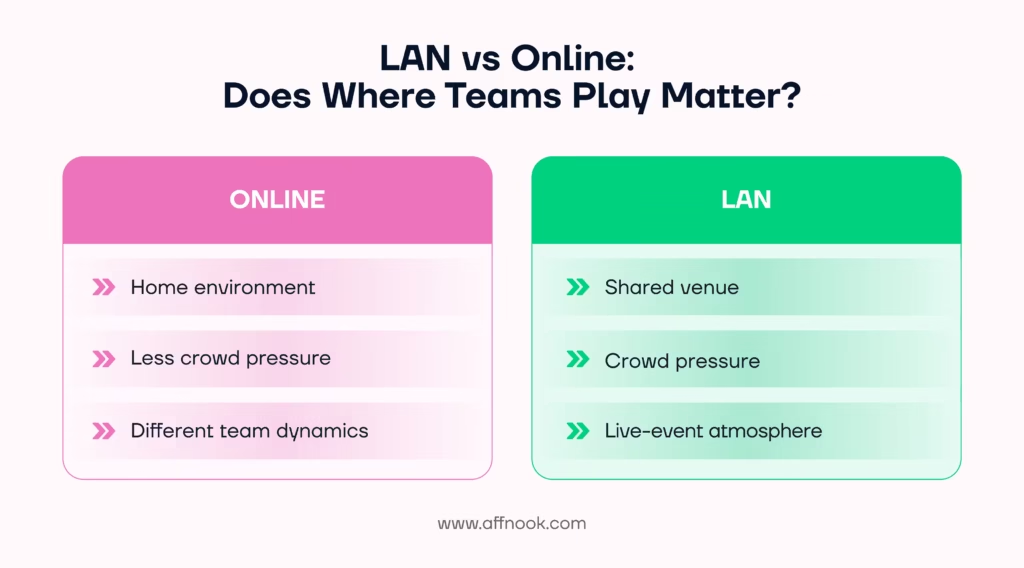
Esports matches can either be played online from home bases or at physical local area networks where everyone competes from the same venue.
How does this matter?
Well, some teams perform better online compared to a shared space where they tend to feel crowd pressure. Other teams, on the other hand, thrive in a high-stakes atmosphere of LAN finals.
This is a crucial data point that bettors often tend to miss.
Majors, Minors, and the Tournament Ladder
Most esports titles run a tiered circuit where smaller regional qualifiers feed into larger “minor events” that further lead them to “major tournaments” like the world championships.
As the bettors move up the event ladder, the game gets faster, the rewards get richer, and far more money is on the line.
Group Stages vs Playoffs
There is something that the new bettors are oblivious to, and that is the fact that not all matches in a group stage are played at “full intensity.” Once a team has already secured qualification to the playoffs, some teams will field weaker line-ups or play more cautiously in a dead-rubber group match. This pattern is also called sandbagging.
This can very subtly break the value of a bet that is based on assumptions. These assumptions are not valid when qualification scenarios are already decided.
Best-of-One vs. Best-of-Three vs. Best-of-Five
These factors are the most relevant yet highly overlooked in the esports betting scenario. They are divided into three categories-
- Best-of-one: This round is like a flip of a coin. One bad round, one off-game, one unlucky matchup, and the “better” team can be out. There is no scope for more chances in this round. This round is mostly prevalent in the group stages and can be rarely seen in the knockout rounds. This is because organisers know a single map isn’t always a fair test of who’s actually better.
- Best-of-three: This is the most common format across both group and knockout stages. It normally runs from one to three hours. This format is normally preferred because, unlike the best-of-one format, it allows teams to recover from a poor first map, adapt to the opponent’s strategies, and use map vetoes.
- Best-of-five: This is the longest format that is reserved exclusively for knockout rounds and grand finals. This gives the stronger side more room to recover from a bad map.
Hence, while betting on a shorter game, it is necessary to remember that these games are just a shorter version of a normally longer game. The risks, however, are completely different because one lucky or unlucky moment can change everything.
How Do Tournament Brackets Actually Work?
Before backing a team to win a tournament, it is important to understand how it is won in the first place. Different bracket structures create different paths to a title, and the format itself changes how much a single loss actually costs a team. Let’s understand these structures.
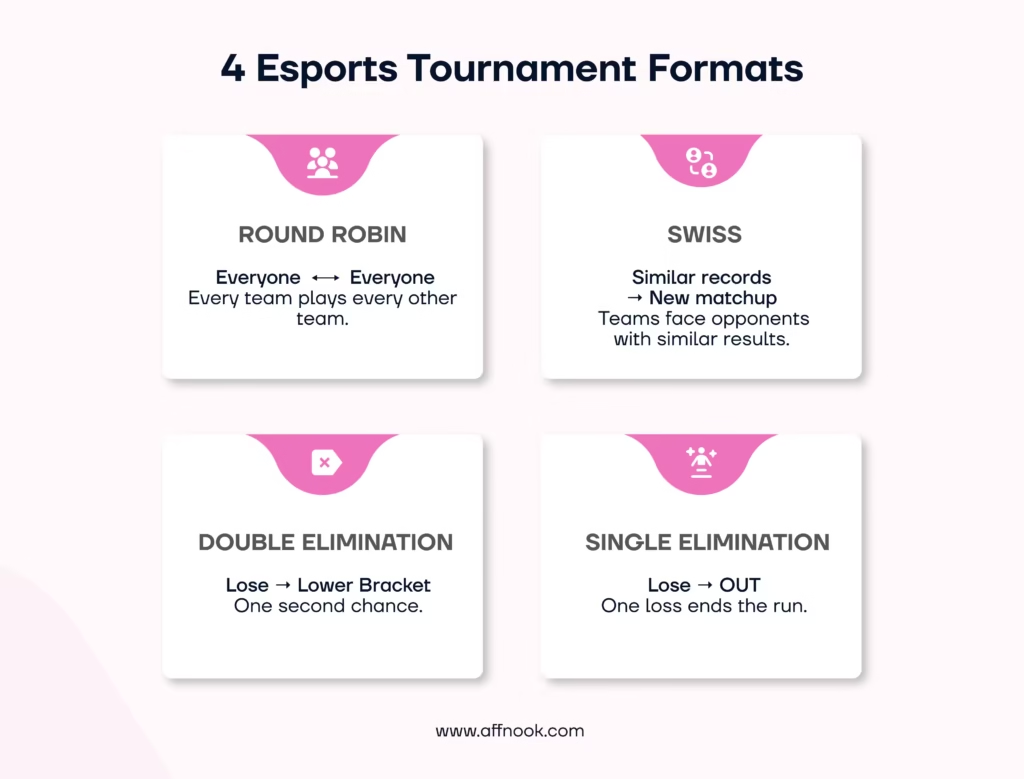
- Round robin – Here, every team plays every other team once, with points awarded for wins and sometimes draws. It is time-consuming and is hence mostly utilized by smaller groups. A double round robin, on the other hand, is the one where teams meet twice. It is common amongst major regional leagues.
- Swiss format – It is a non-eliminating tournament system where the participants play a fixed number of rounds. They play with opponents who have the same or similar win or loss records. Nobody gets knocked out immediately. Instead, teams must accumulate a set number of wins (usually 3) to advance or 3 losses to be eliminated.
The Swiss format changes the state of esports betting. This is because teams are matched based on their current score, and matchups change quickly. This makes odds shift fast between rounds and makes betting harder to predict. - Single elimination – As the name suggests, lose one match and the participant is out. It is a straightforward yet unforgiving method. A single bad map in a Bo3 can end a favourite’s run.
- Double elimination – This is a far more forgiving method. Here, a team dropping their first match falls into a “lower bracket” rather than being eliminated outright, giving them a second chance to fight back toward the final. Lose again, though, and they’re out for good. This format is genuinely worth understanding as a bettor who is interested in esports betting, since a team’s price to win the whole event should account for the fact that one early loss isn’t necessarily fatal.
Different tournament formats change how risky a bet is by either offering a second chance or causing instant elimination. This forces bookmakers to constantly shift odds based on a team’s safety net and current momentum.
The Different Kinds of Leagues and Circuits for Esports Betting
Before placing your next esports bet, here is how the five main tournament formats change the game for bettors.
Developers Controlled Leagues
- What they are: Official leagues run directly by the game makers.
- How they work: Teams buy permanent slots with no risk of dropping out.
- Examples: League of Legends (LCK, LEC), VALORANT Champions Tour, Call of Duty League.
- Betting impact: Very stable rosters make past stats and head-to-head history, which makes it highly reliable.
Open-Circuit Tournaments
- What they are: Open competitions based purely on skill.
- How they work: Any team can earn a spot through regional qualifiers.
- Examples: CS2 Majors and Dota 2’s The International.
- Betting impact: High unpredictable value because new and data-poor teams often get mispriced.
Multi-Title Festivals
- What they are: Massive global events hosting multiple game tournaments at once.
- Examples: Esports World Cup and EVO.
- Betting impact: Packed schedules and unique crowd energy can cause unexpected results.
Invitationals and Showmatches
- What they are: Unofficial, friendly events built for entertainment.
- How they work: Organizers directly invite popular teams or famous streamers.
- Betting impact: Risky to bet on because player motivation and effort levels vary wildly.
Grassroots and Collegiate
- What they are: Local, amateur, and university-level student tournaments.
- How they work: They act as the local channel for exploring new talent.
- Betting impact: Rarely available on sportsbooks but great for finding future stars early.
So far, the discussion has been around the esports events and their type because that is the primary aspect to understand when it comes to betting. The second most important aspect of esports betting is wagering and winning. This is what a bettor cares about the most.
What do they keep at stake, and what do they win? This is where the different mediums of exchange come into the picture.
Skins vs Cash vs Crypto in Esports Betting

Skins
In the betting niche, skins have a completely different meaning. It refers to a different look for a –
- Weapon
- Character
- Item
It must be noted that this medium of exchange changes nothing about how a game plays but can carry real financial value because of supply and demand within the game’s marketplace.
But the question that arises here is that how did a purely cosmetic item become a betting currency?
The concept of using skins for esports betting started with the Counter-Strike game. Skins could be traded between players and could be deposited onto third-party websites. They could be wagered on outcomes, or even on casino-style mini-games built entirely around skins as chips.
Skins have a real dollar value on trading marketplaces, and this created a form of gambling that functioned almost entirely outside the regulatory frameworks that are built for cash betting.
Cash
Cash betting is the most common and oldest medium of exchange for not just sports betting but the broader betting and gambling industry. It means wagering through a licensed sportsbook and using actual currency, taking into account the regulations.
This form comes with consumer protection and is hence a safer form of transaction as compared to skin betting. This is why it is recommended to anyone new to esports betting.
Crypto
The rise of online crypto gambling is also leading to an increase in crypto as a medium of exchange. It is especially appealing to the bettor base that’s already comfortable with digital wallets. It is, hence, inclined towards the younger and digitally native audience.
What is appealing about this mode is that it offers –
- Faster deposits and withdrawals
- Lower transaction fees
- Access to bettors where banking access is limited
However, before completely diving into the process, bettors must understand the main risks. They include –
- Price shifts – Crypto values change constantly. Your deposit value can drop before you get paid.
- Loose rules – Government oversight varies by region.
- Two platform types – Some sites are fully licensed. Others operate in a legal gray area with zero player protection.
Additionally, check for safety as well. This involves –
- Look for a real regulatory authority on the site.
- Read terms and ensure cash-out rules are clear.
- Avoid gray markets and stick to platforms with a verifiable legal home.
Where It Can Be Played
We now know what esports betting is, the different events that are organised for it, and how to bet on these games. But where to actually go to play these games?
Licensed Sportsbooks and Specialist Platforms
Most major traditional sportsbooks now feature esports as a dedicated section alongside traditional sports. Additionally, exclusive esports betting platforms cater exclusively to competitive gaming fans.
These sites operate under strict gambling licensing regimes for their respective jurisdictions. This ensures that consumers are protected, this includes –
- Identity verification
- Secure payment
- Dispute resolution
- Strong responsible gambling tools
Prediction Markets
A newer and rapidly growing participant in the space is the prediction market. Instead of placing a traditional fixed-odds bet against a bookmaker, prediction markets allow users to buy and sell contracts that are attached to specific outcomes.
Here, the bettor is essentially trading a “yes” or “no” position on an event with other users. It is because they function as financial exchanges, they are structured and regulated differently than sportsbooks.
the United States, for example, some operate under commodities-trading oversight rather than gambling licenses. This space evolves frequently, so it is vital to check current local rules rather than assuming standard sportsbook logic applies.
Skin Betting Platforms
We understand what skins betting is, and there are now betting platforms that are built especially for skin betting. It must be noted, however, that these platforms exist in a regulatory grey zone and generally lack the consumer protections found at licensed sportsbooks.
As these platforms operate outside the traditional gambling sector, users have little recourse if a platform refuses a payout or suddenly shuts down. Game creators regularly force these sites to close, which is why skin betting is widely considered a high-risk route for casual bettors.
How to Tell If a Platform Is Legitimate
The credibility of an account must be verified by making sure a few structural checks are made before the account is created –
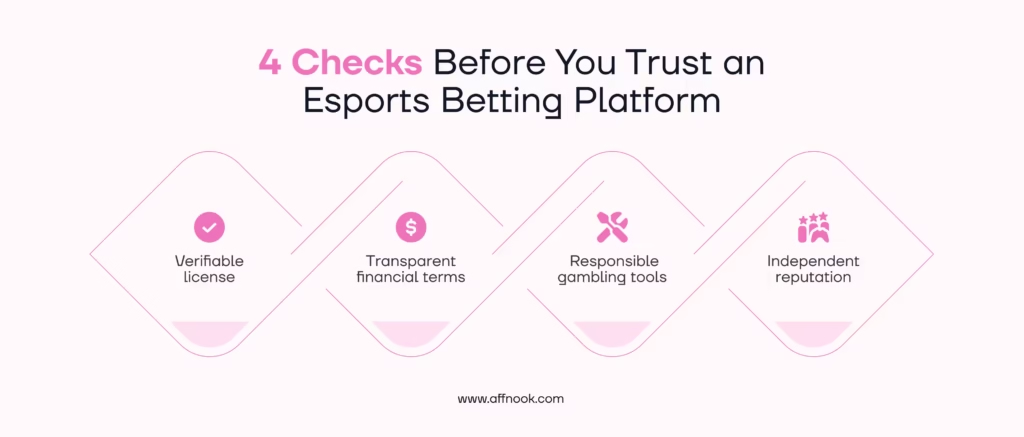
- Verifiable Licensing – Look for an official license number from a recognized gambling authority (such as the MGA or UKGC) displayed transparently in the website footer.
- Transparent Financial Terms – Ensure withdrawal rules, processing times, and potential transaction fees are explicitly stated in the terms of service.
- Responsible Gambling Tools – Check for visible self-exclusion options, reality checks, and customizable deposit limits.
- Independent Reputation – Search third-party forums and user review platforms to make sure that payouts are consistent and customer service is reliable.
Strategy and Bankroll
“Bet responsibly” and “Manage your bankroll” are commonly used phrases in esports betting, but how do you actually do that?
Well, it’s all a game of numbers. Let us understand that.
To build a proper structure, the first step is to establish a total bankroll. This bankroll is an isolated amount of money that they must not lose completely (eg $1000).
From this pool, a base unit is identified, which represents 1-2% of the total capital. If we go by the example of the bankroll being $1000, then the base unit would be 1%-2%. A disciplined staking plan uses these numbers to dictate every single wager based on risk and value.
Understanding the Vig
Every bookmaker builds a small margin into their odds, called the vig or juice. Let us understand it more simply through an example.
If a match were a genuine 50/50 coin flip, fair odds would be 2.00 on both sides (decimal). But a sportsbook might offer 1.91 on both sides instead.
To see what this means in numbers, let us look at the implied probability by dividing 1 by the odds.
- At fair odds (2.00): (1 / 2.00) + (1 / 2.00) = 0.50 + 0.50 = 100% total market probability.
- At bookmaker odds (1.91): (1 / 1.91) + (1 / 1.91) = 0.5236 + 0.5236 = 104.7% total market probability.
The extra 4.7% is the vig, and that is how the house makes money irrespective of who wins.
Because of this built-in margin, a coin-flip bettor will steadily lose money over time. To simply break even at odds of 1.91, one cannot just win 50% of their matches. They must maintain a strict win rate of 52.36%.
The knowledge of the existence of a vig does not mean that it can be eliminated. But it does mean one should treat “the odds look close to 50/50” as different from “this is a fair coin flip”, because it never quite is.
Expected Value
Expected value (EV) is what is expected to win or lose, on average, over many identical bets. Positive EV (+EV) means the offered odds beat the true probability of the outcome.
For example, a sportsbook prices a Counter-Strike underdog at 2.10 odds (implying a 47.6% win chance), but post-research shows they have a 55% true probability of winning.
If a 1-unit bet ($10) is placed on this match, the formula is
(Probability of Winning × Potential Profit) – (Probability of Losing × Stake):
- The Math: (0.55 × $11) – (0.45 × $10) = $6.05 – $4.50 = +$1.55 EV
One can never know the true probability with certainty, but it is important to understand if there is even a value that is expected to be generated.
Closing Line Value
The odds that are being bet at should be compared to the odds that are available right before the match starts. If one consistently bets at better odds than where the market ends up settling, that’s a strong sign they are finding value.
When a bettor identifies an edge early in the week, they can lock in a team at 2.20 odds. If heavy market action later shifts the line, those odds might close at 1.85 by match time.
This significant drop means the bettor successfully secured a massive Closing Line Value, proving they beat the house’s final estimate.
Line Shopping
Just like different shops put different prices on the product, different sites price matches differently. Just like window shopping, checking two or three sportsbooks takes seconds and costs nothing, but it significantly boosts long-term profits. It sounds too simple to matter, but it does.
Patch Notes
This is where esports betting completely diverges from traditional sports. Esports games get regular updates called “balance patches.” The game developer might suddenly weaken a popular character or strengthen a weak strategy. This shifts which teams are favored almost overnight.
A team that relies on a strategy that just got weakened might take weeks to recover. On the other hand, a team whose play style fits the update perfectly can suddenly dominate. Bettors who actually read these patch updates work with information that casual bettors completely ignore.
Roster Changes and Stand-Ins
Rosters in esports change more swiftly and frequently than in traditional sports. Players get benched, transferred, or occasionally can’t compete due to visa issues, illness, or personal circumstances, which may require a stand-in player at short notice. A missing star player on the team or a substitute brought mid-tournament can change the course of the whole game. This is why following team news is not an optional practice for a bettor, it is, in fact, foundational.
The Most Common Beginner Mistake
It is not a complicated mistake and is quite common: Betting through emotions rather than rationality and logic. Some mistakes are universally human, they may not necessarily have to be esports-specific, but esports’ fast-moving, emotionally engaged fanbase makes them easy to fall into. So, some of these mistakes include –
- Backing a favourite team, regardless of the form.
- Chasing a loss by doubling the next stake to “win it back.”
- Ignoring team news because you already decided who’s going to win.
Consideration for Global Players
Betting strategy does not exist in vacuum, hence, there are some strategies that must be taken into account in accordance with what the bettors need.
Payment Methods Matter
Local payment networks dictate liquidity. For instance, in Brazil, PIX changed the industry by allowing instant, fee-free deposits and cash-outs.
Local payment providers and setups affect everything from deposit speed to withdrawal friction. This is why it is worth checking if a platform actually supports convenient local payment rails before deciding it’s the right fit.
Time Zones and Following International Leagues
Major tournaments are hosted across every region and time zone. Following a favourite team internationally often means watching and betting at unusual hours.
A major tournament like The International or the League of Legends World Championship moves continents every year. A bettor in Europe might have to stay awake until 4:00 AM to catch a live draft phase in East Asia.
Live sports betting requires sharp focus. Fatigue causes bettors to miss crucial in-game cues, leading to poor emotional decisions and blowing past their limits.
Mobile-First Behaviour
In regions where mobile is the primary way people can access the internet at all, betting behaviour naturally follows –
- Shorter sessions
- Reliance on push notifications and in-app promotions
- Stronger engagement with mobile-native esports titles
One may not always have a PC in their hand, but they sure always do have their phones on them. Due to this easy accessibility of device platforms, bettors alike go for mobile-first gambling, instead of thinking of it as just another afterthought.
However, to win in a wrong run, a bettor must study, do their research, and analyze the industry. Let us explore the esports betting industry insights from the 2026 iGB report.
Esports Betting Market Insights
Numbers may not tell the whole story, but they surely are a useful reality check against assumption. The data on esports betting tells a consistent story that this niche is more sophisticated than what its reputation suggests.
As per Oddin.gg’s latest State of Esports Betting report, an average esports bettor now stakes approximately seven times more on their first bet than a bettor coming from traditional sports. This is a striking figure that links the reports to esports’ younger yet highly engaged audience.
A median 31% year-on-year increase was recorded recently. Additionally, there is also sustained momentum across major titles like Counter-Strike 2, League of Legends, and VALORANT.
Big events show this on an even stronger scale. Take the League of Legends World Championship as an example. The average stakes there shot up compared to last year, leaving other major esports finals far behind.
But what changes the real scenario is how much of this happens live. Across the top five esports titles, in-play betting makes up the lion’s share of all activity.
Dota 2, on the other hand, leads the pack here because its matches are long and tactical and keep its viewers hooked. This proves that esports bettors are not casual fans. They are confident, they engage, and are locked into action.
Apart from volume, the bettors are also getting much more sophisticated. Instead of just picking a match winner, people are diving into markets in greater depth. They are betting on –
- Specific player performances
- In-game item usage
- Complex combination bets
This behavior looks exactly like seasoned sports bettors, instead of new bettors who are just testing the waters. Esports betting has hence grown from its experimental phase and has actually become a genuine pillar of the broader betting industry.
The Other Side of the Story
Until now, the discussion has been around what bettors should know. This section is written for the other side of the industry, and that includes affiliates, marketers, and operators who decide whether, and how, to build esports betting into their business.
The LTV Argument That Is Hard to Ignore
The fact that esports bettors stake almost seven times more on their first bet than traditional sports bettors is one of the strongest lifetime value arguments that an affiliate or an operator can make for this vertical.
Higher first-bet stakes suggest that the bettor could become a high-value customer over time and could actually engage. This changes the entire economics of what an esports referral is worth compared to a generic sports betting referral.
Which Commission Model Actually Fits?
The esports audience profile is –
- Young
- High volume
- Live betting driven
This has real implications, and for this it is important to understand which affiliate deal structure performs best.
- CPA (cost-per-acquisition) deals reward pure volume and can work well where esports fandom is exploding. This, however, is still relatively cheap to drive and is useful for testing new, less mature markets.
- Revenue share deals reward long-term player value, which aligns naturally with esports’ high stake sizes and strong live-betting engagement. This is a better long-run fit given what the data shows about esports bettor behaviour.
- Hybrid models let affiliates capture upfront value while still benefiting from the higher lifetime value esports players tend to show. It is the most balanced starting point when testing a new geo or title.
The Compliance Conversation Nobody’s Having Enough
Esports betting has a younger audience, but as much as it is exciting, it also raises the compliance stakes considerably.
- Age verification matters more here than in traditional sports betting marketing, given how young esports’ fanbase skews.
- Responsible marketing practices need to account for an audience that grew up inside gaming culture, not around it.
- Clear separation between organic gaming content and betting promotion is essential, precisely because the overlap between “gaming audience” and “underage audience” is real and growing.
- Affiliates and operators who treat esports marketing exactly like traditional sports betting marketing, without adjusting for this, are taking on real reputational and regulatory risk.
What Actually Converts in Esports Betting Creative
Generic sports betting creative like –
- Team badges
- “Back your team” messaging
- Static odds boards
tends to underperform in esports. Instead, what tends to work better is –
- Tournament calendars and countdown urgency, tied to live event schedules
- Streamer and content-creator partnerships, a channel with far more organic trust in esports than in traditional sports
- Live-betting-specific messaging that leans into esports’ famously fast-paced, highly fluctuating matches
To Conclude
Esports betting is not just a passing trend. It is a niche of its own, with its own ways, trends, and community of people who take it seriously. What started off as an extended fan passion for competitive iGaming has taken its own space in the wider betting and iGaming industry.
For a bettor, the idea is to understand that esports rewards those who actually pay attention. This includes reading patch notes, tracking roster changes, understanding tournament formats, and knowing the difference between a Bo1 and a Bo5. And all of this adds up to real, usable knowledge.
The odds, the strategy, and even the risks may look familiar to anyone who has bet on traditional sports before, but the pace at which esports moves means old habits and assumptions do not necessarily have to be passed on.
For affiliates and operators, the opportunity is just as real. A younger, high-stakes, live-betting-driven audience is not something the wider betting industry can afford to overlook, but it is also an audience that demands more care, not less. Compliance, responsible marketing, and platform legitimacy matter just as much here.
Help Section
Is esports betting legal?
Esports betting is legal only where gambling on esports is permitted under local law and through an appropriately licensed operator. The rules can differ significantly by country, state, or province, so bettors should verify the regulations that apply to their location before depositing or wagering. A platform that accessible online does not automatically suggest that it is legally authorized to accept bets in a specific jurisdiction.
Can you bet on esports tournaments before they start?
Yes. Pre-match betting is one of the most common ways to wager on esports. Depending on the title and tournament, markets can include the match winner, series score, map winner, handicaps, totals, and tournament winner. Markets become available and may change as teams are announced, brackets are confirmed, and new information emerges.
What is a map handicap in esports betting?
A map handicap adjusts the starting position of teams in a series. For example, in a best-of-three series, a team might be given a virtual +1.5-map advantage while the opponent receives -1.5. The bettor is therefore predicting the margin of victory rather than simply choosing which team wins the series.
What role does artificial intelligence play in esports betting?
AI and machine-learning systems can process large quantities of information, including historical results, player statistics, team performance, and real-time match data. Operators can use these systems for pricing, risk management, fraud detection, and market monitoring. Bettors may also use analytical tools to organize information, although automated predictions should not be treated as guarantees of an outcome.