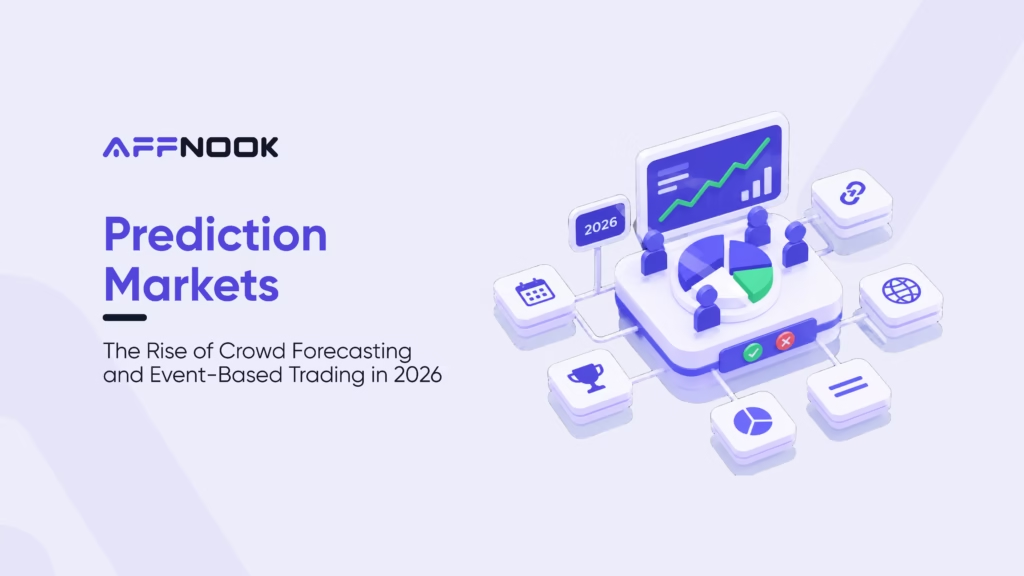
People are no longer just consuming news. They are putting money behind what they believe will happen next.
That single shift explains why prediction markets are becoming one of the most talked-about digital industries in 2026.
From elections and sports championships to inflation rates, celebrity events, and even weather forecasts, prediction markets are changing the way people interact with information. Instead of simply reading headlines or scrolling through opinions on social media, users can now participate in event-based trading by buying and selling contracts tied to real-world outcomes.
In simple terms, prediction markets are platforms where people trade on future events. Users place bets on questions like:
- Will Bitcoin cross $150,000 this year?
- Which political candidate will win the next election?
- Will a major sports team win the championship?
- Will interest rates fall before the end of the quarter?
The prices in prediction markets keep changing based on what people think is most likely to happen. If more users believe an event will happen, the price goes up. This creates a live picture of public opinion and crowd forecasting.
What makes prediction markets different from traditional betting is that they are connected to data, trends, and real-world information. Many users join not only for entertainment, but also to use their knowledge, research, and understanding of current events.
Social media has also played a huge role in their growth. Political discussions, sports conversations, viral news, and online communities can quickly change market predictions within minutes.
At the same time, technologies like blockchain, decentralized finance, and mobile trading apps have made prediction markets faster, more transparent, and easier to access for users worldwide.
Businesses, analysts, and even governments are now watching prediction markets closely because they can provide real-time insights into public sentiment and future trends.
As finance, media, and internet culture continue to connect, prediction markets are becoming a new way for people to interact with information and predict what may happen next.
What Are Prediction Markets and Why Are They Exploding Online?
Prediction markets are digital platforms where people trade on the outcomes of future events. Instead of buying stocks or cryptocurrencies, users buy positions connected to real-world questions and predictions.
For example:
- Will a particular candidate win the election?
- Will a football team win the championship?
- Will inflation rise next quarter?
- Will a major tech company launch a new product this year?
Each outcome has a price that changes in real time based on what users believe is most likely to happen. The higher the confidence around an event, the more expensive that outcome becomes.
At first glance, prediction markets may look similar to online betting. But the industry is evolving into something much larger than gambling. These platforms combine finance, forecasting, data analysis, and internet culture into one experience.
That is one of the biggest reasons prediction markets are exploding online.
People today are surrounded by information every second. News spreads instantly through social media, podcasts, livestreams, and online communities. Instead of passively consuming that information, users now want to participate in it. Prediction markets allow them to turn opinions, research, and instincts into tradable positions.
This is where crowd forecasting platforms become powerful.
When thousands of users collectively trade on an event, the market starts reflecting what the crowd believes is most likely to happen. In many cases, these live probabilities adjust faster than polls, analysts, or traditional media reports. A breaking news update, injury announcement, political debate, or economic report can instantly change market sentiment within minutes.
The internet has also created a generation that is highly comfortable with digital trading behavior. Younger audiences already interact with cryptocurrencies, fantasy sports, creator economies, gaming marketplaces, and stock trading apps. Prediction markets feel like a natural extension of that digital ecosystem.
Unlike traditional financial products, event-based trading is also easier for casual users to understand. Someone may not fully understand stock valuation models or macroeconomics, but they can still form an opinion on whether a sports team will win or whether a public event will happen.
This simplicity is helping prediction markets reach mainstream audiences much faster than many expected.
How Prediction Markets Turn Opinions Into Tradable Assets
The core idea behind prediction markets is surprisingly simple: opinions gain value when people are willing to back them financially.
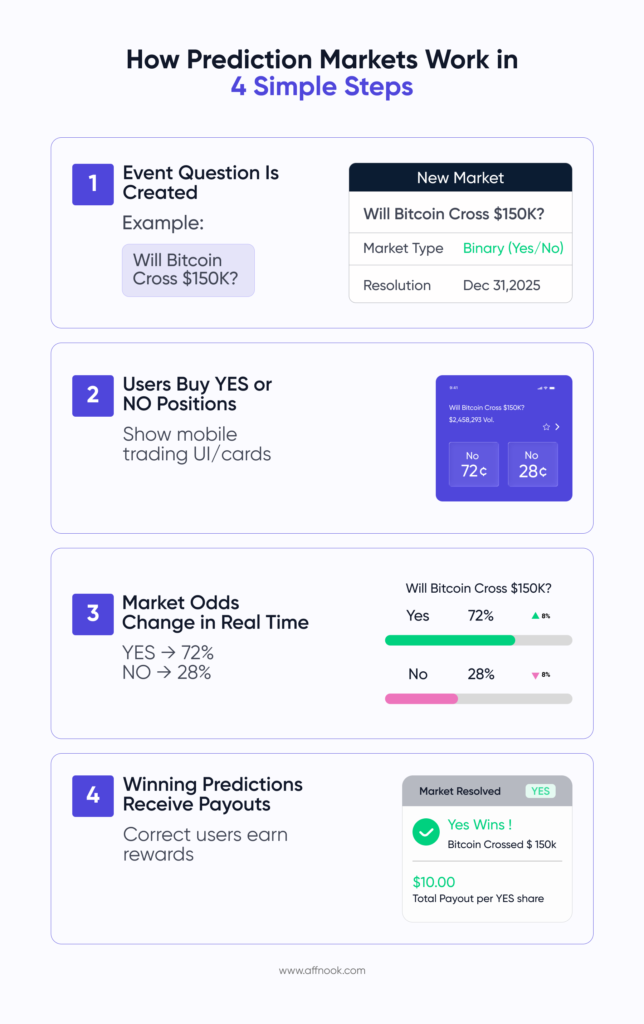
Every market starts with a question tied to a future event. Users then buy shares or contracts representing possible outcomes. If the prediction turns out to be correct, the position pays out. If not, the value drops to zero.
For example, if a contract predicting “Team A will win the final” is trading at 70 cents, the market is essentially saying there is a 70% probability of that outcome happening.
As more people buy or sell positions, prices move dynamically. This creates a constantly updated prediction system powered by crowd intelligence.
What makes this model interesting is that users are financially motivated to be accurate. Unlike social media opinions, where people can make random claims without consequences, prediction markets reward users who correctly interpret trends, news, and probabilities.
In many ways, these platforms transform information itself into a tradable asset.
Why Younger Digital Audiences Prefer Event-Based Trading
Younger internet users are driving much of the growth behind prediction markets.
One reason is familiarity with digital-first financial behavior. Gen Z and millennial users already spend time on mobile trading apps, online iGaming platforms, fantasy sports, and crypto ecosystems. Prediction markets combine elements from all of them into one highly interactive experience.
Another reason is engagement.
Traditional investing can sometimes feel slow or disconnected from everyday life. Prediction markets, on the other hand, are tied directly to cultural moments people already care about:
- Elections
- Sports tournaments
- Entertainment news
- Economic trends
- Internet debates
- Technology launches
This creates an experience that feels more social, immediate, and emotionally engaging.
Many younger users also enjoy the idea of “being right before everyone else.” Successfully predicting an outcome gives users a sense of status, insight, and participation in larger conversations happening online.
For digital-native audiences, forecasting has become part entertainment, part strategy, and part financial opportunity.
The Psychology Behind Crowd Forecasting Platforms
The rapid growth of crowd forecasting platforms is deeply connected to human psychology.
People naturally enjoy predicting outcomes. It creates excitement, competition, curiosity, and emotional investment. Whether it is discussing election results with friends or predicting a championship winner, forecasting has always been part of human behavior.
Prediction markets digitize that instinct.
They also tap into several powerful psychological triggers:
- The thrill of uncertainty
- Fear of missing out (FOMO)
- Social validation
- Competitive thinking
- Financial reward
- Community participation
Real-time price movement adds another layer of engagement. Watching probabilities rise and fall creates a live feedback loop that keeps users emotionally connected to events as they unfold.
At the same time, prediction markets give people a feeling of influence and participation. Users are not just reading the news anymore. They are actively responding to it, interpreting it, and positioning themselves around future outcomes.
That emotional and financial involvement is a major reason why prediction markets are quickly evolving from niche internet communities into mainstream digital platforms.
The Rapid Growth of Prediction Markets in 2026
Prediction markets are growing rapidly in 2026 because people no longer want to just watch events unfold — they want to participate in them.
From politics and sports to cryptocurrency and entertainment, millions of users are joining platforms where they can trade on future outcomes. This rise of event-based trading is being driven by a mix of internet culture, mobile-first behavior, and real-time information consumption.
The concept is simple but powerful. Instead of only discussing predictions online, users can now financially back what they believe will happen next. Whether it is an election result, a championship winner, or Bitcoin’s next price movement, prediction markets turn opinions into active participation.
The industry is also benefiting from the growth of digital trading habits. Younger audiences are already comfortable using stock trading apps, fantasy sports platforms, and crypto exchanges. Prediction markets feel like a natural extension of that behavior because they combine finance, entertainment, and social engagement in one place.
According to Statista and Deloitte, younger users increasingly prefer interactive and mobile-driven digital experiences. That trend is helping prediction markets move into the mainstream much faster than expected.
Why Internet Culture Is Fueling Prediction Markets
Internet culture plays a huge role in the rise of prediction markets.
Social media platforms are built around opinions, debates, trends, and viral moments. Prediction markets take that same behavior and attach financial value to it. Instead of simply posting a prediction online, users can trade on it in real time.
This creates a more engaging experience because market odds react instantly to breaking news, live events, and online discussions. A sports injury, political debate, or celebrity announcement can shift probabilities within minutes.
The combination of entertainment, community participation, and financial reward is attracting large numbers of digital-native users to crowd forecasting platforms.
From Elections to Entertainment: Expanding Market Categories
Prediction markets were once heavily focused on political forecasting, but the industry has expanded rapidly.
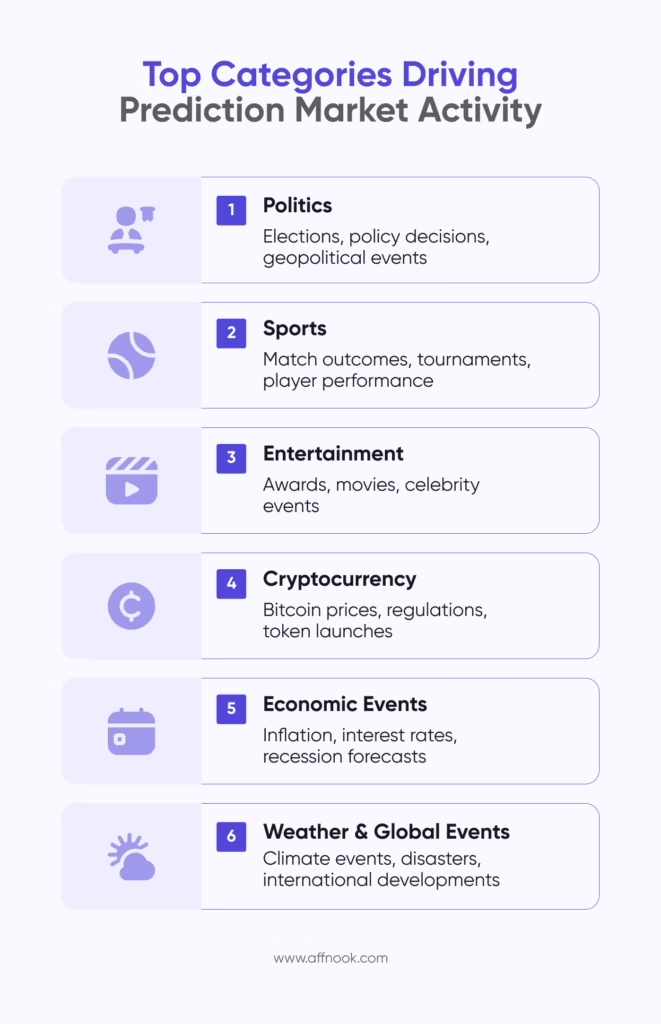
Today, users actively trade markets related to:
- Elections and government policies
- Sports tournaments and player performance
- Cryptocurrency prices
- Award shows and entertainment events
- Inflation and economic trends
- Global and weather-related events
This expansion is helping prediction markets attract wider audiences across multiple industries.
Reports from Grand View Research and GlobeNewswire suggest that event-based trading and alternative digital forecasting platforms are expected to continue growing over the next few years.
The Role of Real-Time Information in Event-Based Trading
Real-time information is one of the biggest reasons prediction markets feel so engaging.
Unlike traditional polling systems, prediction markets react instantly to new developments. Market prices continuously change as users process fresh information and adjust their positions.
For example:
- Election odds can shift after a debate
- Sports markets react instantly to injuries
- Crypto predictions move after regulatory news
- Economic forecasts change after inflation reports
Research from the Pew Research Center shows that younger audiences increasingly consume news through social and digital platforms. Since prediction markets are deeply connected to live information flow, they fit naturally into modern internet behavior.
As online audiences continue demanding faster and more interactive experiences, prediction markets are becoming one of the fastest-growing forms of digital participation.
How Prediction Markets Actually Work Behind the Scenes
Prediction markets may seem complex at first, but their core system is fairly simple. These platforms allow users to trade on the outcomes of future events, while prices constantly change based on what the crowd believes is most likely to happen.
Every market begins with a question, such as:
- Will a candidate win the election?
- Will Bitcoin cross a certain price?
- Will a sports team win the championship?
Users then buy or sell positions tied to possible outcomes. As more people trade, market prices move in real time based on demand, sentiment, and new information.
This is what makes prediction markets unique. Instead of relying only on polls or expert opinions, crowd forecasting platforms use collective user behavior to calculate live probabilities.
Understanding Probability Pricing in Prediction Markets
In prediction markets, prices usually represent probability.
For example, if a contract is trading at 70 cents, the market is indicating a 70% chance of that event happening.
If confidence increases, the price rises. If users lose confidence, the price falls.
This creates a constantly updated forecasting system where odds shift based on breaking news, public opinion, statistics, or real-world developments.
How Market Sentiment Changes Event Odds
Prediction markets react quickly to information.
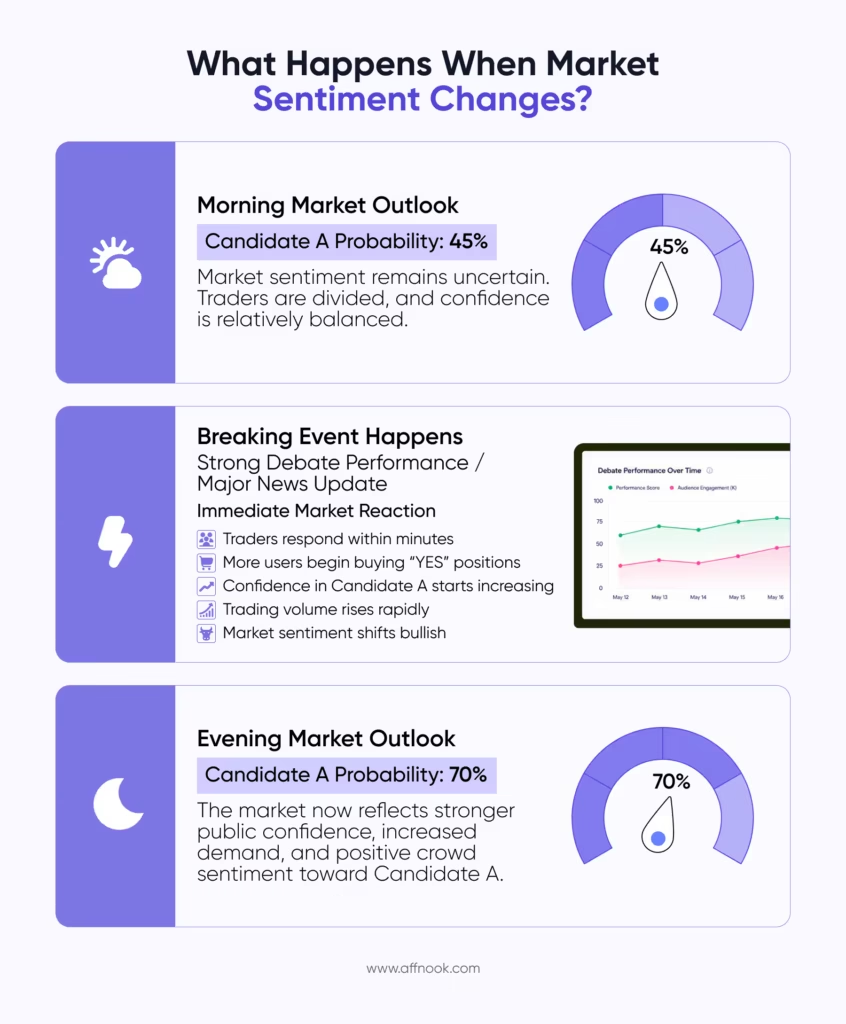
Imagine a political candidate is trading at 45% probability. After a strong debate performance or positive news update, more users may begin buying positions connected to that candidate.
As demand increases, the market probability could rise from 45% to 70%.
The same process happens in sports, cryptocurrency, entertainment, and economic forecasting markets. Prices move dynamically because traders continuously react to new information in real time.
Why Liquidity Matters in Crowd Forecasting Platforms
Liquidity refers to how easily users can buy and sell positions in a market.
High-liquidity markets usually provide smoother pricing and more reliable forecasts because many users are actively participating. Low-liquidity markets can become unstable, where even small trades cause large price swings.
Once the event ends, the market settles automatically. Correct predictions receive payouts, while incorrect positions lose value.
This entire system turns prediction markets into live forecasting engines powered by crowd intelligence and real-time sentiment.
Why Businesses and Media Companies Are Paying Attention to Prediction Markets
Prediction markets are no longer just internet experiments or niche trading platforms. Businesses, media companies, and digital brands are increasingly paying attention because these platforms provide real-time insight into what people believe will happen next.
Instead of relying only on surveys or delayed research reports, companies can now observe live market sentiment as users react to news, trends, sports events, politics, and financial developments. This makes crowd forecasting platforms valuable for both audience engagement and business intelligence.
For many organizations, prediction markets are becoming tools for understanding consumer behavior, tracking sentiment, and improving decision-making.
How Crowd Forecasting Improves Decision-Making
One of the biggest advantages of prediction markets is collective intelligence.
When thousands of users trade on future outcomes, the market absorbs information from news, social media discussions, and public sentiment in real time. This often creates faster forecasting signals than traditional polling systems.
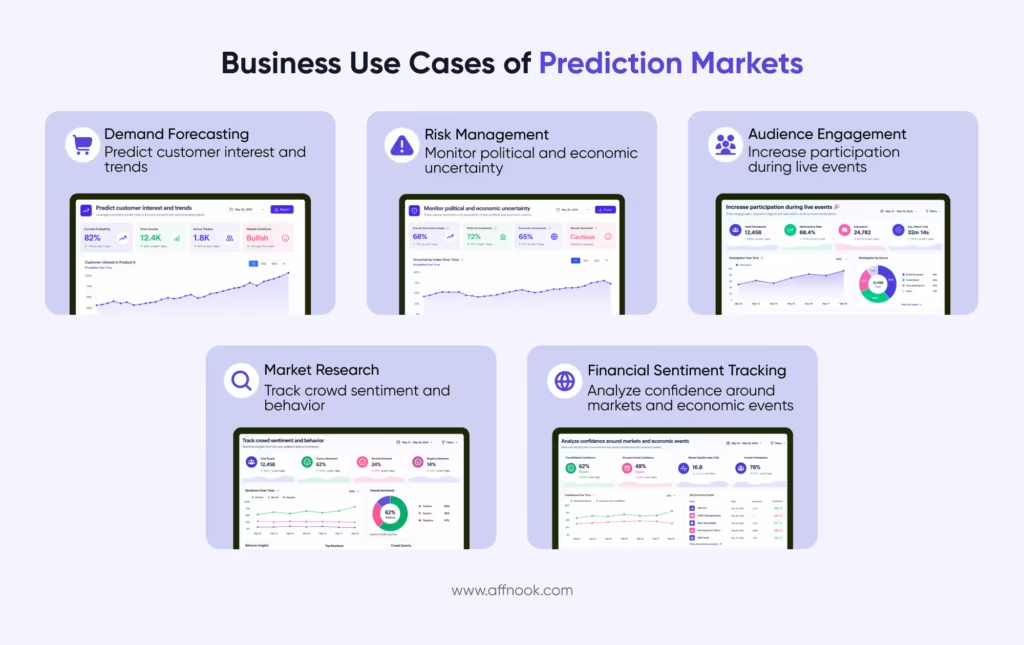
Businesses can use these insights for:
- Demand forecasting
- Risk analysis
- Economic trend monitoring
- Consumer behavior tracking
- Financial sentiment analysis
Many analysts now view prediction markets as useful forecasting systems because users are financially motivated to make accurate predictions.
Prediction Markets as a Consumer Sentiment Tool
Prediction markets also help companies understand how audiences think and react.
Unlike social media opinions, users on these platforms are backing their predictions with money. This often creates more serious and data-driven participation.
Industries such as finance, sports, entertainment, and iGaming are especially interested in this model because audience engagement plays a major role in growth.
Businesses already use tools like affiliate tracking, real-time reporting, and API integrations to monitor user behavior. Prediction markets add another layer by helping brands understand future audience expectations and sentiment trends.
Media Engagement and Real-Time Participation
Media companies are exploring prediction markets because they make content more interactive.
Instead of only watching events unfold, audiences can actively participate by forecasting outcomes in real time. This creates stronger engagement during:
- Elections
- Sports tournaments
- Entertainment events
- Financial news coverage
Prediction markets also fit perfectly with modern internet culture, where breaking news and social media discussions influence public opinion instantly.
As a result, prediction markets are evolving into both forecasting systems and audience engagement platforms, especially in industries focused on live participation and event-based experiences.
The Technology Powering Modern Prediction Markets
Modern prediction markets are powered by technologies that make event-based trading faster, smarter, and more transparent. From blockchain systems to AI-driven analytics, technology is helping these platforms handle real-time forecasting on a global scale.
Unlike traditional forecasting models, crowd forecasting platforms update continuously as users react to breaking news, sports events, elections, or financial developments. Prices and probabilities can change within seconds, creating a highly interactive experience.
Why Blockchain Became Important for Prediction Markets
Blockchain technology plays a major role in modern prediction markets because it improves transparency and trust.
Many platforms use blockchain to record trades and market activity on decentralized ledgers. This helps reduce manipulation and creates more secure systems for users.
Smart contracts are another key feature. These automated digital agreements instantly process payouts once an event outcome is verified. For example, after a sports match or election result is confirmed, the system automatically distributes winnings to correct predictions.
This makes prediction markets faster and more efficient.
AI and Real-Time Data in Event-Based Trading
Artificial intelligence and real-time data systems help prediction markets react instantly to new information.
AI tools can analyze news, social media discussions, financial data, and historical trends to identify patterns and market sentiment. Meanwhile, live data feeds continuously update market odds as events unfold.
For example:
- Sports markets react to injuries
- Political markets shift during debates
- Crypto markets move after major announcements
This constant flow of information keeps event-based trading highly dynamic and engaging.
The Rise of Decentralized Crowd Forecasting Platforms
Decentralized crowd forecasting platforms are also becoming more popular.
Instead of relying fully on centralized companies, these systems allow users to trade directly through blockchain networks. Many users prefer decentralized platforms because they offer greater transparency and global accessibility.
At the same time, mobile-first design is helping prediction markets grow rapidly among younger audiences who prefer fast, real-time digital experiences.
As technology continues evolving, prediction markets are becoming smarter, faster, and more connected to real-time global events.
Regulation, Compliance, and Legal Uncertainty in Prediction Markets
As prediction markets continue growing, governments and regulators are paying much closer attention to the industry. The challenge is that these platforms exist in a legal gray area between gambling, financial trading, and forecasting systems.
Some countries view prediction markets as a form of online betting, while others treat them as financial or information-based markets. This has created ongoing uncertainty around licensing, compliance, and regulation.
Reports from CNBC and TIME have highlighted how regulators are increasingly debating how event-based trading platforms should operate legally.
Are Prediction Markets Considered Gambling?
One of the biggest debates is whether prediction markets should legally be classified as gambling.
Users are placing money on future outcomes, which makes the experience look similar to betting. However, supporters argue that prediction markets are different because they rely heavily on research, probability analysis, and crowd intelligence rather than pure luck.
Political and financial forecasting markets are especially controversial because they can influence public opinion and speculative behavior.
As a result, different countries continue applying different legal interpretations to prediction markets.
Why Governments Are Increasing Scrutiny
Governments are increasing scrutiny because prediction markets now impact politics, finance, and public conversations at a much larger scale.
Regulators are concerned about issues such as:
- Market manipulation
- Insider information
- Election integrity
- Money laundering risks
- User protection
Reports from Moneycontrol and CoinGeek show that many authorities are now focusing on stronger compliance systems, identity verification, and platform transparency.
The Global Compliance Challenge for Crowd Forecasting Platforms
Compliance becomes even more difficult because regulations vary across countries.
Some regions allow limited prediction markets, while others restrict political forecasting or real-money participation entirely. Platforms operating globally must constantly adapt to changing laws, financial rules, and licensing requirements.
Despite these challenges, prediction markets continue growing rapidly. But in the long term, regulation and transparency will likely play a major role in shaping the future of crowd forecasting platforms.
Infographic #5: Biggest Regulatory Challenges Facing Prediction Markets
Visual Idea: Compliance checklist with warning icons
- Election Integrity → Concerns around political influence
- Market Manipulation → Artificial movement of market odds
- Insider Information → Use of confidential data for trading advantage
- User Protection → Fraud prevention and responsible participation
- Licensing Uncertainty → Different legal rules across regions
The Biggest Risks and Challenges in Prediction Markets
Although prediction markets are growing rapidly, the industry also faces several major risks and challenges. Since these platforms operate in real time and are heavily influenced by public sentiment, markets can become highly volatile and unpredictable.
From misinformation to manipulation concerns, crowd forecasting platforms must balance innovation with transparency and user protection.
Can Prediction Markets Be Manipulated?
One of the biggest concerns is market manipulation.
Large traders or coordinated groups may try to influence probabilities by placing heavy trades that create artificial sentiment. Low-liquidity markets are especially vulnerable because even small trades can cause large price swings.
There are also concerns around insider activity, where users with confidential information may gain unfair advantages in political, financial, or sports-related markets.
The Risk of Viral Misinformation in Event-Based Trading
Prediction markets react instantly to news and social media trends. While this creates engaging real-time participation, it also increases the risk of misinformation.
A viral rumor or misleading headline can quickly shift market sentiment before facts are confirmed. Since users react rapidly, event-based trading markets can become unstable during breaking news situations.
Why Transparency Matters in Crowd Forecasting Platforms
Transparency is critical for the future of prediction markets.
Users need confidence that markets are fair, payouts are reliable, and trading activity is properly monitored. Strong liquidity, clear rules, and fraud prevention systems help create more stable forecasting environments.
Another growing concern is addictive behavior. Because prediction markets combine financial incentives with emotional engagement, some users may participate excessively during high-volatility events.
As prediction markets continue expanding, transparency, responsible participation, and platform trust will become essential for long-term growth.
Final Thoughts on the Future of Prediction Markets
Prediction markets are quickly moving beyond their niche internet roots and becoming part of mainstream digital culture. What started as experimental forecasting platforms is now evolving into a growing industry powered by real-time information, crowd intelligence, and event-based trading.
The reason behind this growth is simple: people no longer want to just consume information. They want to participate in it.
From elections and sports to finance and entertainment, prediction markets are changing how audiences react to uncertainty and engage with global events. Businesses, media companies, and digital platforms are also beginning to recognize the value of crowd forecasting platforms for audience engagement, sentiment tracking, and real-time insights.
At the same time, the industry still faces important challenges. Regulation, misinformation, volatility, and market manipulation remain major concerns that could shape the future of the space.
What happens next will depend on how platforms balance innovation with transparency and user trust.
As technology continues evolving, prediction markets may become closely connected with AI forecasting systems, affiliate tracking platforms, real-time reporting tools, and modern iGaming advertising strategies.
Prediction markets are no longer a niche internet experiment. They are becoming a reflection of how digital audiences consume information, react to uncertainty, and participate in global events.
Help Centre
What are prediction markets?
Prediction markets are platforms where users trade on the outcomes of future events, such as elections, sports results, cryptocurrency prices, and economic developments. Market prices reflect the probability of an event occurring.
How do prediction markets work?
Users buy and sell contracts linked to specific outcomes. As more participants trade, prices change in real time, creating a crowd-driven forecast of what is most likely to happen.
Are prediction markets the same as online betting?
Not exactly. While both involve predicting outcomes, prediction markets are often viewed as forecasting tools because prices are influenced by research, data, public sentiment, and market behavior rather than pure chance.
Why are prediction markets growing so quickly?
The growth is driven by increased interest in real-time information, mobile trading, blockchain technology, and younger audiences who prefer interactive digital experiences tied to current events.
What are the biggest challenges facing prediction markets?
Key challenges include regulatory uncertainty, market manipulation, misinformation, liquidity concerns, and ensuring transparency and user protection across different jurisdictions.