
Technological developments are changing every aspect of the world, and the casino industry is no exception. The industry is ever-evolving, driven largely by customer preferences, expectations for immersive experiences, and technological innovations.
This is why casino technology goes beyond being software that runs games. In today’s time, casinos require interconnected systems that manage multiple elements like – game delivery, player accounts, payments, security, analytics, regulatory requirements, and marketing performance. This matters most for operators because their main purpose is to serve players and measure business results accurately.
The state of the market explains why such systems actually matter. According to the UK Gambling Commission’s latest annual industry statistics, licensed operators generated £17.5 billion in gross gambling yield (GGY) across Great Britain’s customer-facing gambling industry in the year 2025-2026. Online casino games totaled £5.7 billion of that period’s remote casino, betting, and bingo sector revenue, including £4.8 billion from slots.
This guide aims to explore this very technology that is now transforming the casino industry into one that is led by artificial intelligence, modern structure, security, analytics, and affiliate tracking. Let us also examine the challenges the operators should consider when they choose and integrate these systems.
What Is Casino Technology and How Does It Work?
Casino technology refers to the software, hardware, infrastructure, and digital systems used to deliver casino games and manage casino operations. This covers everything. Be it the systems that determine game outcomes or tools that process transactions, manage player accounts, monitor activity, and measure marketing performance.
Technology here is not just limited to online casinos but also involves land-based casinos, however, their technological requirements might differ.
- A physical casino may use eGaming machines, surveillance systems, cashless payment solutions, and centralized casino management software.
- An online casino is more inclined towards the internet infrastructure, game servers, account management systems, payment integrations, and digital security controls.
How Does It Work?
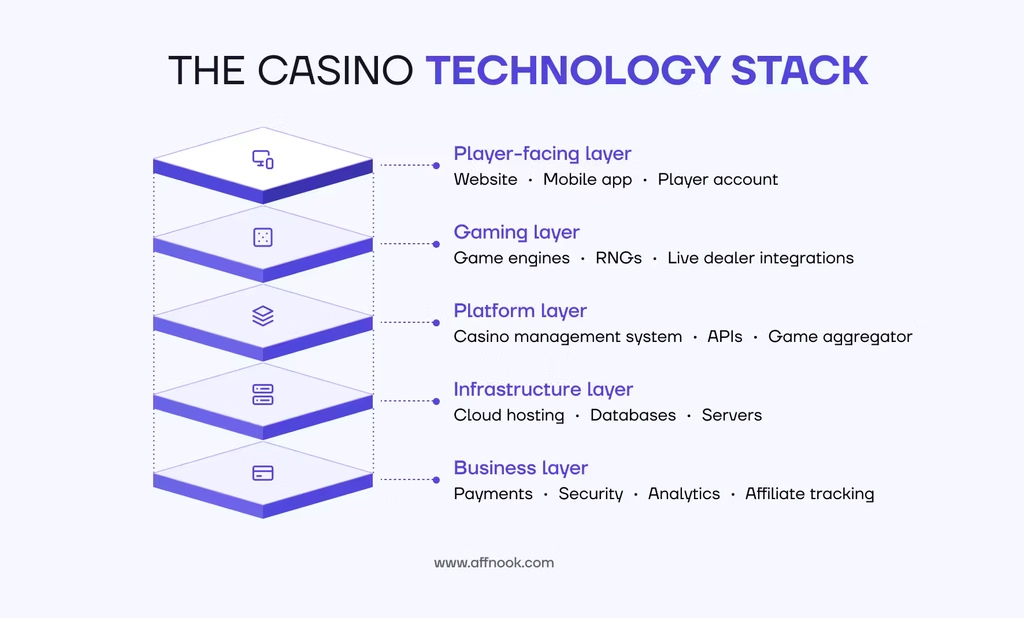
A casino’s operation involves multiple layers. This includes –
- User-facing interface – The website or mobile application through which players access games, manage accounts, and interact with the platform.
- Casino management systems – Software that handles player accounts, session information, balances, bonuses, and other operational functions.
- Gaming systems – Game servers, random number generators (RNGs), live dealer platforms, and game integrations that deliver different gaming experiences.
- Payment infrastructure – Integrations that support deposits, withdrawals, transaction records, and payment verification.
- Security and compliance systems – Tools and processes that help with identity checks, access control, monitoring suspicious actions, and regulatory obligations.
- Analytics and reporting – Systems that help teams understand player activity, financial performance, acquisition sources, and operational issues.
The elements together, but how do they exchange information? This happens with the help of databases, APIs, and integrations. They play their respective roles according to the way a player interacts with the casino platform.
When a player opens a slot game, the casino platform may authenticate the account, check relevant eligibility conditions, launch the game through an integration, and record the resulting activity. If the player makes a withdrawal, the payment system and account records must reflect the transaction accurately.
What Goes Behind an Online Casino’s Technology?
An online casino depends on multiple technologies working together. Understanding these components helps operators assess platform capabilities, identify integration requirements, and helps them understand whether their existing systems can reinforce the future growth.
This technology varies depending on the business model.
- An operator using a turnkey platform may receive several capabilities from one provider.
- A business using a modular architecture may integrate separate suppliers for gaming, payments, player management, analytics, and affiliate tracking.
Casino Management Systems and Player Account Management
A casino management system helps with coordination of the operational side of the casino. On the basis of the platform’s requirements, it may include –
- Player account management
- Bonus configuration
- Transaction records
- Game access
- Reporting
- Promotional tools
Player account management, on the other hand, is necessary because it aligns the players’ accounts with the services they actually use. The system also maintains data such as account details, verification status, available balances, transaction histories, and relevant restrictions, which can later be used as a reference point.
Some of the most basic player actions, like registration, identity verification, and deposits, involve separate systems, of which the operator needs a consistent view.
Operators should evaluate whether the system offers:
- Centralized player and transaction records.
- Appropriate role-based access permissions.
- Integration with gaming, verification, and payment providers.
- Reporting that supports operational and compliance requirements.
- Reliable handling of account updates and transaction discrepancies.
A platform with more features does not necessarily have to be better. Its capabilities must match the operator’s needs and work reliably with the rest of the stack.
Game Engines, RNG and Game Aggregators
Game engines provide the computational logic that is required to run games.
RNGs, on the other hand, generate values used to determine outcomes in games designed around randomized results.
For example, a slot game’s RNG may determine the outcome, while the interface displays the corresponding symbols and any applicable payout.
Game aggregators have a different purpose altogether. They provide operators with access to games from multiple suppliers through integration. This reduces the need to establish and maintain a separate integration for each game provider.
APIs and Third-Party Integration
APIs allow different applications to exchange information or request actions through integration. Online casinos may use them to connect gaming providers, payment processors, identity verification services, analytics tools, and affiliate tracking platforms.
However, integrations can introduce operational and security risks.
Common issues include:
- Authentication weaknesses – Systems may not correctly verify who is making a request.
- Incorrect permissions – Users or applications may access information or functions they shouldn’t.
- Data inconsistencies – Connected systems may record the same event differently.
- Integration failures – Delayed or unsuccessful requests can interrupt workflows.
- Version changes – Updates to an API may require changes to the connected application.
Operators should assess access controls, error handling, integration testing, and responsibility for maintaining each connection.
Suppose a payment provider confirms a deposit but the casino platform fails to update the player’s account promptly. The payment may have succeeded while the player-facing experience remains incomplete.
Only those integrations that handle errors, reconcile procedures, and identify any sort of discrepancies are actually reliable
Hence, while selecting integrated systems, operators should ask certain questions –
- How is access controlled?
- What happens when an integration fails?
- How are changes tested?
- Who is responsible for investigating incidents?
Cloud Infrastructure, Database and Server Structure
Cloud infrastructure can provide digital assets, storage, networking and services that support online casino operations. As per the architecture, operators can use public cloud services, private infrastructure, or a combination of environments.
Databases store information required by the platform, such as account records, configuration settings, transaction details, and reporting data. Application servers process requests, while networking and content delivery infrastructure help deliver interfaces and assets to users across different locations.
The architecture affects more than speed. It also affects availability, resilience, security, and the ability to handle demand changes.
For example, a large promotional campaign or a major sporting event may generate an increase in website visits and registration attempts. The operator’s infrastructure needs to handle that demand without causing excessive delays or making critical functions unavailable. Capacity planning, performance monitoring, and appropriate scaling mechanisms can help manage these conditions.
Cloud hosting does not automatically guarantee reliability or security. Poor configuration, insufficient monitoring, weak access controls, and dependence on a single service can still create operational risks.
Operators should therefore evaluate –
- Uptime commitments
- Backup arrangements
- Disaster recovery
- Data residency requirements
- Infrastructure monitoring
- Ability to restore services after an incident.
What Are the Latest Casino Technology Trends?
Operators are always looking for innovative ways to deliver games, manage operations, protect accounts, and understand player activity, which leads to the ultimate evolution of casino trends.
However, emerging technologies differ on the basis of their maturity, cost, and suitability for particular markets.
A useful way to evaluate a trend is to ask three questions:
- What problem does it solve?
- What evidence supports its use?
- And what technical, financial, or regulatory considerations would affect implementation?
Artificial Intelligence and Machine Learning
AI and machine learning can help process large amounts of data, identify patterns, and support selected operational tasks.
Potential applications include:
- Fraud monitoring – Flagging unusual transactions or account activity for investigation.
- Customer support – Categorizing requests and helping agents retrieve relevant information.
- Operational analytics – Identifying patterns in errors, transactions, or system performance.
- Workflow automation – Routing cases or generating alerts based on defined conditions.
However, an automated alert is not proof of fraud, and AI outputs can be inaccurate. Operators need to validate results, manage access to data, and establish appropriate human slips and errors.
VR and Augmented Reality
Virtual reality (VR) creates immersive digital environments, while augmented reality (AR) overlays digital elements onto a view of the physical world.
Some of the potential ways that it can be applied include –
- Simulated casino environments.
- Interactive digital gaming spaces.
- More immersive interfaces for compatible devices.
Adoption depends on hardware availability, audience demand, development costs, and usability. These technologies should be assessed against a specific business need rather than treated as essential features for every online casino.
Blockchain and Provably Fair Games
If five people pool their money to place a bet, they would also have to keep track of who spent what amount. Blockchain is a shared ledger technology that records information according to a defined protocol.
Gambling-related platforms do not just use it for maintaining records but also for digital asset transfers.
Provably fair systems, on the other hand, use cryptographic methods to help users verify aspects of how certain game outcomes were generated.
These concepts should not be confused, and hence some facts must be kept in mind –
- Blockchain does not automatically prove that a game is fair.
- Provably fair verification depends on the actual implementation.
- Neither technology automatically establishes regulatory compliance.
- Blockchain-based payments may introduce fees, processing delays, and jurisdiction-specific restrictions.
Operators should assess the exact use case, verification process, and applicable regulatory requirements before adopting these technologies.
Mobile-First Casino Platforms
Today, a player might open an online casino while commuting, during a break, or relaxing at home. They expect the platform to load quickly, respond smoothly, and make every action mobile-friendly. This is why mobile-first design has become an important part of casino technology.
The Mobile Gambling industry is projected to grow from 82.85 in 2025 to 239.55 by 2035.
A mobile-first platform is built around the needs of users accessing the service through smartphones and other mobile devices. It focuses on –
- Responsive layouts – Interfaces that adapt to different screen sizes.
- Touch-friendly navigation – Controls and menus designed for taps and swipes.
- Faster loading – Efficient performance across different network conditions.
- Reliable account access – Smooth login and transaction handling.
- Consistent security – Appropriate protection across supported devices.
How Does Casino Technology Power Online Games and Live Dealers?
When a player spins a gambling slot reel, joins a live roulette table, or opens a new game, several technologies work behind the scenes to make that experience possible. The platform must process game logic, display outcomes, manage player actions, and record relevant activity without disrupting gameplay.
The technology differs depending on whether a game uses randomized digital outcomes, a live dealer, or another format. If the operators can understand these differences, they will be better able to analyse game quality, integration requirements, and the technical support that is required to deliver a reliable experience.
Random Number Generator and Game Fairness
Ever wondered what determines the outcome when a player spins a digital slot reel?
In many online casino games, the answer lies in the technology of a random number generator (RNG).
RNGs produce values that determine game outcomes. The game’s rules and mathematical design process these values.
For example, a slot game may use randomly generated values to determine where symbols land on its reels. The software then displays the corresponding result and calculates any payout according to the game’s rules. The animation itself is not evidence that the result was random.
The UK Gambling Commission‘s RTS 7 provides a useful regulatory example. It requires covered games to produce acceptably random outcomes and states that results should be implemented fairly and in accordance with the rules and prevailing payouts described to customers.
What should the operators keep in mind?
- Generation of random outcomes – Understand how the game generates and processes random values.
- Testing and certification – Examine the testing and certification applicable to the markets where the game will operate.
- Game documentation – Review information supplied by providers about game rules, probabilities, and technical implementation.
- Software updates – Ensure that changes to game software are appropriately managed and tested.
Live Dealer Streaming and Low Latency Video
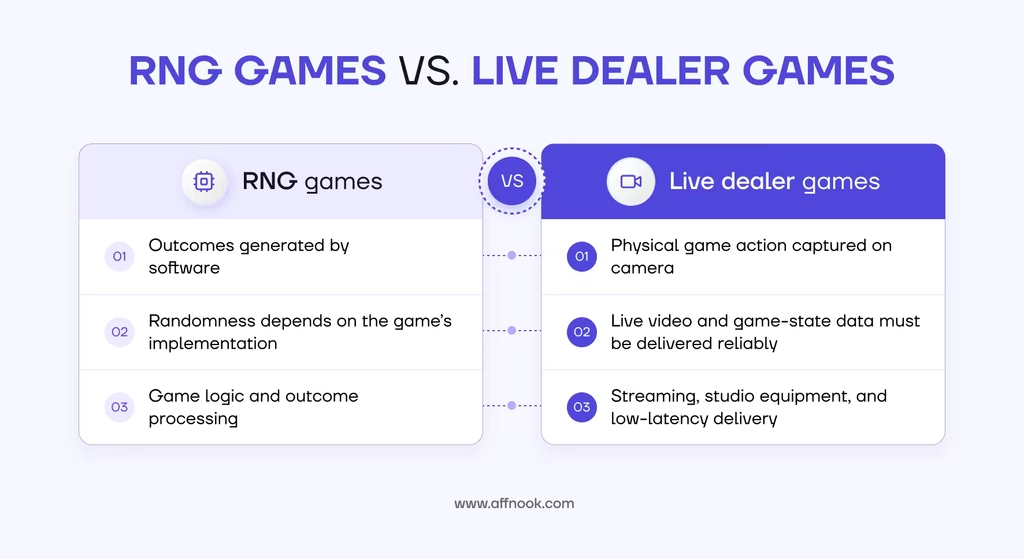
Usually, digital games have their own software that generates the outcome, but now the trends are changing. There are also live dealer games that bring a physical gaming environment to the player’s screen. This experience is more than simply streaming a video.
How does this work?
A dealer conducts a game in a studio or casino setting, cameras capture the action, and a streaming system delivers the video to players through an online interface.
The platform must coordinate several elements –
- The live video stream.
- The displayed game state.
- Player actions and betting windows.
- The information needed to determine and communicate results.
One of the biggest technical considerations here is the delay between an action taking place and the player seeing it. If the video and interactive interface become evidently out of sync, players may see an action after the corresponding betting window has closed or experience delays when submitting an action.
Streaming quality depends on factors such as network conditions, video encoding, server infrastructure, and the player’s device. Operators and providers need to monitor these components and define what happens when a connection is interrupted.
Live dealer systems may also include multiple camera angles, localized tables, chat functionality, and different game formats. These features increase the coordination required between the streaming infrastructure and the casino platform.
Game Integration and Cross-Device Compatibility
A casino may offer hundreds of games, but simply adding them to its platform does not guarantee that players can access them smoothly. Each game needs to connect properly with the platform and work across the devices it supports.
This is where game integration comes in.
It connects a provider’s game to the casino platform, allowing players to launch it and allowing the exchange of information between systems.
A successful integration must be responsible for:
- Authentication – Verifying the player’s access to the game.
- Session creation – Establishing and managing the game session.
- Currency support – Handling supported currencies where relevant.
- Game availability – Making sure the game can be accessed in the intended markets.
- Transaction handling – Recording relevant game transactions accurately.
- Error reporting – Identifying and managing technical issues.
Game rounds and transactions involve several connected services depending on the structure of the platform
Compatibility also matters.
A game should behave as intended on the devices and browsers it supports. Operators need to consider screen dimensions, touch controls, loading performance, and the handling of interruptions when a player switches applications or loses connectivity.
Before launching a new game, teams should test the full player journey, including:
- Game launch and authentication.
- Gameplay and player interactions.
- Transaction records and balance updates.
- Interrupted sessions and reconnection.
- Recovery from errors.
How Does Casino Technology Improve the Player Experience?
For a player, the first impression of a game is determined by its visual design. But that is not enough. Navigation of the platform, access to relevant information, completion of transactions, and resolution of problems.
Casino technology can support these activities, but its effectiveness depends on how the systems are designed and implemented.
Personalized Game Discovery and Interfaces
A casino may offer games from multiple suppliers across several categories. Without effective navigation, players may find it difficult to locate particular games or understand the available options.
Search tools, filters, category pages, and recommendation systems can help organize a large catalogue. Where appropriate and permitted, personalization may use a player’s stated preferences or relevant activity to make the interface more useful.
However, personalization should not be confused with predicting whether someone will win. Recommendations can help people discover content, but they cannot guarantee a particular game outcome.
Operators should also consider privacy and user control. Data used for personalization should have an appropriate basis, be handled transparently, and comply with applicable data-protection requirements.
Faster, Smoother Gameplay Across Devices
Performance affects the entire player journey. Slow pages, failed game launches, repeated logins, or interrupted transactions can make a platform difficult to use.
Operators can monitor page-loading times, application errors, game launch failures, transaction completion, and other technical indicators to identify problems. Testing across different devices and network conditions can reveal issues that may not otherwise appear in a controlled environment.
A responsive interface should adapt to different screen sizes while keeping important information readable. Apart from the game itself, this also applies to account management, payments, and customer support.
Loyalty Programs, Gamification, and Player Engagement
Loyalty systems and gamification features can organize promotions, rewards, milestones, and other interactions. Their implementation may involve rules engines, player account data, campaign management, and reporting.
For example, a platform may need to check whether a player meets the eligibility criteria for a promotion, record the relevant activity, and display the applicable reward. The underlying systems must apply the promotion’s rules consistently and communicate the terms clearly.
Operators should avoid treating increased activity as the only measure of success. In gambling environments, engagement features also need to be assessed against responsible gambling obligations and player-protection measures.
Technology should support clear information, appropriate controls, and the ability to identify potentially harmful patterns where required. Features that encourage repeated activity without adequate safeguards can create risks rather than improve the overall player experience.
The strongest player experiences combine usable design, reliable systems, transparent rules, and appropriate protections.
How Does Casino Technology Support Affiliate Marketing and Performance Tracking?
Affiliate marketing is an important acquisition channel for many online gambling businesses. In an affiliate program, partners refer potential customers to an operator through agreed marketing arrangements, and compensation may depend on defined outcomes such as registrations, qualifying deposits, or revenue generated by referred players.
Technology supports this relationship by connecting referral activity with conversion records, commission calculations, and partner reporting. Without reliable tracking, operators may struggle to establish which partners contributed to an outcome or whether the reported performance matches the underlying activity.
Affiliate Links, Conversion Tracking, and Attribution
An affiliate link may look like a simple URL, but it carries information that helps operators understand where a potential customer came from and which partner should receive credit for the referral.
When someone clicks an affiliate link, the tracking system records relevant referral information and attempts to connect subsequent activity with the appropriate affiliate and campaign.
How does this tracking process work?
- Referral click – A potential customer clicks an affiliate’s tracking link.
- Click recording – The system captures relevant details, such as the tracking identifier and campaign information.
- Player registration – If the visitor registers, the system attempts to associate the registration with the original referral.
- Conversion tracking – Qualifying actions, such as a first-time deposit (FTD), are recorded.
- Attribution – The system assigns credit according to the affiliate program’s defined rules.
This process may involve tracking identifiers, landing pages, conversion events, and server-to-server integrations. The operator’s platform and tracking system must use compatible event definitions and data.
Connecting a click to a conversion isn’t always straightforward. A player may interact with several marketing channels, switch devices, or return after a period of time. Other issues can include:
- Missing or expired tracking identifiers.
- Tracking restrictions that limit available information.
- Integration errors between platforms.
- Different attribution windows or event definitions.
- Disputed conversion records.
Tracking First-Time Deposits and Player Activity
A campaign can bring hundreds of new registrations, but how many of those users actually make a deposit?
And what happens after that first transaction?
For casino operators, looking beyond sign-ups helps them understand the quality and performance of affiliate traffic.
A first-time deposit (FTD) is an important conversion milestone for many casino affiliate programs. However, a deposit should only count as a qualifying event when it meets the program’s defined conditions.
What information can tracking systems help operators monitor?
- Referring affiliate – Identifies the partner responsible for the referral.
- Campaign details – Shows which campaign generated the conversion.
- Conversion timestamp – Records when the qualifying action took place.
- Goal identifier – Helps distinguish between different conversion events.
- Brand information – Connects the activity to the relevant operator or brand.
- Subsequent player activity – Where supported by the integration and permissions, provides additional insight into player engagement and financial performance.
These details help operators move beyond a simple count of registrations. For example, one campaign may generate many sign-ups but relatively few qualifying deposits. Another may attract fewer registrations but a higher proportion of users who meet the program’s conversion criteria.
However, a high FTD count doesn’t automatically mean a campaign is profitable. Operators may also need to evaluate:
- The applicable commission structure.
- Subsequent player activity and revenue.
- Customer acquisition costs.
- The quality and reliability of conversion records.
Affiliate Reporting, Commission Calculation, and Payouts
Affiliate reporting helps operators understand performance at the level of individual partners, campaigns, brands, and conversion goals. Depending on the platform, reports may include clicks, conversions, deposits, revenue, commissions, and other agreed metrics.
Commission calculations depend on the commercial model. Common structures include cost per acquisition (CPA), revenue share, and hybrid arrangements that combine elements of both. The applicable contract determines how qualifying conversions or revenue are calculated and how adjustments are handled.
Technology can automate calculations and prepare payout records, but automation does not remove the need for accurate inputs and clearly defined terms. Operators should ensure that the tracking system’s calculations match the commercial agreement, including any applicable deductions, adjustments, minimum thresholds, or carryover rules.
Payout automation can also reduce manual administration when it is supported by appropriate validation and approval controls. Teams should be able to investigate discrepancies, review changes, and reconcile payment records against the amounts due.
- For affiliate managers, the goal is to make performance and payment information traceable.
- For partners, it is to provide understandable reporting and a consistent basis for resolving questions.
Fraud Monitoring and Partner Performance Analysis
Affiliate programs can face issues such as duplicate conversions, misleading referrals, prohibited traffic sources, or activity that violates program terms. Tracking technology can help flag unusual patterns, but determining whether a violation occurred may require additional evidence.
For example, a sudden increase in clicks without a corresponding change in qualifying conversions may warrant investigation. It could reflect low-quality traffic, a technical tracking issue, a change in audience behaviour, or another explanation. The pattern alone does not prove fraud.
Operators should combine relevant tracking data with clear partner terms, appropriate monitoring, and a documented investigation process. Decisions that affect commissions or partner access should be supported by evidence and handled consistently.
Performance analysis should also look beyond the total number of affiliates or referrals. Useful questions include:
- Which partners generate qualifying conversions?
- How does the conversion rate differ across campaigns?
- Which traffic sources produce activity that meets the program’s quality requirements?
- How do commissions compare with the eligible revenue or acquisition outcomes they support?
- Are unusual changes caused by partner activity, tracking issues, or another operational factor?
These questions help operators distinguish partner volume from measurable contribution. A large affiliate base does not automatically mean a high-performing program, just as a low conversion count does not by itself prove that a partner is ineffective.
The most useful evaluation combines consistent tracking, clear commercial rules, and context about the quality and value of the outcomes being measured.
Choosing Affiliate Tracking Technology
When evaluating affiliate tracking software for a casino business, operators should consider the following capabilities.
- Tracking and attribution – Can the platform record referral activity and associate eligible conversions with the correct affiliate and campaign?
- Reporting and reconciliation – Can teams compare clicks, conversions, deposits, commissions, and relevant financial records? Are discrepancies visible and traceable?
- Fraud monitoring – Does the platform help identify suspicious patterns and provide enough information for further investigation?
- Integration capabilities – Can it connect with the operator’s existing systems through supported APIs or other integration methods?
- Commercial flexibility – Can the system support the commission structures, qualification rules, and reporting requirements specified in affiliate agreements?
- Access controls and data protection – Can users access only the information and functions they are authorized to use? Are sensitive records handled appropriately?
- Scalability and support – Can the system accommodate the expected number of partners, campaigns, events, and reporting requirements while providing suitable technical support?
Ultimately, affiliate technology helps connect acquisition activity with business reporting. Its value depends on the quality of the tracking setup, the consistency of the underlying data, and the operator’s ability to interpret the results responsibly.
What Challenges Do Casino Operators Face When Adopting New Technology?
Adopting casino technology involves more than selecting software with the right features. Operators must consider integration, data quality, security, ongoing costs, regulatory obligations, and the practical work required to maintain systems over time.
These challenges become more important as a casino’s technology stack grows and more providers become involved in its operations.
Integrating Legacy Systems and Third-Party Providers
Operators may already rely on established systems for player accounts, payments, gaming, reporting, or affiliate management. Replacing everything at once can be expensive and disruptive, so new technology often needs to integrate with existing infrastructure.
The difficulty is that different systems may use different data formats, identifiers, event definitions, and processing rules. A conversion recorded by one application may not be represented in the same way by another.
For example, a casino platform may record a deposit as successful while a reporting integration receives the event late or fails to process it. If there is no reconciliation mechanism, the discrepancy can affect financial reports and commission calculations.
Before implementation, operators should map the systems involved, identify which application is authoritative for each type of record, and define how errors will be handled. Integration testing should cover both normal transactions and failure scenarios.
Documentation, version management, and clear responsibility for maintenance are also important. An integration that works today may need updating when a provider changes its API or data structure.
Managing Security, Privacy, and Regulatory Requirements
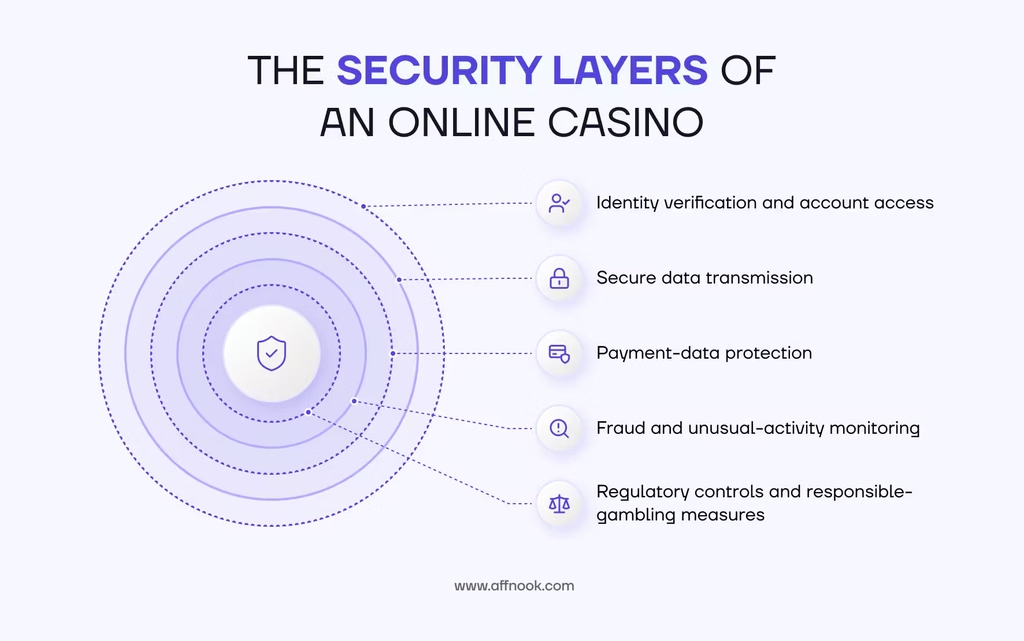
Every additional system can introduce new access points, data flows, and responsibilities. Operators need to understand what information each provider receives, how it is protected, and which party is responsible for maintaining the relevant controls.
The World Economic Forum’s Global Cybersecurity Outlook 2025 reported that 54% of surveyed large organizations identified supply-chain challenges as the biggest barrier to achieving cyber resilience. This is a general organizational finding, not a casino-specific statistic, but it illustrates why third-party oversight matters in connected technology environments.
A practical assessment should cover access permissions, authentication, data sharing, security testing, incident notification, and the provider’s approach to vulnerabilities. Operators should also know how to revoke access and respond if a supplier’s service becomes unavailable or compromised.
Privacy requirements matter as well. The European Data Protection Board identifies principles under the GDPR that include purpose limitation, data minimisation, accuracy, storage limitation, and confidentiality. These principles are relevant when the GDPR applies to an operator’s processing of personal data.
Technology selection should therefore include a review of data flows, retention practices, applicable legal requirements, and contractual responsibilities. A vendor’s general claim that its platform is secure is not a substitute for evaluating the actual controls and obligations involved.
Ensuring Scalability, Uptime, and System Performance
A system that performs well under normal conditions may struggle when demand increases or several connected services experience problems simultaneously.
Operators should evaluate how infrastructure responds to changes in traffic, transaction volume, reporting workloads, and the number of active integrations. Load testing and performance monitoring can help identify bottlenecks before they affect customers.
Availability also depends on more than hosting capacity. External payment providers, game suppliers, identity verification services, and other dependencies can affect the wider player journey.
A resilience plan should define how critical services are monitored, how incidents are escalated, and how systems are restored. Backups should be tested, recovery objectives should be established, and the operator should understand the limitations of its providers’ service commitments.
It is also important to distinguish a brief performance issue from a problem that affects the integrity of transactions or account records. Some incidents require more than restoring access; they may also require reconciliation and investigation.
Evaluating Technology Costs and Choosing Vendors
The purchase price or subscription fee represents only part of the cost of casino technology. Implementation, integrations, training, maintenance, testing, support, and future upgrades can add substantially to the total cost of ownership.
A low-cost product may require extensive customization. A feature-rich platform may introduce capabilities the operator does not need or cannot maintain effectively.
Vendor evaluation should therefore begin with business requirements. Operators should identify essential capabilities, expected transaction volumes, integration needs, reporting requirements, and the markets in which the platform will be used.
They should also examine documentation, service commitments, support arrangements, data portability, contract terms, and the practical process for migrating away from the provider if necessary.
A useful approach is to compare vendors against the same criteria and test critical workflows before committing to a major implementation. The goal is not to select the platform with the longest feature list. It is to choose technology that meets operational needs and can be supported over its intended lifecycle.
Conclusion
Casino technology is the foundation that connects gaming, payments, player management, security, analytics, and marketing operations. Each component serves a different purpose, but the overall value depends on how effectively these systems work together.
Choosing a technology requires more than following trends. It means evaluating integration requirements, data quality, scalability, compliance, and the costs of maintaining the platform over time.
Affiliate tracking is one part of this wider ecosystem. When implemented properly, it helps operators connect referral activity with conversions, partner performance, and commission reporting. That visibility makes it easier to evaluate acquisition activity using consistent data rather than relying on partner counts or clicks alone.
The most effective casino technology stack is ultimately one that supports the operator’s specific requirements, gives teams reliable information, and can evolve without compromising the integrity of the business.
Help Centre
Casino technology includes the software, hardware, infrastructure, and digital systems used to deliver casino games and manage operations. It can include game platforms, player account management, payment processing, security, analytics, and affiliate tracking.
Online casinos commonly use casino management systems, game software, RNGs, APIs, databases, cloud infrastructure, payment integrations, identity verification tools, and reporting platforms. The exact technology stack depends on the operator, its providers, and applicable regulatory requirements.
AI can analyze data, identify patterns, assist with customer support, and flag activity that may require further investigation. Its usefulness depends on data quality, system design, and appropriate oversight. An AI-generated alert should not automatically be treated as proof of fraud or harmful behaviour.
Game fairness depends on properly implemented game rules, appropriate outcome-generation mechanisms, testing, and compliance with applicable requirements. RNG-based games use random number generators to determine outcomes according to their design. The specific testing and certification obligations vary by jurisdiction.
Affiliate tracking systems record referral activity and connect eligible conversions with affiliates and campaigns. They can also support reporting, commission calculations, fraud monitoring, and payout workflows. Reliable results depend on accurate tracking, consistent attribution rules, and properly integrated systems.
Operators should assess business requirements, integration capabilities, security, scalability, reporting, vendor support, regulatory obligations, and total cost of ownership. Testing critical workflows before implementation can help reveal compatibility issues and operational risks.