The movement across industries to aggressively adopt AI is no secret. In fact, if quick, market-ready execution is required, there’s simply no other way to go anymore.
At the start of this very year itself, an estimated 4 out of 5 iGaming companies were already using AI or machine learning in some production capacity, according to a survey of more than 150 senior operator, platform and supplier executives run jointly by NEXT.io and The Playa.
Fraud prevention, personalization, customer support and compliance are the functions absorbing the bulk of that investment, and the pace of adoption keeps accelerating even in areas where measurable returns still lag behind ambition.
Of course, this is not a niche technology story. For all intents and purposes, AI has been an overarching theme across various applications in online casinos.
A lot goes directly through it. AI in iGaming now decides which games a player sees first, which transactions get blocked, which marketing messages a regulator will fine an operator for, and increasingly, which brands even get mentioned when a player asks ChatGPT or Google’s AI Overviews where to play.
This article breaks down where the technology actually stands today, what the data says about its impact, and where operators, suppliers and affiliates should expect it to go by 2027.
The State of AI in iGaming: A 2026 Data Snapshot
The shift isn’t immediate, nor is it missable. A few figures listed below make this movement quite evident.
- 61% of iGaming operators actively collect and store player data for personalization, yet close to 40% still lean on limited, channel-siloed targeting rather than true AI-driven segmentation, according to personalization platform Dynamic Yield’s iGaming benchmarking, reported by Intellias.
- 56% of operators surveyed for SOFTSWISS’s 2026 iGaming Trends Report named AI integration one of their top three business priorities, and the perceived importance of AI rose to 8.41 out of 10, up from 8.15 the year before.
- The inaugural “State of AI in Gaming 2026” report from KPMG and UNLV’s International Gaming Institute, based on a survey of 83 land-based and online operators and suppliers, scored the industry’s overall AI maturity at just 45 out of 100, even though the strategic ambition score sat at 57. Generative AI alone is already used by over 80% of companies, while adoption of autonomous AI agents lags far behind. In other words, intent is outrunning execution.
- Global online gambling revenue is on track to pass $121 billion in 2025, close to a fifth of the roughly $643 billion the entire gambling industry generated that year, according to market data compiled by Gambling Insider from Statista. H2 Gambling Capital expects total global gambling revenue to cross $1 trillion by 2030, with online channels driving most of that growth, which gives some sense of scale for how much value now flows through AI-touched systems.
The gap between ambition and maturity is the single most important thing to understand about AI in iGaming right now. Everyone is investing. But, few are executing well. That gap is exactly where competitive advantage sits for the next 18 months, and it is also where regulatory compliance and reputational risk concentrates for operators who move fast without proper guardrails.
Why are iGaming Operators Betting Big on AI?
Operators are not adopting AI because it is fashionable. They are adopting it because the return on specific use cases is measurable and, in several cases, substantial.
Personalization and CRM: Powers the Revenue Engine
Concrete results from major operators back up the perceived enthusiasm.
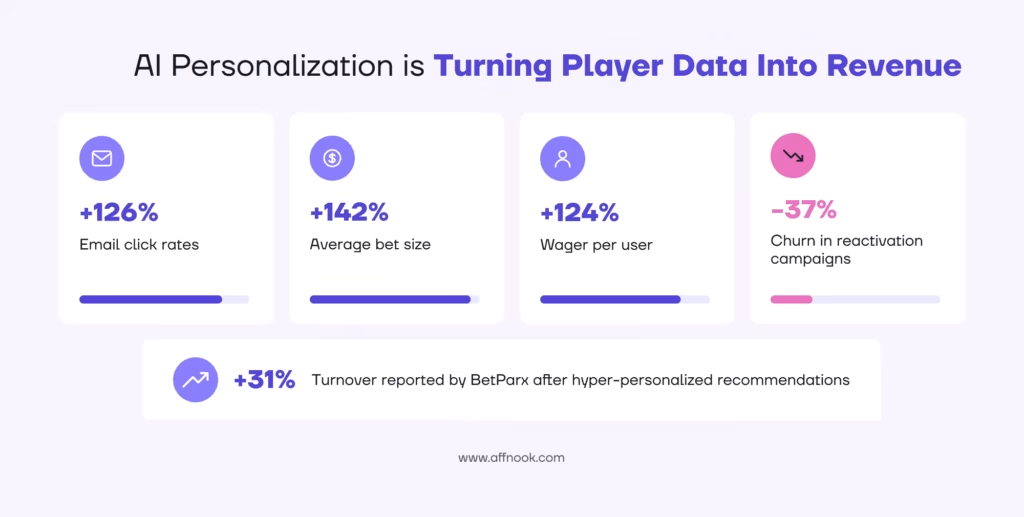
When platform provider GiG partnered with Sportradar’s AI personalization engine VAIX in March 2026, Sportradar noted that VAIX’s models had already delivered measurable uplifts for operators worldwide since 2017, including gains as high as 126% in email click rates, 142% in average bet size and 124% in wager per user during reactivation campaigns, alongside churn reductions of up to 37%, according to GiG’s announcement of the partnership.
Sportsbook operator BetParx separately reported a 31% increase in turnover after deploying hyper-personalized recommendations, while South African operator YesPlay more than tripled its average unique players after adopting Optimove’s AI-driven segmentation and iGaming campaign automation.
The mechanism behind these gains is very simple: instead of sending every player the same reload offer, machine learning models allocate a certain promotional spend against predicted player lifetime value, which raises the effective yield of every bonus dollar spent.
In effect, over a longer period of time, this protects the bridge between gross gaming revenue and net gaming revenue, the metric that actually funds an operator’s bottom line — the one that matters across all marketing spends.
Fraud Detection and AML: Strengthens the Compliance Backbone
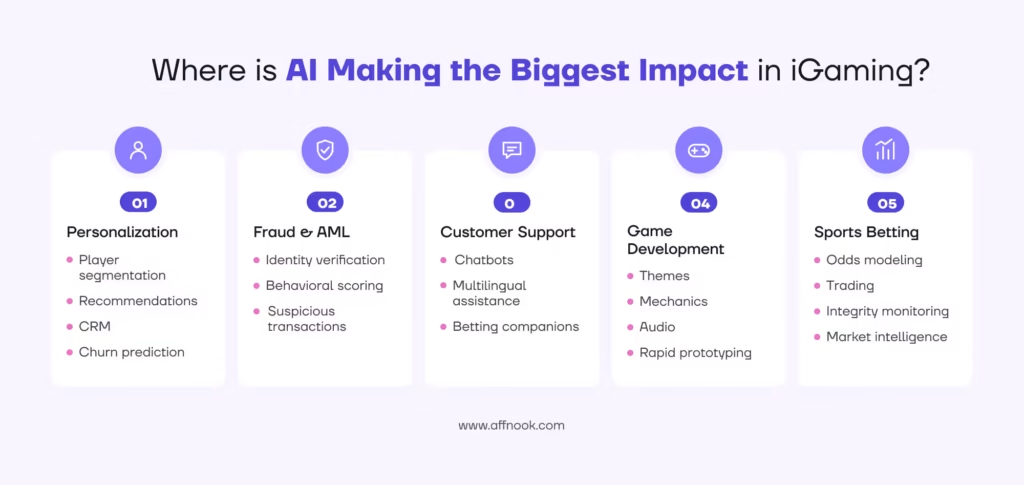
Fraud detection is the single most widely deployed AI function in iGaming, and the arms race behind it is intensifying rather than settling down. Sumsub’s iGaming Fraud Report 2026, based on more than 3 million observed fraud attempts across the sector, found the global iGaming verification fraud rate reached 1.53% in the first quarter of 2026, up 18% year over year and up roughly 40% from 2024.
Suspicious transaction volume rose 4.5 times between Q1 2025 and Q1 2026, and the average suspicious transaction value nearly doubled to more than $6,500. So, online gambling fraud is actually going up, rather than decreasing every year.
Fraudulent verification attempts now take 4.6 times longer than legitimate ones, evidence of more deliberate attacks in which fraudsters test document combinations and step through liveness checks rather than relying on blunt, high-volume bot traffic. The tools involved read like a generative AI showcase: synthetic faces, edited documents, templated identities and mass-generated applications.
For iGaming affiliate marketing platforms, this has direct commercial consequences too. Independent benchmarking from ad-fraud researchers at Spider AF puts fraudulent activity at close to 45% of all affiliate traffic industry-wide. TrafficGuard estimates that unchecked affiliate fraud cost advertisers more than $84 billion in a recent year, over a fifth of total digital ad spend.
Behavioral and device-level scoring, rather than static IP or cookie-based rules, is what catches a fraudulent first-time depositor before it ever triggers a commission payout, which is exactly why layered fraud protection has become a baseline requirement for any modern iGaming affiliate marketing platform rather than an optional add-on.
Conversational AI and the Rise of the Betting Companion
Chat-based assistants have quietly become one of the fastest-growing AI use cases in the vertical.
Roughly 60% of operators now run some form of customer support automation, and multilingual, natural-language chatbots are increasingly the first point of contact for routine queries, freeing human agents for complex escalations, according to a 2026 analysis from Applause, a digital quality testing firm that works with sportsbook and casino operators.
The more interesting development is the emergence of the conversational betting companion: an AI assistant that can surface odds, explain a market, pull up statistics or answer account questions inside a single chat thread instead of a traditional menu-driven app.
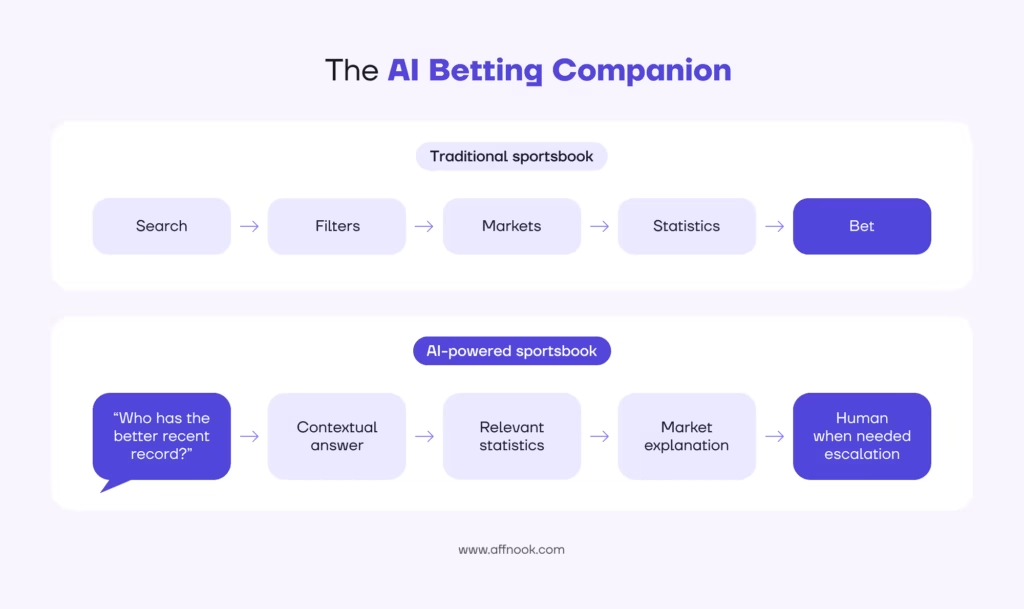
SBC News has documented the arrival of what it calls “the conversational sportsbook“, where players increasingly expect to ask a question in plain language and get a direct, contextual answer rather than navigating tabs and filters.
This shift matters for two reasons. First, it raises engagement, retention and loyalty, because a well-built assistant reduces the friction between curiosity and action. Second, it raises the stakes of getting it wrong. A conversational assistant that hallucinates a statistic, mishandles a self-exclusion request or nudges a vulnerable player toward a risky bet is not a minor UX bug. It is a compliance incident with real financial and reputational consequences, which is why testing these systems properly has become its own discipline.
Generative AI Is Rewriting Game Development
The most visible frontier of AI in iGaming is generative content. Platforms such as SlotGPT now let players generate playable online gambling slot titles from a text prompt, covering visuals, mechanics and even bespoke audio, with an exclusive publishing pathway onto Stake.com, one of the largest online casinos globally.
Earlier entrants such as XGENIA have demonstrated AI tools that let operators launch personalized slot variants in minutes rather than months.
This compresses a game development cycle that traditionally took studios months into a process that can run in hours, and it opens the door to hyper-niche, player-designed content that would never have justified a traditional production budget.
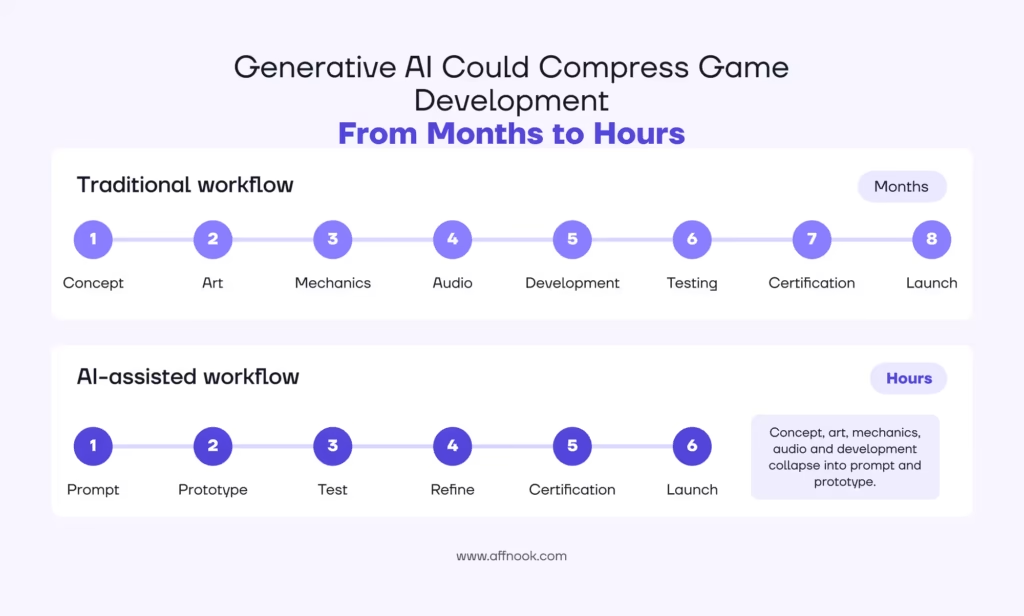
It is early, experimental and largely unregulated territory, and the games it produces still need to pass fairness, RNG certification and jurisdictional approval before real-money launch.
Expect suppliers to treat generative game design as a rapid prototyping layer that sits ahead of certified production pipelines, rather than a replacement for them, through 2027.
AI in Sports Betting: Odds, Trading and Risk
Sports betting has its own distinct AI story, sitting alongside the broader casino-side use cases. Trading desks increasingly rely on machine learning models to price in-play markets in real time, adjusting odds as game states change far faster than a human trader could react manually.
On the integrity side, the International Betting Integrity Association’s cross-operator monitoring network gives AI models a shared data layer to train on when flagging suspicious betting patterns, an important defense against match-fixing and insider-driven betting activity. Market intelligence has also become an AI category of its own.
Analytics platforms such as Blask use computer vision and neural network models to scan tens of thousands of gaming websites daily, tracking brand visibility and market share across jurisdictions with claimed accuracy above 90%, giving operators and affiliates a data-driven view of competitive positioning that used to rely on guesswork.
Responsible Gambling: AI as Both Shield and Risk
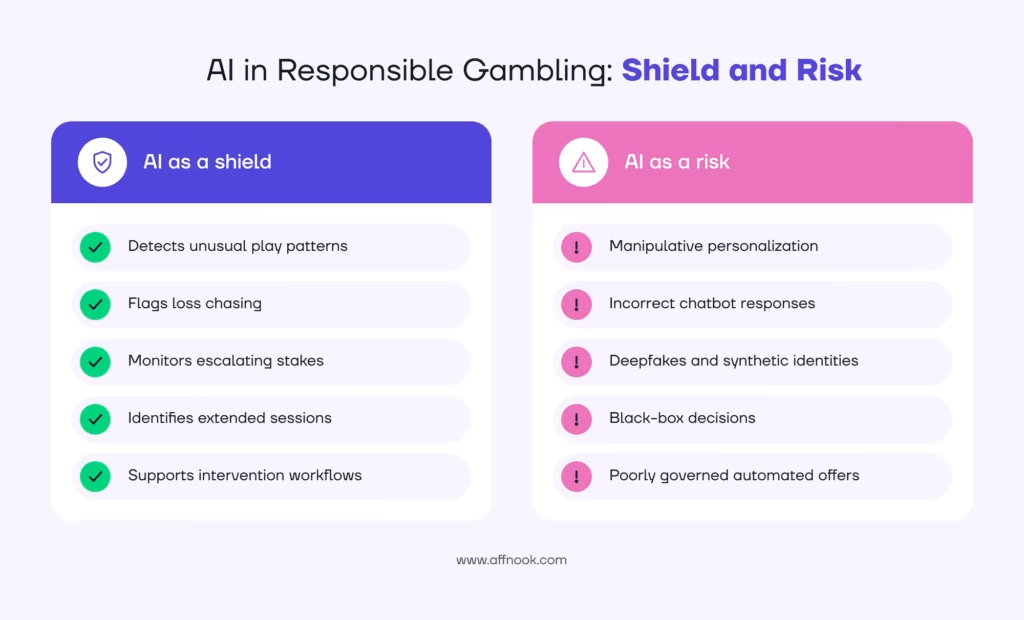
Responsible gambling is where AI adoption and regulatory pressure meet most directly, and it deserves its own analysis because the data cuts both ways.
On the protective side, pattern-detection systems now flag risky-play signals such as stake escalation, loss-chasing or extended session length, and they are becoming the practical mechanism operators use to meet affordability and intervention duties under frameworks like the UK Gambling Commission’s Licence Conditions and Codes of Practice.
The scale of the underlying safer-gambling infrastructure is already substantial: the European Gaming and Betting Association reported that 21 million customers actively used safer-gambling tools across its member markets in a recent year, with millions more deposit and time limits in place, a base that AI-driven monitoring increasingly layers on top of rather than replaces.
On the risk side, the KPMG and UNLV report found that tracked AI-related incidents in gaming have increased sharply since 2023, with deepfakes emerging as the most common category used to promote illegal or inappropriate gambling. Only 70% of gaming companies reported having any form of responsible AI practice in place, and fewer than 5% described those practices as embedded consistently across their organization.
Perhaps most striking: 58% of regulators surveyed said they did not believe the gaming industry could effectively self-regulate its own AI use, while only 13% were aware of operators having internal responsible AI governance frameworks at all.
That disconnect between regulator confidence and operator practice is arguably the single biggest governance gap in the industry today, and it is likely to be the fault line along which 2027’s enforcement actions land.
Regulatory Pressure is Catching Up with Innovation
Technology has outpaced regulation in iGaming before, but the gap is closing fast, and 2026 has been the year AI regulation went from theoretical to operational for the sector.
The EU AI Act and iGaming
Since 2 August 2026, the EU AI Act’s Article 50 transparency obligations have applied directly to gambling operators, suppliers and affiliates with EU market exposure.
More significantly, the Article 5 ban on manipulative AI has been enforceable since February 2025, and it is written in language that maps uncomfortably well onto certain iGaming practices: an AI engine that dynamically adjusts game volatility, odds or bonus triggers in response to a player showing markers of harm is exactly the kind of behavioral exploitation the ban targets. Penalties can reach €35 million or 7% of global annual turnover, whichever is higher.
The Digital Omnibus reform pushed the compliance deadline for standalone high-risk systems under Annex III to 2 December 2027, and for embedded high-risk systems under Annex I to 2 August 2028, giving operators more runway on credit scoring and player risk-rating tools specifically. But that delay does not touch the prohibited-practices ban, which is already live, and it should not be read by compliance teams as an excuse to slow down broader governance work.
UKGC, MGA and Other Frameworks
Outside the EU, the UK Gambling Commission, Malta Gaming Authority and Germany’s GGL each impose their own AI-relevant obligations. None of these bans AI outright, but all three hold the operator accountable for AI-driven outcomes. UKGC rules extend marketing liability to AI-personalized offers, meaning self-excluded and vulnerable players must be systematically excluded from automated offer engines.
MGA’s auditability requirements push operators toward explainable models over black-box scoring, since licensees must be able to demonstrate why a specific bonus, limit or affiliate decision was made. GGL rules constrain how aggressively AI can personalize offers and require geo-targeting systems to respect licensed-territory boundaries precisely.
Jurisdictions including Belgium, Finland, Italy and a growing number of US and Canadian provinces are now actively mandating or encouraging automated monitoring systems for player protection, according to KPMG and UNLV’s research, which also found that AI-related gaming patent filings rose from just 15 grants in 2010 to 100 by 2025, with the United States accounting for over 61% of filings worldwide.
AI is Also Rewriting iGaming SEO and Discovery
There is a second, quieter transformation underway that affects every operator and affiliate marketing team in the vertical: AI is changing how players and B2B buyers find gambling brands in the first place.
Speaking at SiGMA North America 2026, iGaming SEO consultant Nestor Vazquez described the current landscape as harder to maintain than at any point in his career, because operators now have to optimize for traditional search rankings and large language model visibility simultaneously.
Ahrefs’ analysis of 146 million search results found that gambling queries trigger Google’s AI Overviews in only about 1.4% of cases, a lower rate than many other verticals, but when an AI Overview does appear, its effect on organic click-through can be substantial. Separately, Search Engine Land reported that traffic referred from AI platforms grew 527% between January and May 2025 alone.
Gartner has predicted a 25% decline in traditional search volume by 2026 as AI assistants absorb a growing share of queries, and gambling-specific first-touch discovery through AI assistants is rising from a negligible base just a few years ago.
Two practical consequences follow for content and affiliate teams.
First, large language models cite statistics pages, comparison tables and named regulatory sources far more readily than promotional landing pages, which is pushing content strategy toward citable, data-first assets rather than persuasive copy.
Second, an AI answer that recommends three casino brands effectively compresses what used to be a ten-listing search results page, concentrating referral value in the handful of sources that models trust.
The core recommendation echoes this: rather than building content narrowly for AI platforms, operators should strengthen the brand signals that establish who they are, what they offer and where they are licensed to operate, since that consistency is what earns citation in AI-generated answers in the first place.
Why Traditional QA Breaks Down for AI Features
As AI features multiply across the player journey, from conversational assistants to personalized recommendation engines, the way operators test those features has to change too.
According to Applause’s analysis of AI testing in iGaming, conventional scripted test cases simply are not built for non-deterministic systems that can produce different outputs from the same input.
The failure modes are subtler than a crash. A hallucinating chatbot, an irrelevant or irresponsible recommendation, or a poor handoff to human support can each erode player trust and generate compliance exposure well before anyone notices a technical fault. Applause recommends four practical shifts:
- testing under real-world conditions across devices, regions and player personas rather than lab environments,
- using techniques like LLM-as-judge to make non-deterministic outputs defensible to regulators,
- expanding UX testing to cover the full range of conversational paths a player might take, and,
- treating adversarial testing, deliberately trying to break a chatbot with ambiguous or manipulative prompts, as a standard part of every release cycle rather than an afterthought.
What 2027 Looks Like: Where AI in iGaming is Headed
Pulling the data together, a few directional bets look reasonably safe for 2027.
Consolidation around explainability.
As MGA-style auditability requirements and EU AI Act high-risk obligations phase in through late 2027 and 2028, black-box personalization and risk-scoring models will lose ground to explainable alternatives that can produce an audit trail on demand. Operators that have not started this migration by early 2027 will be doing it under regulatory pressure rather than on their own timeline.
AI spend keeps concentrating in fraud and CRM.
With fraud already the single most widely deployed AI function in the industry, verification fraud rates still climbing according to Sumsub’s 2026 data, and AI ranked a top-three business priority by 56% of operators in SOFTSWISS’s Trends Report, expect continued double-digit growth in fraud and retention-focused AI spend specifically, even as overall technology budgets tighten elsewhere.
Generative content has graduated from novelty to pipeline.
Expect certified studios to formally integrate generative prototyping tools like SlotGPT and XGENIA-style platforms into pre-production, using AI to rapidly test themes and mechanics before committing full production budgets, rather than shipping raw AI output directly to players.
Governance gap narrows, unevenly.
Given that only 13% of regulators currently see evidence of internal responsible AI frameworks at licensed operators, expect a wave of formal AI governance mandates, particularly from UKGC and MGA-aligned regulators, by the end of 2027. Operators who build responsible AI policies now, rather than reactively, will have a real compliance advantage.
Discovery keeps fragmenting.
As AI assistants absorb a growing share of search queries, affiliate and content strategy will need to serve both a traditional search algorithm and a language model simultaneously, rewarding operators and affiliates who invest in verifiable, source-backed content over purely promotional copy.
Getting AI Adoption Right: A Practical Checklist for Operators, Brands
For operators, suppliers and affiliates navigating this shift, a few priorities stand out from the data above.
- Treat AI governance as a compliance function, not a marketing feature. Document why every AI-driven bonus, limit or affiliate decision was made, since auditability is quickly becoming a regulatory expectation rather than a nice-to-have.
- Invest in adversarial and real-world testing for every conversational or generative feature before it reaches players, not after a complaint or regulatory inquiry forces the issue.
- Separate fraud detection from static rule-based thresholds. Behavioral and device-level scoring materially reduces false positives and protects legitimate affiliate partners from unfair clawbacks, which is exactly the kind of layered fraud protection a modern iGaming affiliate management platform should provide out of the box.
- Build content around verifiable data, not just promotional messaging, since large language models increasingly reward citable, source-backed pages with visibility that promotional copy no longer earns on its own.
- Watch the EU AI Act’s Article 5 prohibitions closely, even if your high-risk deadline sits in 2027 or 2028, because the manipulative-AI ban is enforceable today and maps directly onto dynamic odds, volatility and bonus-trigger practices common across the industry.