iGaming is a fiercely competitive industry. Battles are being fought for the same player by every operator, sportsbook, casino brand, and affiliate network—though organic traffic will no longer cut it. SEO is slow, affiliate relationships must be nurtured, and retention is only useful after conversion.
This is where PPC marketing for iGaming kicks in.
PPC creates a sense of urgency in a competitive market. This week, you can enter a new GEO, test player intent next week, and prove profitability by the time your competitors even start planning their new week’s campaign. But there is a catch, iGaming PPC isn’t typical paid media.
You have to follow Google certification guidelines, deal with limited advertising on Meta, adhere to local gambling regulations, contend with soaring CPCs, manage bidding competition with affiliate marketers, risk fraud, and navigate a challenging attribution environment.
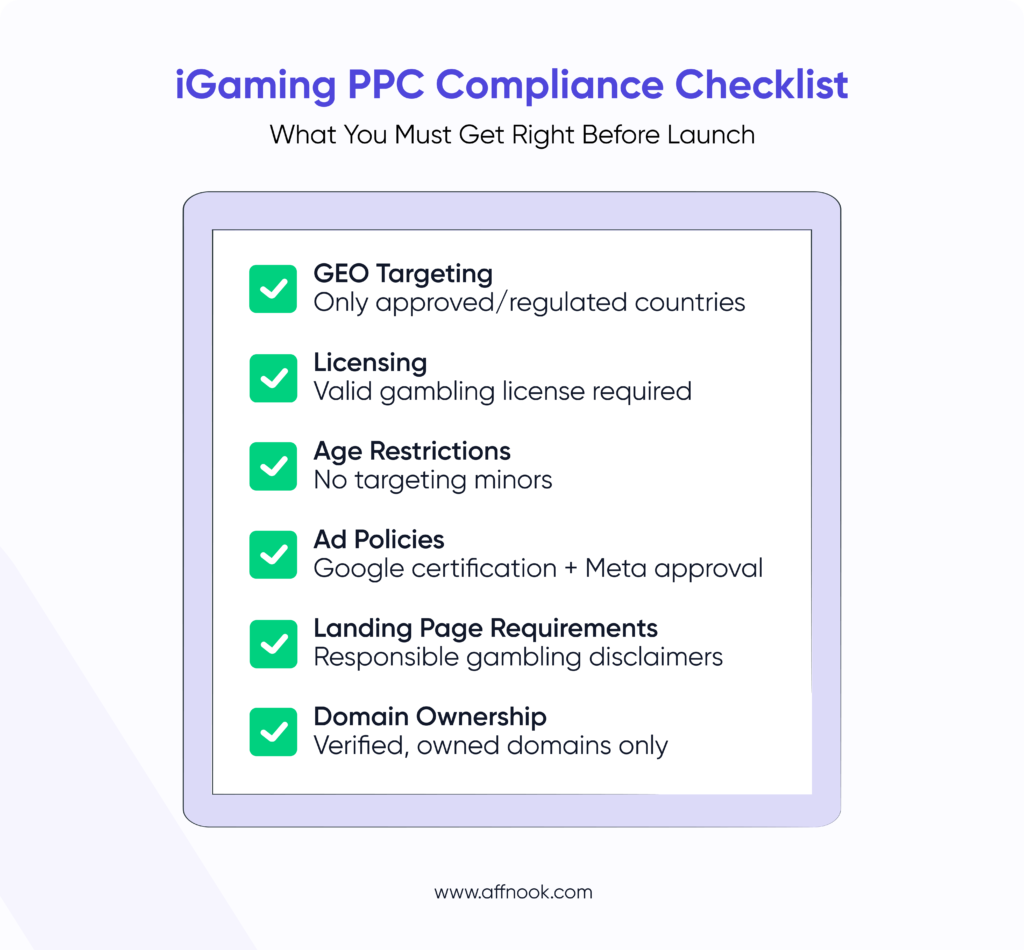
For instance, Google mandates that gambling providers target only white-listed countries, don’t target minors, and ensure their landing pages have responsible gambling information. Advertisers also need to apply for certification in each country.
If approached incorrectly, PPC is a money sinkhole. But when done right, PPC marketing for iGaming can be one of the most cost-efficient traffic sources.
In this article, we’ll detail how to scale paid traffic for profit—in compliance, keywords, funnels, tracking, and loops.
What is PPC Marketing for iGaming?
Pay-per-click (PPC) marketing is a form of paid advertising where website traffic is bought by paying for each click an advert receives. Typically, in iGaming, search engine advertising (Google Ads and Microsoft Ads) and social media advertising (Meta Ads) are paired with native advertising, push, and programmatic display.
PPC offers instant access to high-value users searching for betting sites, casino bonuses, sportsbook promotions, or even payment-specific casinos.
For instance, the user of “best betting sites in the UK” is more likely to deposit than the reader of a sports newsletter.
This is why PPC marketing for iGaming is important.
It enables operators and affiliates to:
- Launch quickly in new GEOs
- Test offers faster
- Control acquisition costs
- Scale profitable campaigns
- Reach players with strong deposit intent
The biggest benefit is control. You have control over bids, targeting, and landing pages, as well as the conversion process—which affiliate-only models don’t.
But unlike the e-commerce PPC industry, iGaming has to follow platform and regulatory restrictions. You’re buying quality, compliant players—not clicks.
And that makes or breaks your business.
Platform Restrictions You Must Understand First
Compliance is step one in campaign planning.
Google supports advertising within a limited number of countries, subject to specific certification guidelines for each. Advertisers need to comply with all required licenses, display responsible gambling messaging on landing pages, and comply with all age restrictions. Google also expects individual applications for each country you target.
Google also introduced requirements for healthier policies and clearer ownership of domains in 2026. Websites on free platforms, subdomains with other parties, or non-owned domains may be ineligible for certification.
This makes PPC marketing for iGaming extremely discipline-driven.
Meta is even stricter.
Gambling is restricted content, needing written consent, license documents, and targeting by age. Even affiliate or aggregator landing pages for gambling sites may be flagged. In industry forums, Meta appears to be particularly harsh on gambling-related businesses, even when the product is B2B infrastructure (such as risk software).
That’s why a lot of operators use pre-landers instead of casino landing pages.
Other channels, like native, push, and direct media buying, are often needed once scale is affected by Google and Meta restrictions.
GEO Compliance Is the Foundation of Scaling
A high-performance campaign in the UK may be banned in Germany. Welcome to the iGaming acquisition.
Each GEO has different regulations regarding licensing, bonuses, age verification, advertising disclosure, and responsible gambling practices. In regulated markets such as the UK, Sweden, and Germany, slip-ups can mean your account gets suspended—not just that your campaign doesn’t perform.
So, PPC marketing for iGaming is both a media and legal strategy.
Before launching an iGaming campaign, it’s important that operators clarify:
- Licensing eligibility
- Platform certification requirements
- Bonus promotion restrictions
- Responsible gambling disclosures
- Payment method legality
- Audience age restrictions
- Local ad copy compliance
For instance, in Australia, the bar on exposure to gambling ads, including issues related to verified adult audiences and advertising time, is gaining momentum. Recent changes show the pace of compliance evolution.
Expanding without legal certainty is not sportsmanship—it is risk. PPC success is all about consent.
High-Intent Keyword Strategy Wins Over High Volume
Clicks do not equal sales.
The tendency in PPC marketing for iGaming is to focus on broad, expensive keywords with “traffic volume”, but they are of poor conversion (deposit) quality.
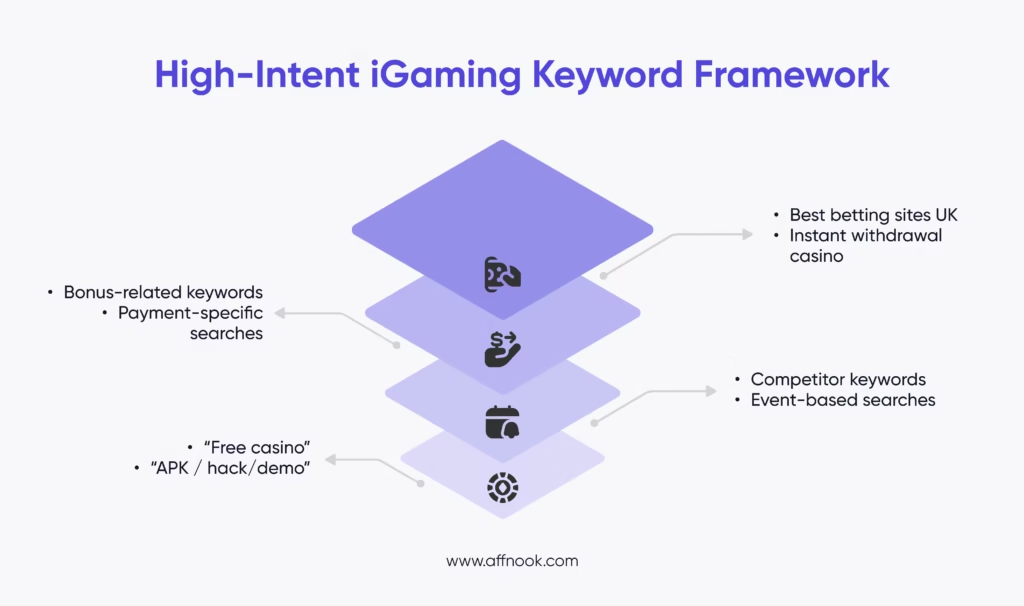
Intent matters more. While you may get massive traffic for keywords like “online casino”, for example, keywords like:
- best betting sites UK
- instant withdrawal casino
- Champions League betting bonus
may give you better conversions due to urgency and an intent to buy.
1. Brand Terms
Protect your own branded traffic.
2. Competitor Terms
Good but risky because of trademark and political issues.
3. Bonus Intent Keywords
Users seeking promotions to sign up are already.
4. Payment-Specific Searches
High intent due to interest in deposits and withdrawals.
5. Event-Based Sports Betting Searches
Particularly robust during sports events and tournaments.
Negative keywords are key. Terms such as “free”, “demo”, “APK”, “hack”, and “jobs” typically waste money rather than attract actual players.
Second, there is a brand bidding conflict. This means operators, affiliates, and sub-affiliates bid against each other on branded keywords, driving up the cost per click (CPC) and channel cannibalisation.
PPC marketing for iGaming becomes expensive cannibalisation if there’s no agreement.
Conversion Funnels Matter More Than CTR
Some operators promote offers directly to “sign-ups“. That usually fails.
These direct-to-offer funnels are often noncompliant, lack trust, and have low conversion quality.
A good PPC marketing for iGaming approach builds on pre-landers.
These include:
- Comparison pages
- Casino review pages
- Bonus explanation pages
- Sports event previews
- Educational betting content
- Payment method guides
Pre-landers prepare the user for registration. And they limit the risk of being rejected on sites such as Meta and Google because they don’t directly promote, but build information.
Once that’s established, quality landing pages are key.
High-converting pages prioritize:
- Mobile-first design
- Fast load speed
- Strong trust indicators
- Clear CTAs
- GEO personalization
- Responsible gaming disclosures
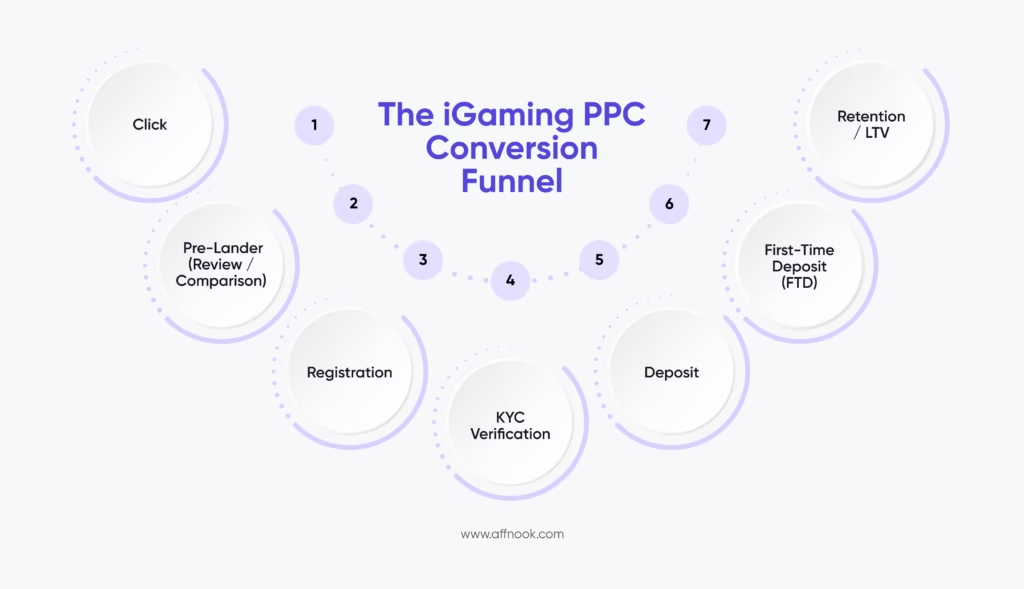
Critical to this is not just a CTR, but further optimization. The real funnel is:
Click → Registration → KYC → Deposit → First-Time Deposit (FTD) → Retention
A cheap click is not a win if it doesn’t pay. The best PPC marketing for iGaming programs focuses on profitability (of first-time deposits) and long-term value—not just registrations.
Tracking Basics: Without Attribution, PPC Becomes Guesswork
Attribution powers the successful iGaming PPC programs. They know clicks and registrations—not what’s profitable.
Without attribution, it is risky to scale.
PPC marketing for iGaming should have at least:
- UTM parameters
- Click IDs
- Postback tracking
- Conversion APIs
- CRM integration
- Deposit and FTD reporting
It can be even more complex when PPC is combined with affiliates, SEO, influencers, and direct promotions.
A player can click on a Google ad, browse an affiliate review, and backtrack via branded search before making a deposit. Who gets credit?
Typically, teams use last-click, creating flawed decision-making. PPC managers blame affiliates. Affiliate managers blame paid search. Finance sees conflicting reports.
This is where having a centralized tracking and attribution layer becomes critical. Platforms like Affnook, for example, are designed specifically for iGaming affiliate ecosystems—helping operators and networks unify PPC and affiliate data, reduce duplication, and get closer to real revenue attribution instead of fragmented channel reporting.
Advertiser discussions of Google certifications also reveal how the lack of documentation and process visibility prompts problems in pre-permitting campaigns. So, measuring multi-channel attribution is one of the hidden issues in iGaming PPC.
Without a single tracking solution, decisions to scale are based on a lie. And partial truth is expensive.
Campaign Structure and Budgeting for Profit
A single campaign for all GEOs, devices, and offers is a recipe for disaster. For scalable PPC marketing for iGaming, segmentation is key.
Campaigns should be separated by:
- GEO
- Brand
- Device
- Match type
- Funnel stage
- Player value segment
This helps manage budgets, reporting, and bidding. So, UK sportsbook traffic shouldn’t compete with US casino traffic.
Budget planning should accommodate testing, too. If the campaign isn’t funded properly, there will be insufficient data to make optimisations.
Track these metrics first:
- CPC
- CPA
- FTD cost
- ROAS
- LTV: CAC ratio
- Deposit-to-registration ratio
Retargeting should be funded separately, as visitors who return are much cheaper to convert.
You don’t want the cheapest. You want to get players at a cost you can profitably recoup.
That is the true measure of successful PPC marketing for iGaming.
Optimization Loops That Protect ROI
PPC is not “set and forget”. It needs optimization cycles to be profitable.
Weekly reviews should include:
- Search term analysis
- Negative keyword expansion
- Device bid adjustments
- GEO performance review
- Creative refreshes
- Fraud detection checks
- Landing page tests
- Player quality validation
Low CPC doesn’t necessarily result in higher performance.
More expensive traffic delivers better VIP retention and increased lifetime value. Here is where advanced PPC marketing for iGaming outperforms simple media buying.
You are not optimizing for leads. You are tuning for good players.
Fraud needs to be monitored. This includes bot traffic, fraudulent account signups, incentivized referrals, and click fraud. On platforms like Meta with account restrictions, advertisers often report account suspension and unpredictable delivery loss.
Lastly, don’t grow too quickly. Validate attribution first. Validate compliance first. Validate deposit quality first.
Then scale.
Because with iGaming games, more money does not equal better results. Better systems do.
Final Thoughts
PPC marketing for iGaming isn’t about buying traffic. It is revenue engineering.
The success of operators and ad networks does not come through spending, but rather tracking, structuring, and compliance, while others chase vanity metrics.
The complexities of Google, Meta, proprietary brand bidding, poor attribution, and fraud make this a very sophisticated paid media space. But this is also a game of opportunity.
When compliance, high-intent targeting, pre-landers, attribution, and retention-optimised KPIs drive campaigns, then PPC is among the fastest ways to scale net profitable players.
The next frontier of iGaming growth is for operators who view paid traffic as a performance system, not advertising.
This is where the money is.
Help Section
What is PPC marketing for iGaming?
PPC marketing for iGaming is a paid advertising strategy where operators and affiliates pay for clicks to acquire players through channels like Google Ads, Microsoft Ads, Meta Ads, native advertising, and push traffic.
Is Google Ads allow for gambling and betting websites?
Yes, but only in approved countries and with proper certification. Operators must comply with local regulations, display responsible gambling messages, and meet Google’s advertising policies.
Which keywords work best for iGaming PPC campaigns?
High-intent keywords such as “best betting sites UK,” “instant withdrawal casino,” and event-specific betting terms typically perform better than broad keywords because they attract users ready to deposit.
Why is attribution important in iGaming PPC?
Attribution helps operators understand which campaigns, keywords, and channels generate registrations, deposits, and first-time depositors (FTDs). Without proper tracking, scaling campaigns becomes risky and inefficient.
How can operators improve ROI from PPC marketing?
Operators can improve ROI by focusing on GEO compliance, using pre-landers, targeting high-intent keywords, implementing accurate tracking, optimizing landing pages, and regularly reviewing campaign performance and player quality.