Did you hear iGaming is a highly profitable industry? Well, it’s you and 389238 others. Cue an increasingly crowded market, where businesses and casino advertisers are vying for space, recognition, and most importantly, users.
To understand this, a look at the numbers is crucial. In 2024, the entire iGaming market was valued at USD 78.66 billion, according to data from Grand View Research.
Everyone wants a piece of the pie. The only way to get ahead is to truly understand the iGaming player, their needs and what everyone else (i.e., your competitors) is up to.
The competition for users also adds towards other acquisition pressures, namely, the high cost of acquiring (and then retaining) a single paying customer. That’s the main reason why CTR and CPA matter so much to casino advertisers.
Here, advertisers see CTR as a proxy for intent, while CPA signals efficiency of the process. Together, they reflect the overall success of any operator or brand’s user acquisition strategy.
What does A/B Testing Mean for Casino Advertisers?
Promoting gambling online in any part of the world comes with a list of restrictions and rules. In the strictest sense, A/B testing them involves navigating this quagmire while running controlled experiments on variables like creatives, landing pages, GEOs, and event-focused optimization flows.
Of course, these limitations extend across a wide range of areas:
- Platform-specific rules, such as online gambling ad rules on Snapchat or specific permissions for gambling ads on Google, are necessary to note. Otherwise, ads may take up significant budgets but still get banned.
- Compliance-related restrictions on what businesses can claim, how promotions must be carried out and what trust indicators need to be included for sure.
- A reliance of third-party affiliate marketing publishers and influencers to promote platforms, bonuses and special events.
For brands that are engaged in app-first marketing, this dynamic is slightly different. Deep in-app actions like deposits, registrations or withdrawals affect both CPA and CTR, and this entire process needs to be mapped, before it can be tested for.
However, if casino advertisers use API-based linkages between marketing tools like MMPs and affiliate marketing software, A/B testing can be used to develop a universal understanding of some basic archetypes influencing both mediums.
A Funnel-based Perspective: CTR vs CPA
Before any testing can commence, it is important to all those running online casino ads to understand that both metrics lie at different ends of the marketing funnel.
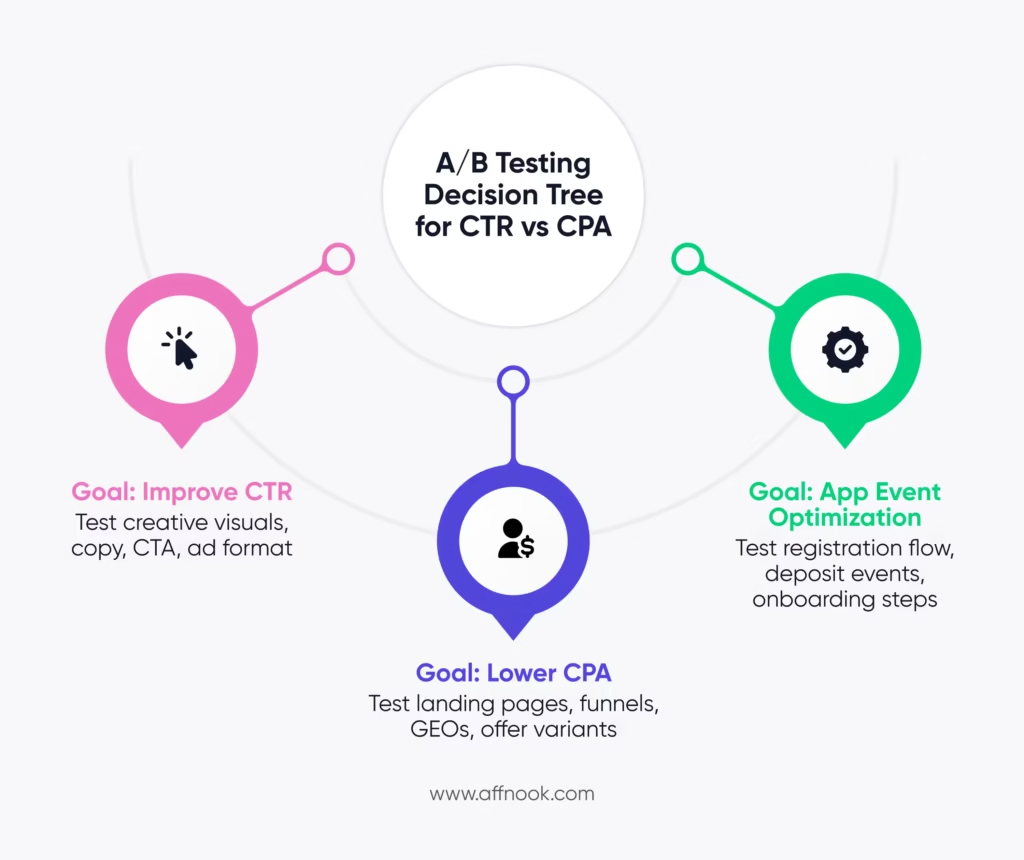
You see, CTR or click-through rate occurs right at the top of the funnel. This TOFU indicator is decisive in determining whether your efforts in building prospects are paying off. Comparatively, the CPA is an indicator of your campaign’s effectiveness in comparison to costs incurred. This is something that gets evaluated after the ‘acquisition’ has been completed.
What To Test: High-Impact Variables Casino Brands Should Prioritize
Creative Elements
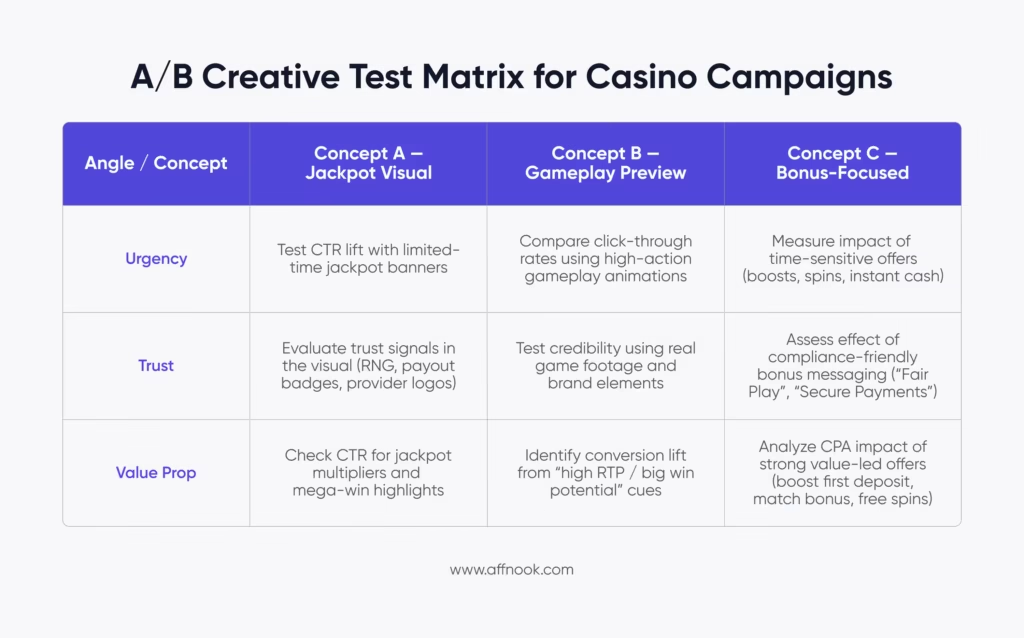
There are a number of variables which can be compared through A/B testing across campaigns.
- Visuals on the ad: Offer-focus vs informational approach
- Call-to-action: Short, simple phrases vs long, complex sentences
- Format: Static creatives vs video-format ads
- Theme: Dark tones vs light tones or plays on visual hierarchy
Landing Pages and User Navigation
You can try a few different page setups and element tests herein.
- Layout: Change the placement of elements across the page, such as trust badges, call-to-action buttons and so on.
- Localization: Test pages on generic lines as well as on hyper-localized lines (language, currency, etc.)
- Experience: Shorten the sign-up flow to FTD pipeline or add several KYC steps from the get-go to see behavioral changes in real-time.
Geos and Traffic Quality Inputs
- Identify traffic fatigue in the most competitive geos. Try a variety of strategies to compare the best performing one.
- Test out the same creatives in multiple geos to see broad commonalities that secure better outcomes.
How Casino Advertisers Should Run Effective A/B Tests
There needs to be a well-drawn SOP that dictates the process of running A/B tests to ensure that outcomes on CTR and CPA can be clearly visualized.
Define a Single Clear Variable
Each test should be run on a single variable. If you test two things at once, you may mistake the result of one of them for the other. This risk is why limiting A/B testing to one item at a time is suggested.
Build Hypotheses Based on Audience Intent
To understand the impact of player variables on CTR and CPA, tests need to be run on diverse intent variables. Think: tier 1 vs tier 3 or short-term players (lottery or slots) vs long-game players (blackjack).
Establish Sample Size and Budget Requirements
Any A/B test needs to be performed scientifically for its results to be valid, and applicable beyond the testing phase. Therefore, casino advertisers need to make a distinction for a testing group and a control group, along with clear delineation of spends that can be used for ads without being wasted.
Run Tests for Sufficient Amounts of Time
If you test for a single day, your outcomes may be influenced by factors that occur on that very day for the test group. Such findings cannot be noted conclusively. Only when identified behavior can be attributed time and again, can be considered valid from an A/B testing perspective.
Analyze and Apply Learnings Across Mediums
What you learn by running funnel-wise gambling ads should not be limited to how ads get run henceforth. The learnings should be applied to marketing on social media, through affiliates and so on.
Summing Up
There is a great deal of evidence across industries that shows A/B testing as a critical tool for marketing success. By trying out variations on communication, presentation and so on, casino advertisers can learn more about player needs, and respond accordingly.
CTR and CPA are two metrics that advertisers struggle with most. By slowly trying out different strategies on the promotional front in iGaming, they can arrive at the most effective marketing strategy.