Poker is a popular card game and is played throughout the world, combining strategy with chance and decision-making. Poker has grown from playing in the casino market to thousands of mobile application users and hundreds worldwide.
Online poker, as part of the online gaming industry, continues to see overall growth globally. By 2025, the global online gambling market is projected to be $88 billion, and $202.8 billion by 2033, with online gambling continuing to grow at around a 11% compound annual growth rate.
As gamers move to the digital form of gaming, poker continues to be one of the most skill-based games, attracting millions of players every day who play in cash games, tournament formats, or through mobile devices.
For this ecosystem to continue to succeed, understanding poker terms and playing poker for both players and affiliates, analysts, and iGaming operators is of utmost importance; operators need to analyze user activity, conversion rates, and friendliness on iGaming operator platforms.
What is poker?
Poker is a family of card games in which players wager based on the ranking of their hand relative to the predetermined betting rounds. Texas Hold’em is the most popular form of poker, followed by Omaha and Seven Card Stud.
In Texas Hold’em, each player has two cards that are not seen by anyone else, but all players share five cards that are exposed to all. The object of playing poker is to win the pot by creating the strongest possible five-card hand, or to force other players to drop out of the game via strategic betting.
Poker is the only game that combines both luck and skill, which is opposite from traditional games of chance because the deal is random at the moment of receiving the cards, but long-term success in poker is based on the analysis of probabilities and the psychology of how players make decisions.
Growth of online poker
Online poker forms a niche but significant segment of the global online gambling industry, which includes casino gaming, sports betting, and poker. Poker contributes a measurable share within the multi-billion-dollar iGaming ecosystem.
The size of the global online poker market is estimated to be $3.86 billion in 2024, and is projected to grow to $6.9 billion by 2030, for a compound annual growth rate (CAGR) of approximately 10.2%.
These numbers really show that poker is well established within the booming iGaming industry.
Why should we care about poker terminology?
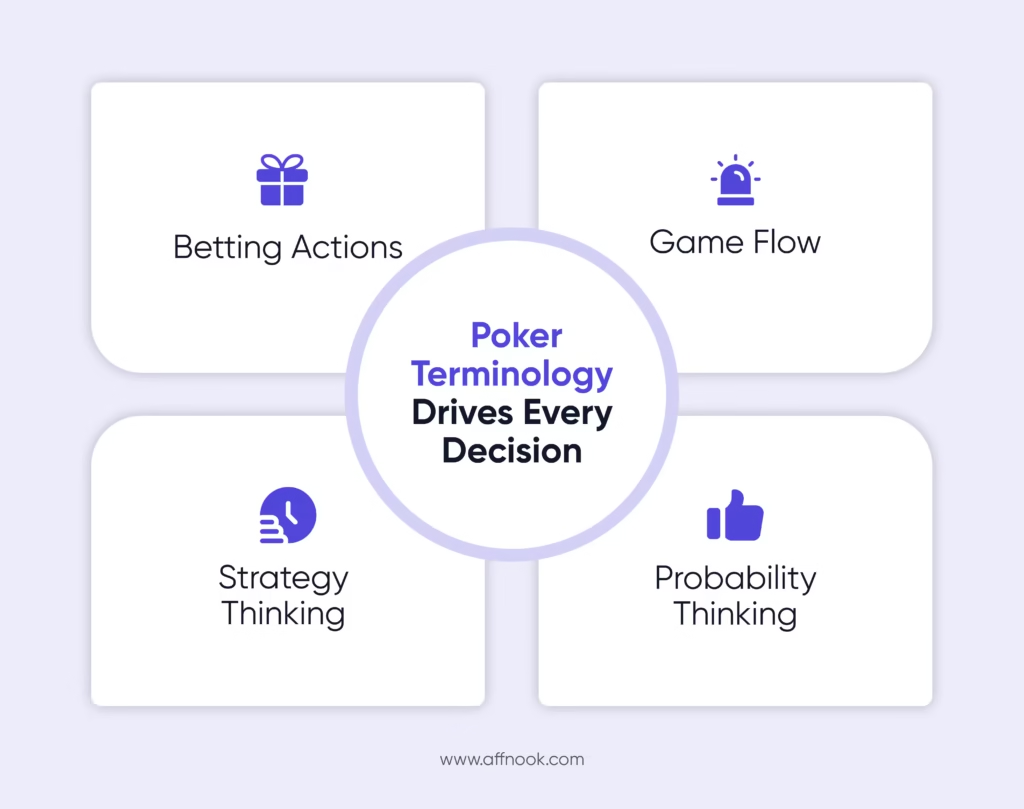
Every poker game has its own set of terms that describe what happens during play. Understanding these terms helps players follow the game and make better decisions.
Understanding poker terminology will allow you, the iGaming player, to understand:
(1) How the game is structured; game flow (flop, turn, river)
(2) The types of actions available to you during betting (raise, fold, call)
(3) The strategy behind the game (bluff, equity, position)
(4) The probability of winning the hand (outs, pot odds)
Poker terminology is important for operators within the iGaming ecosystem when tracking player performance.
By analyzing where players travel from (clicking, registering, depositing), operators can revise their strategies to enable better user acquisition models and retention rates.
This is especially true for iGaming affiliates, as they require accurate traffic quality, conversion rate, and player lifetime value measurements.
Poker hand rankings
Poker hand ranking decides the outcome at a showdown. The strongest hand is awarded the pot.
Poker hand ranking in the standard order of strength from lowest to highest is as follows: royal flush, straight flush, four of a kind, full house, flush, straight, three of a kind, two pair, one pair, and high card.
Understanding these rankings is crucial to making betting decisions based on hand strength compared to the probability of your opponents holding cards that beat you.
Essential poker terms
We have divided some of the important poker terms which you should know about into categories, including betting actions, structure of the game, community cards, and terms related to strategy.
Betting actions
- Fold – To exit the hand and lose the chips you have invested.
- Call – To place a bet equal to the current amount. To match an existing bet.
- Raise – To increase the size of your bet.
- Check – To pass without betting.
- All-In – To wager all of your remaining chips.
Structure of the game
- Blinds: Forced betting (mandatory and risk-free) before cards are dealt.
- Small Blind: This is the first forced bet.
- Big Blind: This is the larger of the two forced bets, setting the minimum baseline for the betting limits at the table.
- Button: The dealer position at the table (a position of strategic advantage).
- Pot: The total number of chips at stake.
Community cards
- Flop: The first three community cards.
- Turn: The fourth community card.
- River: The fifth and final community card.
- Board: The total number of community cards.
Terms related to strategy
- Bluffing: Betting with an intentionally weak hand to induce your opponent(s) to fold by bluffing.
- Equity: A percentage representing the chance of winning the pot.
- Position: The order in which you will play; those who play later have a greater advantage in position than those who play first.
- Outs: A card (or cards) that will improve your hand.
The role of poker in the online gaming industry
Poker is one of the most significant components of the increasing decoupling of the iGaming industry ecosystem through performance across digital channels, such as mobile and desktop.
In some emerging markets, the adoption of mobile gambling platforms has surpassed 70%, transforming player acquisition strategies.
In its contribution to this marketplace, poker generates many attributes that are beneficial to operators and affiliates, including:
- High amounts of player engagement time (long periods of play)
- Repeated opportunities for play
- A high level of participation in tournament-style events
- A robust dataset related to player behavior
All of these attributes allow operators and affiliates to develop effective marketing campaigns, determine the value of a player, and improve their player acquisition methods.
Additionally, for platforms within the iGaming ecosystem to maintain and achieve quality growth across the various channels, platforms leverage accurate iGaming attribution tracking systems to monitor marketing spend versus actual player lifetime deposits and actions.
Conclusion
Poker involves more than distributing cards, but it requires an intricate system consisting of odds, psychology, and the art of decision-making as part of a growing, multi-billion-dollar globalized digital marketplace.
Poker terminology is critical for all people involved in an iGaming ecosystem, from casual enthusiasts to operators monitoring metrics like gross gaming revenue.
Because mobile-first users and online poker continue to grow, poker terminology is becoming more relevant to anyone working in gaming, analytics, or digital marketing.
To better analyze poker player acquisition, increase your affiliate performance, and gain greater visibility into your iGaming campaigns, book a demo to see how we can assist you with data-driven decision-making.
Help Centre
1. Is poker legal or illegal?
The legality of poker depends on the country or region where it is played. Some jurisdictions fully regulate online and live poker, while others restrict or prohibit certain forms of the game.
2. Is poker called gambling?
Yes, poker is generally classified as a form of gambling because players wager money or valuables on the outcome of a game. However, unlike many casino games, poker is widely recognized as a skill-based game where strategy and decision-making significantly influence long-term results.
3. How many poker cards are in a deck?
A standard deck used for poker has 52 cards. It includes 4 suits (hearts, diamonds, clubs, spades) with 13 cards each.
4. Why is poker important in the iGaming industry?
Poker is a major iGaming vertical that attracts millions of players globally. It generates valuable player data, making accurate tracking and performance analysis essential for operators and affiliates.
5. How can affiliate tracking help online poker operators?
Affiliate tracking helps operators measure player acquisitions, attribute conversions to the right marketing partners, monitor campaign performance, and identify high-quality traffic for better ROI.