
In cricket, the game can shift at any time. The current form of a cricket team, pitch conditions, the performance of cricket players, and the prevailing weather conditions can all influence the outcome of the match, but how can one study all these factors and predict the outcome of the match?
The importance of sports prediction models comes into play here.
If we talk about the global sports analytics market, its value is approx. USD 5.7 billion in 2025. And it is expected to reach USD 23.1 billion by 2033.
At the present time, most online betting sites use data analysis, AI, and machine learning to analyze and predict the results of sporting events. They don’t simply rely on the teams’ ranks and past outcomes; instead, they study player stats and scores together with information about weather conditions and other factors that may affect the match’s scores.
Sports prediction models apply this technology in the determination of different probabilities in various matches. Today, these tools are used in different sports such as cricket, football, basketball, and tennis.
But how exactly do sports betting prediction models function? What kind of impact do AI and machine learning technologies have on the ability to make predictions about matches?
What Are Sports Prediction Models?
Sports prediction models analyse past match records, current team performance, and different statistics to estimate the possible results of sporting events.
In simple terms, these models study what happens in previous matches, compare it with the latest match conditions, and help you calculate the possible result.
Let’s understand with an example: before an IPL cricket match, a prediction model may analyse:
- Previous performances of both teams.
- Batting and bowling statistics.
- Individual player form.
- Head-to-head match records.
- Pitch conditions and weather.
- Home-ground advantage.
- Injury updates and player availability.
Once these details are processed and considered, the model comes up with probability-based predictions for the various outcomes of the match.
However, Predictions are not always accurate. For example, a model may show that a team has a 65% chance of winning, but this does not guarantee that the team will win the match.
Why Are Prediction Models Important in Sports Betting?
Prediction models enable betting companies to analyse data from various sources and have an awareness of the elements that impact sporting events.
They can support several activities:
1. Odds Calculation: Calculating the chances of different match results to help set betting odds.
2. Risk Management: Checking possible risks and losses across different sports betting markets.
3. Live Betting: Updating predictions as the match progresses and conditions change.
4. Player Analysis: Looking at individual player performance and their role in the game.
5. Market Monitoring: Keeping track of betting trends and changes in market activity.
These insights help betting operators make better decisions, manage risks, and run their betting operations smoothly.
How Do Sports Prediction Models Work?
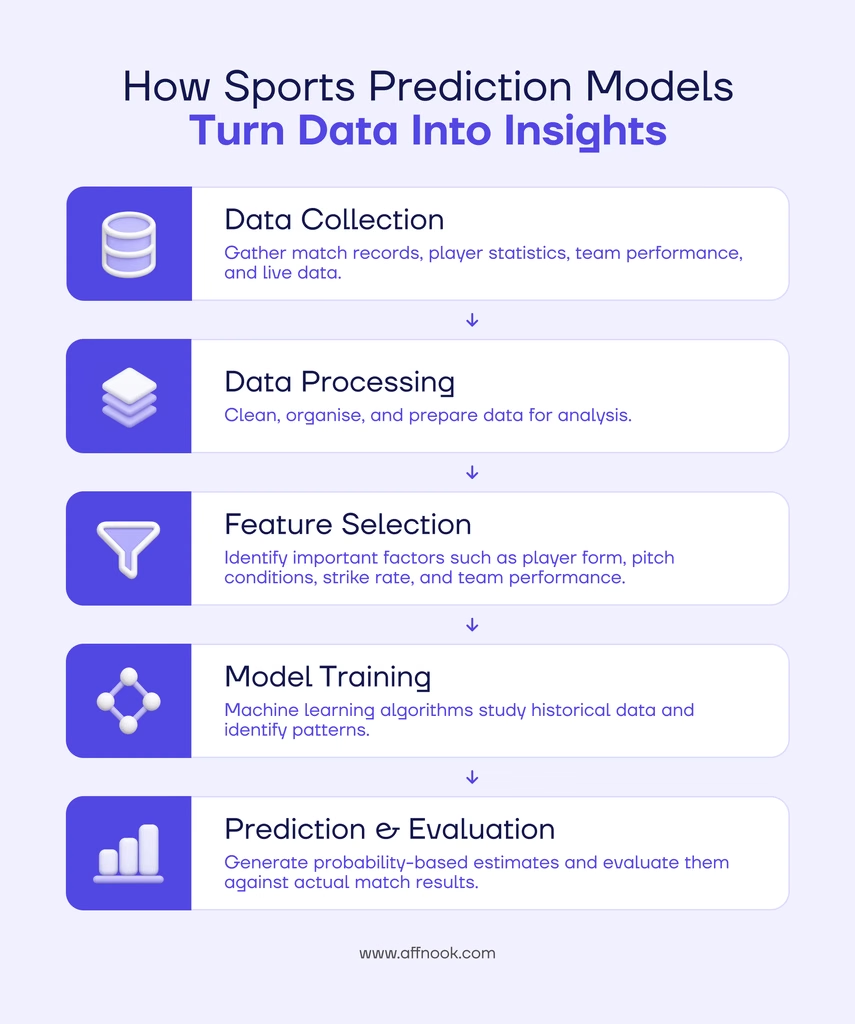
A sports prediction model follows a structured process. It collects information, processes the data, identifies patterns, and generates probability estimates.
Although different models use different techniques, most follow five important stages.
Step 1: Data Collection
The first step is gathering relevant information about the sporting event.
Data can come from historical match records, official sports databases, player statistics, live score feeds, and other verified sources.
For example, a football prediction model may collect:
- Goals scored and conceded.
- Shots on target.
- Possession percentage.
- Passing accuracy.
- Player availability.
- Previous match results.
- Team performance against different opponents.
The quality of this information plays a major role in the reliability of the final prediction.
Step 2: Data Processing
Raw data is not always ready for analysis. It may contain missing values, duplicate records, inconsistent formats, or irrelevant information.
During this stage, the system cleans and organises the collected data.
For example, if a football player has missed several matches because of an injury, the model needs to distinguish between their overall historical performance and their recent playing form.
This helps ensure that the model works with relevant and consistent information.
Step 3: Feature Selection
Not every data point has the same importance.
Feature selection involves identifying the variables that have a meaningful relationship with the outcome being predicted.
For a cricket match, important features may include:
- Batting strike rate.
- Bowling economy.
- Wickets taken.
- Pitch behaviour.
- Average first-innings score.
- Team performance during powerplay overs.
The selected features become the inputs for the prediction model.
Step 4: Model Training and Analysis
Once the data is prepared, machine learning algorithms can study historical patterns and relationships between different variables.
For example, a model may identify that a particular cricket team performs better while chasing targets under specific conditions.
It learns from previous examples and uses those patterns to analyse upcoming matches.
Step 5: Prediction and Evaluation
Finally, the model generates probability estimates or predicted outcomes.
The results are then evaluated against actual match outcomes to understand how well the model performs.
Developers may adjust the model, introduce new variables, or retrain it using updated information.
How Does Data Analytics Help in Sports Prediction?
Data is the foundation of every prediction model. Without relevant and reliable information, even advanced AI systems may generate inaccurate results.
Sports analytics helps convert raw match information into useful performance insights.
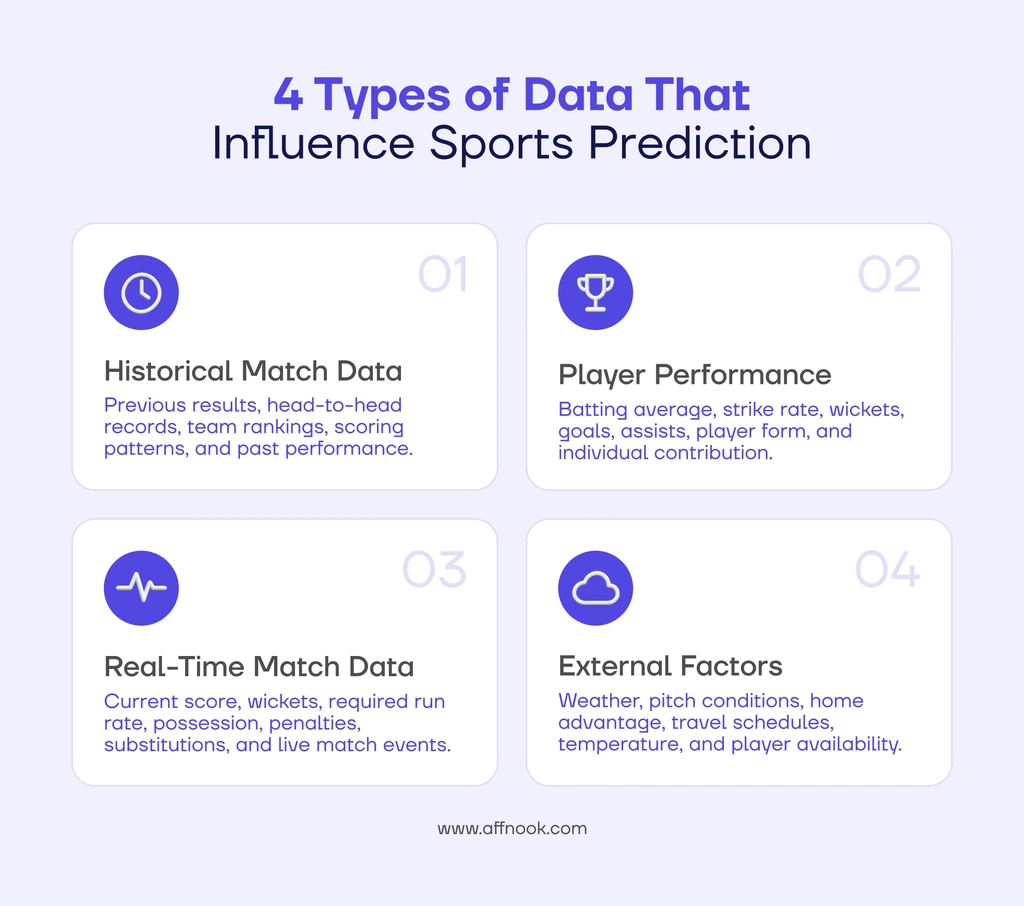
Let’s look at some important types of data used in sports prediction.
1. Past Match Data –
Past match records help prediction models understand how teams and players have performed in previous games.
This data includes match results, scores, team rankings, previous meetings, and performance against different opponents.
For example, a football team may have a good record against teams that follow defensive strategies. A prediction model can use this information when estimating the result of its next match.
However, past results alone cannot predict the outcome. Current player form, team selection, and match conditions also need to be considered.
2. Player Performance Data –
A player’s performance can have a big impact on the team’s result. Prediction models study individual player records to understand their strengths and contribution to the game.
In cricket, this may include batting averages, strike rates, bowling economy, and wickets taken.
In football, models may look at goals, assists, passing accuracy, successful tackles, and expected goals (xG).
3. Real-Time Match Data
Match conditions can change within minutes, so prediction models need updated information to estimate possible outcomes.
In cricket, the current score, wickets remaining, required run rate, and overs left can affect a team’s chances of winning.
Similarly, in football, a red card, penalty, player injury, or substitution can change the direction of a match.
4. External Factors
Player and team performance are not the only things that affect a match. External conditions can also influence how a game unfolds.
Some important factors include:
- Weather conditions
- Pitch and ground conditions
- Temperature and humidity
- Home-ground advantage
- Travel schedules
- Rest time between matches
For example, a cricket pitch that supports spin bowling may give an advantage to teams with better spin bowlers.
How Artificial Intelligence Influences Sports Prediction
Artificial intelligence is helping sports analytics systems process large datasets, identify patterns, and generate insights more efficiently.
Traditional statistical approaches often depend on predefined mathematical relationships. AI-based systems can analyse more complex relationships across multiple data points.
Here are some ways AI influences modern sports prediction.
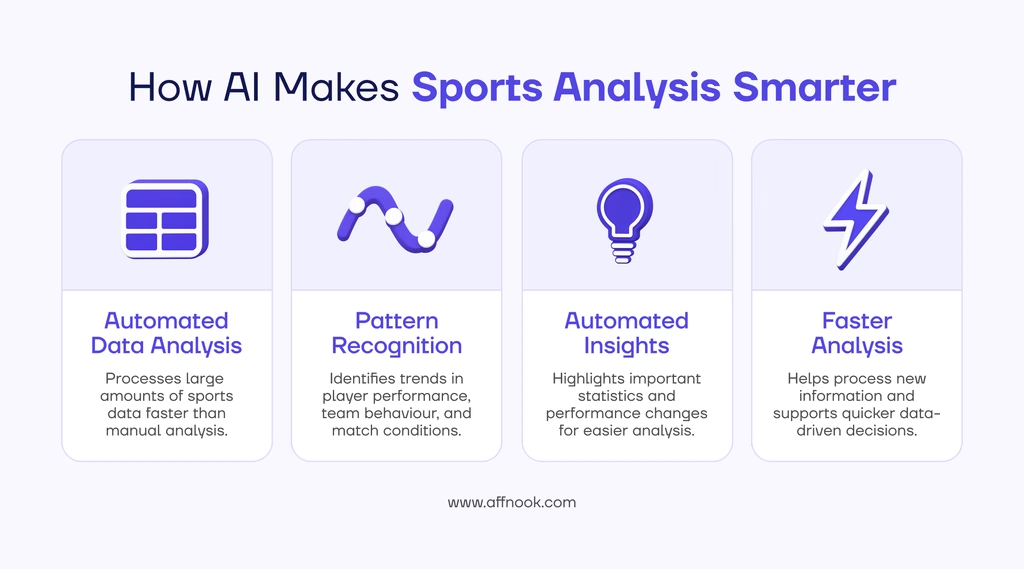
1. Automated Data Analysis
Sports events generate large volumes of information. Manually analysing every statistic can take considerable time.
AI systems can process multiple datasets simultaneously and identify patterns that may be difficult to notice through manual analysis.
For example, an AI system may compare team performance across different stadiums, player combinations, and match conditions to identify trends.
2. Pattern Recognition
Small details in a player’s or team’s performance can sometimes reveal useful patterns.
For example, in cricket, a team may struggle against left-arm fast bowlers or score fewer runs during the middle overs. In football, certain defensive formations may lead to fewer goals being scored.
AI can study these patterns across multiple matches and help analysts understand where teams perform well and where they struggle.
3. Automated Insights
Sports data often contains hundreds of numbers, which can be difficult to understand at a glance.
AI-powered tools can make this information easier to read by highlighting important changes in player form, team performance, and match conditions.
This helps analysts and betting operators focus on the information that matters instead of going through multiple reports.
4. Faster Decision-Making
In sports betting, match conditions and market activity can change quickly. Having access to updated information helps operators respond to these changes without spending too much time on manual analysis.
AI can process new data and support decisions related to betting odds, market conditions, and potential risks.
However, these insights should always be checked before making important decisions. Human review is still necessary to ensure the information is accurate and useful.
Real-World Applications of Sports Prediction Models
Predictive technology is not limited to estimating which team might win a match. It has several applications across sports analytics and betting operations.
Let’s understand some of the major use cases.
1. Match Outcome Prediction
This is one of the most common applications.
Models analyse historical performance, current team form, player availability, and match conditions to estimate the probability of different outcomes.
For example, a football prediction system may estimate the probability of a home win, away win, or draw.
These estimates can support betting market analysis and odds-related decisions.
2. Live Betting Analysis
Live betting requires continuous evaluation because match conditions change throughout an event.
A cricket match can look completely different after a quick sequence of wickets. Similarly, a football match can change following a red card or penalty.
Prediction models can use live match feeds to update probability estimates as new information becomes available.
3 Player Performance Prediction
Sports models can also focus on individual player performance.
For example, a cricket model may estimate a batter’s potential scoring range based on their recent form, opposition bowling attack, and ground conditions.
A basketball model may analyse a player’s scoring, rebounds, assists, and minutes played.
These insights can support player-focused statistical markets.
4 Sports Risk Management
Prediction systems can help operators understand how different betting outcomes may affect their overall exposure.
For example, if a large proportion of betting activity is concentrated on one match outcome, operators may need to review their risk exposure.
Analytical systems can help identify unusual patterns and provide information for further assessment.
5 Performance Comparison
Prediction models can compare different teams, players, and historical performance trends.
These comparisons help analysts understand strengths, weaknesses, and possible competitive advantages.
How Sports Prediction Models Influence Betting Odds
Betting odds represent the price offered for a particular outcome. They are closely connected to the probability assigned to that outcome.
Prediction models can support odds-setting processes by estimating the likelihood of different results.
For example, imagine a football match where a prediction model estimates:
- Team A has a 50% chance of winning.
- Team B has a 30% chance of winning.
- A draw has a 20% chance.
These are hypothetical probabilities used only to explain the concept.
To understand how they relate to decimal odds, the basic formula is:
FairDecimalOdds=1Probability
Using the example above:
| Outcome | Estimated probability | Fair decimal odds |
| Team A wins | 50% | 2.00 |
| Team B wins | 30% | 3.33 |
| Draw | 20% | 5.00 |
These are theoretical fair odds before adding an operator’s margin.
In actual betting markets, odds may also be influenced by market demand, betting activity, operator risk exposure, and external information.
Sports Prediction Models Across Different Sports
Every sport has its own rules, scoring system, and performance indicators. Therefore, prediction models need to be designed according to the sport being analysed.
Let’s look at how these technologies are used across popular sports.
Cricket
Cricket offers several measurable performance indicators, making it suitable for statistical analysis.
Prediction models may consider:
- Batting averages and strike rates.
- Bowling economy and wickets.
- Powerplay performance.
- Pitch conditions.
- Toss results.
- Historical team performance.
- Required run rate during live matches.
For example, during a T20 match, a model may analyse the current score, wickets remaining, overs left, and the batting team’s scoring rate to estimate the probability of winning.
Football
Football prediction models analyse team performance, player statistics, and match conditions.
Common indicators include:
- Expected goals (xG).
- Expected assists (xA).
- Shots on target.
- Possession percentage.
- Defensive performance.
- Player injuries.
- Home and away records.
These indicators can help estimate the likelihood of a win, loss, draw, or other match events.
Basketball
Basketball generates continuous scoring and player performance data.
Prediction models may examine:
- Points per game.
- Rebounds and assists.
- Shooting accuracy.
- Turnovers.
- Player efficiency.
- Team pace.
- Defensive ratings.
These metrics can help estimate team performance and individual player contributions.
Tennis
Tennis prediction models focus on individual player performance and match-specific conditions.
Important factors may include:
- First-serve percentage.
- Break points won.
- Aces and double faults.
- Head-to-head records.
- Surface performance.
- Recent player form.
For example, a player who performs consistently on clay courts may have a different probability of winning against the same opponent on grass.
What Sports Betting Operators Should Know About Prediction Technology
For sports betting operators, understanding prediction technology is not just about knowing which team might win. It is also about understanding how data-driven systems can support better platform operations.
Here are a few important considerations:
Invest in Reliable Data Sources
Accurate and timely data is the foundation of effective predictive analysis. Operators should use reliable data providers and ensure that match information is updated consistently.
Choose Suitable Analytical Models
Different sports and betting markets require different prediction techniques. A model designed for football match outcomes may not work equally well for cricket or tennis.
Operators should select models according to their business requirements and available data.
Monitor Model Performance
Prediction models should be evaluated regularly against actual results. This helps identify performance gaps, changing patterns, and areas that need improvement.
Maintain Transparent Operations
Operators should avoid presenting probability estimates as guaranteed outcomes. Clear communication helps maintain transparency and responsible platform practices.
Strengthen Risk Controls
Analytical insights should work alongside fraud monitoring, exposure management, and responsible gambling measures.
Follow Regulatory Requirements
Ensure that data usage, betting operations, and customer-facing practices comply with applicable laws and regulations in the markets where the platform operates.
Operators should also understand that prediction technology is only one part of a larger betting ecosystem. Platform infrastructure, accurate tracking, payment processes, affiliate management, and reporting are equally important for running efficient operations.
Conclusion
Sports betting has moved beyond traditional match analysis. Data analytics, artificial intelligence, and machine learning are helping operators understand sporting events through deeper performance insights and probability-based estimates.
From analysing cricket batting statistics to evaluating football expected goals, predictive systems can process different types of information and identify patterns that support better-informed decisions.
However, technology does not remove uncertainty from sports. Unexpected match events, player performance, data quality, and changing conditions will always influence results.
The real value of these technologies lies in how effectively operators collect, analyse, and use information.
For modern betting businesses, building a data-driven ecosystem is becoming an important part of staying competitive.
Help Section
Sports prediction models are analytical systems that use historical match data, player statistics, team performance, and other relevant factors to estimate the probability of different sporting outcomes.
AI helps analyse large volumes of sports data, identify performance patterns, evaluate match conditions, and generate probability-based insights. Betting operators can use these insights to support odds analysis, live betting, and risk management.
Commonly used algorithms include logistic regression, decision trees, Random Forest, gradient boosting, and neural networks. The choice depends on the sport, available data, and prediction objective.
Machine learning models can analyse real-time match information and update outcome probabilities as the game progresses. However, they cannot guarantee the final result because unexpected events can change match conditions.
No. AI-based predictions are estimates, not guaranteed results. Their accuracy depends on data quality, model training, selected variables, and changing match conditions. Even advanced models can make incorrect predictions.