The American fantasy sports market in 2015 was indeed a “DFS gold rush,” as many insiders still call it. Daily Fantasy Sports (DFS) operators had a ton of ads to sell during television broadcasts. Customer acquisition costs escalated sharply.
Those who, previously, didn’t place a normal sports bet, took to taking part in paid fantasy games now worth thousands—sometimes, millions—in winnings.
And regulators noticed.
In just one day, a question that had been simmering in legal circles sprang to a global conversation and wide-ranging debates.
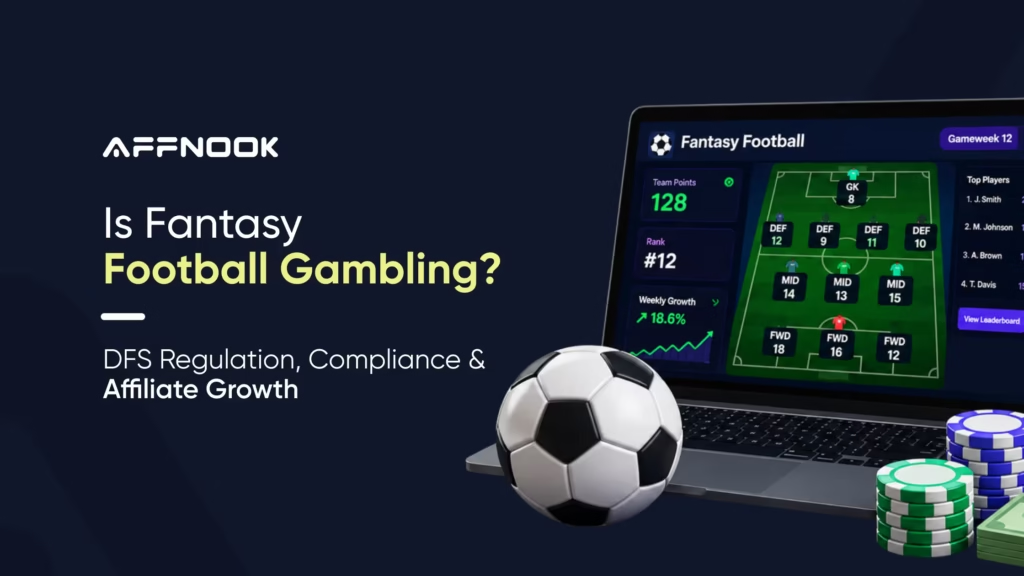
Is fantasy football gambling?
After over a decade, the answer is still very murky.
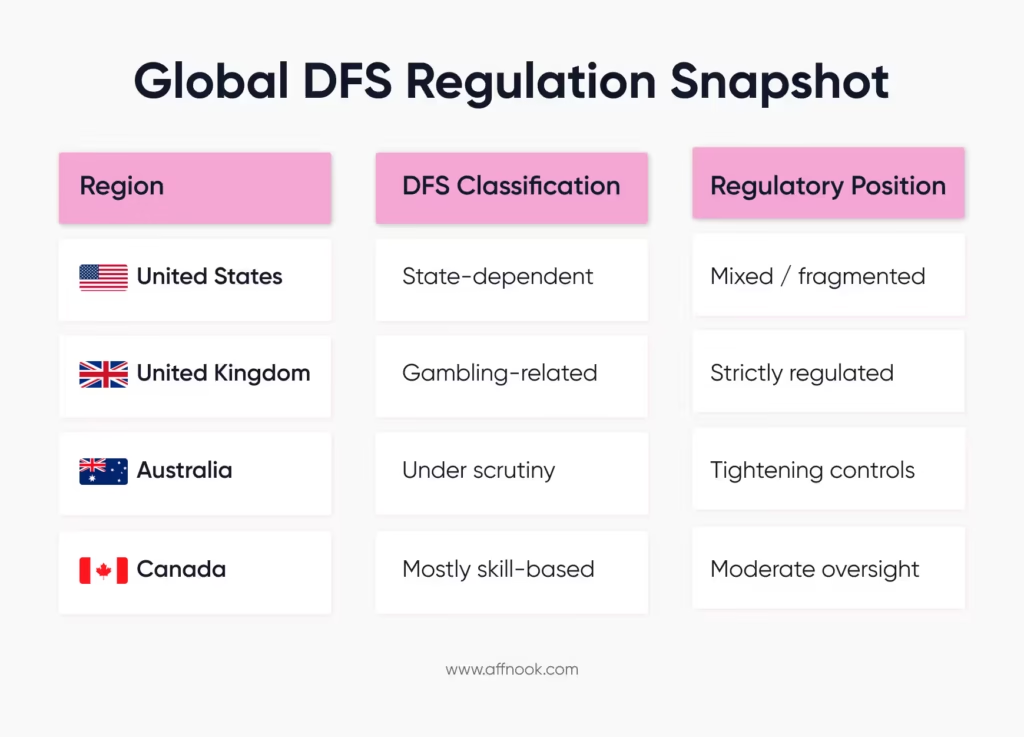
Fantasy football is defined as a skill-based game in some jurisdictions. In others, it falls under the regulatory umbrella of gambling if money is exchanged. In some jurisdictions in the USA, you can play DFS with authorization, but in others, the legality of such a game remains uncertain. Many fantasy products are legally regulated and promoted as games of chance in the UK, and Australian advertising, content, and consumer protection regulations surrounding all interactive gaming products continue to be tightened.
This uncertainty makes it one of the more appealing (yet also potentially legally perilous) options for iGaming brands and affiliate networks today.
Fantasy sports is now firmly in the middle of sports media, online gaming, entertainment, betting, and performance analysis. It is ideal for capturing the most engaged users, it drives repeat engagement, and it is becoming an acquisition channel for sportsbooks.
However, fantasy sport viewers don’t look like traditional sportsbook customers. They read content differently and monetize differently.
It’s a significant factor for those in the iGaming business who rely on operators, affiliate managers, media buyers, and acquisition platforms to make their content stand out in the high-stakes world of today.
The Fantasy Sports & Gaming Association (FSGA) estimates that more than 62 million Americans and Canadians play fantasy sports every year. In the global market, mobile games adoption, sports streaming, and the convergence of DFS and sports betting are expected to drive the market to over $50 billion by the end of the decade.
In parallel, legislators around the globe are keeping a close eye on fantasy game models that are becoming more and more similar to games of chance.
This offers affiliate marketers upside and exposure.
Some markets have less advertising friction than sportsbooks, which can help fantasy sports attract users at the top of the funnel. But, inconsistent regulation can let affiliates unnecessarily put themselves at risk by incorrectly positioning themselves, geo-targeting errors, or overly aggressive promotional messages.
That’s where industry is looking next:
Fantasy sports isn’t just a fan engagement product. It has become an acquisition vertical that is being regulated as such in the wider iGaming ecosystem.
For operators and affiliate networks who are savvy about the legal, behavioral, and monetary quirks of fantasy audiences, though, the opportunity is immense.
What Exactly Is Fantasy Football?
Fantasy football lets the user create a virtual team composed of actual athletes who can score actual statistics based on real events.
Standard fantasy leagues go for a whole season. Players write the rest of the class, make transfers, and play league or friend matches for ranking and prizes.
Daily Fantasy Sports did it all differently.
DFS products focused on quick games over 24 hours or a week. Rather than a daily, ongoing membership, players were permitted to participate in several real-money tournaments each day in a different sport.
This made fantasy sports a viable gaming industry.
DFS contests usually include:
- Salary-cap tournaments
- Head-to-head contests
- Guaranteed prize pool (GPP) tournaments
- Pick’em fantasy formats
- Double-up contests
Rake fees or platform commissions on entry pools are the main income streams of operators. It’s the reason the regulations are still considering whether fantasy football is gambling.
The legal difference is frequently summed up by the question: does skill win out over randomness?
There is a strong push from DFS operators that this game is designed to test analytical skills, statistical modelling, player research, and the line up optimization.
And there is evidence supporting that argument.
A few research projects that have investigated the performance of DFS users over extended time periods established that expert users often have reliable long-term superiority. This consistency has been cited a number of times in legal settings for the “game of skill” classification.
But critics say that luck still ultimately rules, and much of that. Injuries, bad weather, referee calls, coach changes, and anything else that happens during a match can change the course of a game, no matter how well prepared you are.
The issue for the regulators is clear: Fantasy football is a combination of skill and uncertainty, and, if you’re not careful, you can’t really fit it into the categories of regular gambling.
The Legal Debate: Is Fantasy Football Gambling?
To answer the question “Is fantasy football gambling?,” regulators usually evaluate three legal elements:
- Consideration (staking money)
- Chance
- Prize
There is no doubt that prizes and cash entry are definitely part of fantasy sports in many forms. The actual test case has to do with the importance of chance versus skill.
DFS operators argue that fantasy sports is a very different game from sports betting, since users do not bet on the outcome of a single event. Rather, winning is contingent on research, player selection tactics, salary management, and analytical play in the long run.
The argument has played a major part in the development of companies such as FanDuel, DraftKings, and others that started as skill-based entertainment sites instead of gaming operators.
However, many regulators and critics now draw parallels between the behaviour of DFS and betting products.
Many of these high-frequency patterns of participation, quick bankroll rotation, cash payouts, and emotional risk-taking are almost identical to sportsbook activity.
Creating products for pick’em fantasy has complicated things even more. Some DFS products today are nearly the same as player prop betting sites—they enable people to make predictions about player performance in exchange for cash payouts. Regulators globally are increasingly taking steps to implement more stringent regulations.
For operators and affiliates, this gray area poses strategic opportunities and compliance with new obligations.
Fantasy Football Laws in the United States
There’s no more complicated fantasy sports market than the United States.
The Unlawful Internet Gambling Enforcement Act (UIGEA) of 2006 has been the driving force in the modern DFS industry. UIGEA banned illegal online gambling bets but provided a safe harbor for “legitimate” fantasy sports games.
Contests were typically required to:
- Assign and give awards in advance.
- Acknowledge participant knowledge and ability.
- Never results that are dependent on just one player or event.
This exemption paved the way for the dizzying growth rate of the DFS operators.
DraftKings and FanDuel have spent hundreds of millions of dollars on these advertisements and user acquisition campaigns from 2014 through 2018. Fantasy sports had taken off into a mainstream sport virtually overnight.
However, UIGEA didn’t make it legal to play DFS on the federal level. Rather, it left room for individual state interpretation of the law.
The answer to the “Is fantasy football gambling?” question is different in each US state these days.
A few states have regulations and licensing specific to DFS operators. Others allow for fantasy games within a reinterpretation of skills. A few have continued to limit or even prohibit DFS altogether.
This breaks up the market and poses operational challenges for the operators and affiliates.
Now, geo-targeting is necessary. Promotional messages, advertising campaigns, and user acquisition funnels may need to be customized for specific state laws. A compliant campaign in New Jersey can generate liability in another jurisdiction.
There are now several US states that are mandating that DFS operators implement:
- Age verification systems
- Responsible gaming protocols
- Contest transparency standards
- Self-exclusion mechanisms
- Consumer protection safeguards
This regulatory regime is gradually expanding to include affiliates.
The attention of the regulators is not only on the operator. There is increasing pressure on acquisition partners, media affiliates, influencers, and advertising intermediaries regarding promotional compliance.
This is particularly critical because fantasy sports is being used as an acquisition funnel for sportsbooks. DFS ecosystems are now leveraged by the most significant operators as a way to give users access to a wider range of betting options, casino offers, and live betting experiences.
Fantasy sports players are commercial high rollers.
The American Gaming Association (AGA) reported that fantasy fans are much more likely to participate in other sports betting products than non-fantasy sports fans.
That puts DFS in the spotlight as one of the most strategically important top-of-funnel acquisition channels in today’s iGaming industry and gaming pipeline.
The UK’s Approach to Fantasy Sports
The United Kingdom has a centralized regulatory structure, as opposed to the fragmented market in the United States.
Gambling regulation is governed by the UK Gambling Commission, and many paid fantasy contests are covered under the gambling provisions, depending on their rules.
This provides more legal clarity—yet more compliance requirements.
In the UK, fantasy operators might have to adhere to:
- Licensing requirements
- Responsible gambling standards
- Anti-money laundering rules
- Advertising restrictions
- Consumer protection regulations
There has been a large focus on the UK market when it comes to promotional transparency.
Regulators increasingly scrutinize:
- “Risk-free” promotional language
- Misleading earning claims
- Influencer partnerships
- Vulnerable audience targeting
- Youth exposure to gambling advertising
The UK is an established but regulated market for affiliate marketers.
Not all products that are categorized as fantasy are harmless sports entertainment when real money is involved.
But as the fantasy venues roll out more features similar to sportsbooks, their influence and regulation are likely to grow more powerful.
Australia’s Tightening Fantasy Sports Environment
Australia has a complex history when asked, “Is fantasy football gambling?”
In recent years, gambling advertising, inducements, and online gambling have been regulated more effectively, whereas fantasy contests operated in a grey area.
Australian regulators have a keen interest in:
- Consumer protection
- Sports broadcast advertising restrictions
- Youth gambling exposure
- Promotional inducements
- Digital gambling marketing practices
Distinguishing between wagering products and skill-based entertainment is crucial for fantasy sports operators conducting paid fantasy games.
This is somewhat difficult if you are using cross-border marketing for your affiliates.
Some of the promotional strategies that are standard in sportsbook affiliate marketing can be considered an infringement of advertising regulations in Australia through the promotion of fantasy sports.
Payment processing, licensing, and enforcement issues pose additional challenges for offshore players.
This is part of a wider global phenomenon: Regulators are not as inclined to avoid general inquiries into fantasy gambling because they market it as a “game of skill.”
Why Fantasy Sports Is a Goldmine for Affiliates
Despite regulatory complexity, fantasy sports remains one of the most commercially attractive verticals in affiliate marketing.
The answer is in the actions of the user.
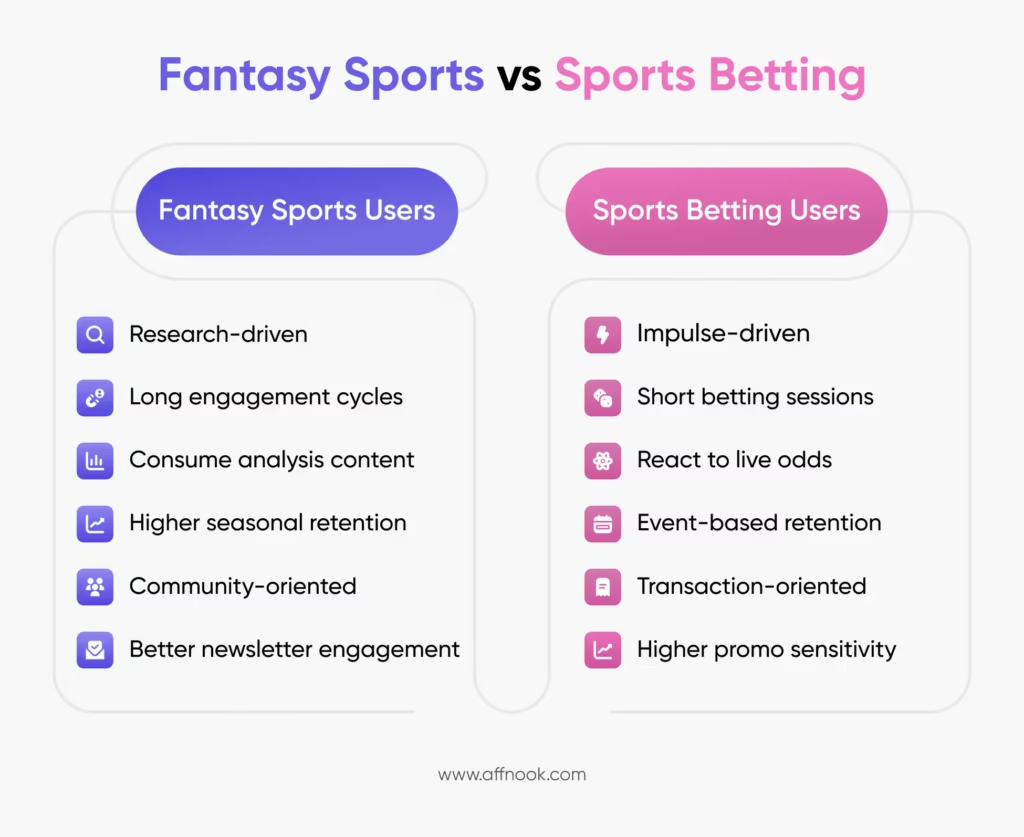
Fantasy sports viewers really are in a completely different class than those who traditionally bet on sports.
Sportsbook acquisition is frequently dependent on impulsive behavior, live betting excitement, and promotional offers. Fantasy users, on the other hand, are very research-oriented.
They actively consume:
- Injury reports
- Statistical breakdowns
- Player projections
- Match previews
- Community discussions
- Data analysis tools
- Lineup optimization content
This gives many more engagement loops.
For a fantasy football user, dealing with content ecosystems can take hours before they can even get into a game. For those affiliates, this allows for monetizing opportunities beyond the standard CPA conversions.
An ecosystem for fantasy affiliate programs might feature:
- SEO-driven player analysis portals
- Subscription newsletters
- Discord communities
- Premium projection tools
- YouTube strategy channels
- Interactive draft tools
This is what makes fantasy traffic more valuable as a long-term option than traditional sportsbook traffic. Unlike gambling, fantasy users bet throughout sports seasons, fostering a more sustainable level of engagement for them.
Advertising accessibility is another significant one.
Some jurisdictions treat fantasy games with less stigma and without the same restrictions on advertising, making it possible for fantasy providers to have more inventory opportunities than sportsbooks.
That can be monetarily gigantic when performed in a legal buy-in agreement.
The Compliance Risks Affiliates Often Ignore
A popular assumption in the fantasy affiliate marketing world is that DFS does not fall under the guidelines of gambling compliance standards.
This belief is dangerous in today’s times.
Regulators are toughening their oversight beyond the operators and are looking at the acquisition ecosystem, comprising affiliates, influencers, publishers, and media buyers.
There are a number of risks that stand out.
Misleading “Skill-Based Income” Messaging
A lot of fantasy campaigns actively promote contests as quick money-making prospects.
This could lead to regulatory risks.
Regulators may object to fantasy sports even if some skill is involved:
- Unrealistic earning claims
- Financial risk minimization
- Misleading success probabilities
- Absence of responsible gaming messaging
Mitigation metrics focus more on the consumer’s perspective than just operator definitions of advertising.
Geo-Targeting Problems
One political campaign might definitely be permitted under state law, and another would not.
For international traffic, affiliates need to have a strong geo-targeting strategy and content controls for each jurisdiction.
This is particularly important in the U.S., where there is significant interstate variation in respect to what is permitted under the DFS found at the State level.
Cross-Promotion Risks
Fantasy sports is more and more turning into a gateway for sportsbooks.
Despite being commercially acceptable, this will lead to further regulatory questioning regarding cross-sell.
Affiliates need to know clearly the difference between fantasy promotion and sportsbook advertising.
Responsible Gaming Expectations
Fantasy sports have become a part of a more comprehensive conversation on safer gambling.
The pressure is expected to increase around:
- Age restrictions
- Deposit transparency
- Self-exclusion systems
- Player protection tools
- Safer gaming messaging
This is the clear end of the time when fantasy sports were something forgiven as an illegal loophole.
Why Fantasy Sports Requires Different Commission Structures
A fact that’s often overlooked in the iGaming affiliate marketing world is that fantasy players do not monetize as much as sportsbook users.
This implies that the old business models, which rely on CPA contracts, tend to be less profitable in DFS.
Sportsbook affiliates generally target quick first-time deposits. Fantasy sports is a different matter.
It’s not uncommon to see users dig through thousands of words of content, putting in weeks of research on contests and communities before converting.
There are better retention characteristics as well.
Fantasy football users can play for an entire NFL season, providing a repeat revenue stream as opposed to peaks in wagers and brief plays.
Consequently, revenue-share and hybrid commission models are frequently more successful than straight CPA.
The best affiliate structures for DFS consist of:
- Revenue sharing agreements
- Hybrid CPA and revenue sharing deals
- Seasonal retention incentives
- Engagement-based bonuses
- Community performance metrics
The fantasy affiliate marketing model is also more like that of media or SaaS than traditional betting acquisition systems.
The operators now prefer affiliates who can provide:
- First-party audience ownership
- Email databases
- Subscription ecosystems
- Community engagement
- Premium sports content
- Data-driven user retention
That is why, over time, the roles of the authority-based fantasy are more effective on paper than any aggressive acquisition arbitrage game.
Fantasy sports winners aren’t simply the ones who’ve bought traffic.
The Future of Fantasy Football and iGaming Affiliate Marketing
It’s no longer a fantasy that sports and sports betting are entirely separate entities.
However, modern operators will be blending:
- DFS contests
- Sportsbook wagering
- Player props
- Pick’em products
- Micro-betting
- Casino integrations
This convergence will not fail to lead to tougher regulations globally.
Policymakers are already increasing scrutiny around:
- Gambling advertising
- Influencer promotions
- AI-driven personalization
- Consumer protection
- Youth targeting
- Data privacy
These developments won’t leave fantasy sports affiliates in a vacuum.
However, the opportunity will not go away.
The fantasy market remains ongoing to expand, especially among the younger sports fans who are on the go and looking for something other than watching a sport.
Conclusion
Ultimately, the answer to “is fantasy football gambling?” depends on jurisdiction, contest structure, and how regulators interpret the balance between skill and chance.
The new successful affiliates of the future will be interested in:
- Niche fantasy communities
- Data-driven personalization
- Women-focused fantasy ecosystems
- AI-powered sports analysis tools
- Subscription-based engagement models
Not everyone with the most traffic will necessarily be the biggest winner.
They will be the operators/affiliates who can find scale and compliance maturity, audience trust, and a long-term engagement strategy.
In this era of the iGaming market, sustainable growth is not the exploitation of grey areas.
It stems from a better comprehension than others.
Help Centre
1. Is fantasy football considered gambling in regulated online gaming markets?
Depending on jurisdiction, game design, and the inclusion of real money wagering, entry fees and chance desired results in game play, fantasy football can be considered a form of gambling.
2. Why do regulators treat Daily Fantasy Sports differently from traditional sports betting?
Often times, outcomes depend on more than just luck and event betting, and may depend more on the skills of the players, use of statistics, and strategic skill, which is why it is often classified with its own section in regulators.
3. Can iGaming affiliates legally promote fantasy football platforms internationally?
While affiliates can promote fantasy sports globally, they must adhere to responsible gaming, advertising standards, geo-targeting controls, and local gambling laws in each market.
4. Are fantasy sports users more valuable than sportsbook users for affiliate marketing?
Fantasy sports players often exhibit longer retention times, higher engagement rates, and greater content interaction, making them a valuable customer base for long-term affiliate marketing strategies.
5. What compliance risks do affiliate networks face when promoting DFS platforms?
Misleading “skill game” messaging, cross-border advertising violations, improper geo-targeting, and the lack of responsible gambling disclosures can pose risks to affiliate networks.