What is a Sub-Affiliate?
A sub-affiliate can be defined as someone that the principal affiliate brings in to assist in driving traffic to that principal affiliate. Since the principal affiliate is the one who brings him in, it’s his duty to manage the relationship with them, while they make a certain percentage of their revenue.
Where the Operator Fits
The operator maintains a connection exclusively with the principal affiliate. As per the platform rules, the second-level affiliate does not exist for the operator. In simple words, it’s like hiring someone to do part of your work, here the principal affiliate is outsourcing the services.
Hence, the operator is aware of the traffic and conversions attributed to the principal affiliate, but does not know from where this traffic is actually coming.
Second-tier Affiliate vs. Affiliate Network
These have similar interaction types, although their purpose differs:
- Sub-affiliate: operates beneath a single important affiliate who is in charge of the interaction and distribution of commission
- Affiliate network: brings together several affiliates under one umbrella, where standard contracts and control are applied
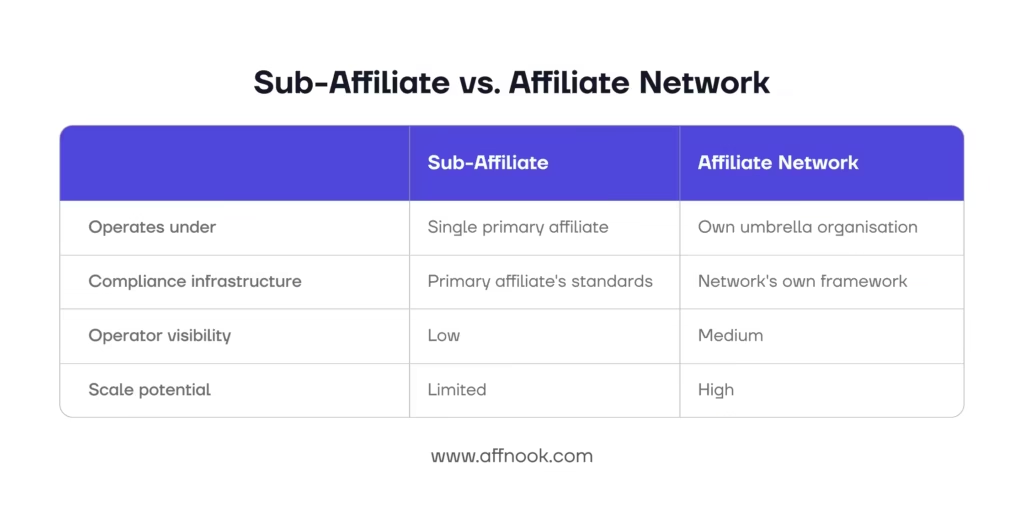
In practice, the difference carries some importance to the operators due to the existence of compliance mechanisms with respect to the networks. The notion of sub-partnership lies wholly within that of the main affiliate — all compliance policies of any main affiliate apply to the secondary-affiliate as well.
Why It’s More Common Than Operators Realise
It is common for any main affiliate with a number of traffic sources, media-buying associates, and content creators performing under its brand to operate on a second-tier affiliate basis — it does not matter if it is called that in the contract. Large affiliate networks work in this manner when the business grows.
How Sub-Affiliate Commission Structures Work
Affiliate commission payouts exceeded $10 billion globally in 2024 — a significant portion of which flows through multi-level commission structures where the operator never directly touches the final recipient.
The commission structure of such a scheme runs from top to bottom, from the operator to the main affiliate and then from the main affiliate to the sub.
The Basic Commission Chain
Operator → Primary Affiliate → Second-tier affiliate
The operator settles the commission for the primary affiliate on the basis of CPA, revenue share or a hybrid way of payment; then the primary affiliate forwards its earnings to the sub-partner.
A Practical Example
The principal affiliate is receiving a 30% revenue share agreement from the operator. The principal affiliate then recruits a second-tier affiliate and agrees to share 10% of the revenue share with them, and keeps 20% of the total for itself.
Operator pays: 30% of NGR to main affiliate
Main affiliate pays: 10% of NGR to sub affiliate
Main affiliate keeps: 20% of NGR
As we see, no matter how many sub-affiliates operate under one primary affiliate, the operator will always pay 30% of NGR.
Where It Gets Complicated
- Manual tracking: when the platform doesn’t allow multi-tier attribution, commission payments may be tracked manually, which may lead to disputes.
- Commission stacking: in programs with multiple levels of affiliates, a percentage from every level is taken, which makes it difficult to keep competitive margins.
- CPA splits: fixed costs in CPA may not be separated easily, which is the reason why most second-tier affiliate partnerships end up as revenue share.
Why Operators and Networks Use Sub-Affiliates
These affiliates emerge to tackle the limitation of direct recruitment in certain circumstances.
Scale Without Direct Recruitment
The process of recruiting affiliates on an individual basis can be quite time-consuming. However, in the case of the recruitment of ten affiliates by a principal affiliate, it is equivalent to eleven affiliates recruited on the basis of one operator contract, hence reducing overhead costs.
GEO-Specific Market Access
The lead affiliates, who have special skills regarding the local markets, are the responsible party for finding secondary affiliates that enable them to use GEO-specific traffic sources which cannot be used by the operator. This implies that the operator will need only one sign-in from the lead affiliates.
How Networks Are Built on This Model
Affiliate networks are, in fact, sub-affiliates on a large scale. Here, the network becomes the main affiliate where several dozen or even hundreds of small affiliates are gathered under the network as a whole. It is the responsibility of the network to ensure compliance and tracking while commissions are paid.
The Trade-Off
The increased level of reach through the affiliates will lead to a reduced level of direct visibility for the operator. As the distance from the operator’s agreement increases, it becomes increasingly difficult to measure quality, monitor compliance, and assign conversions.
The Compliance and Quality Risk
The benefits of these affiliates come with liability, which reaches to a level of the program that the operator cannot control.
Liability of Operator Doesn’t End With Primary Affiliates
Under UKGC and MGA models, the operators are responsible for everything their affiliates have done to promote the operators’ products, including sub-affiliates unknown to the operator. Common liabilities are:
- Promotion within constrained regions outside the operator’s licensing area
- Deceptive marketing promises or conditions
- Approaching self-excluded or at-risk players
Traffic Quality Risk
Second-level affiliate traffic appears to be the same as that of the first-level affiliate traffic – bonus hunters or traffic that has not been verified by FTD looks like first-level affiliate traffic traffic until the player information has been captured, but when the traffic issue becomes apparent at the NGR or QFTD stage, the commissions would have already been paid out.
Fraud Risk
Fraudulent traffic from second-tier affiliates could be passed through a trusted main affiliate without multi-level attribution. The reputation of the main affiliate acts as camouflage – and it will not be detected by the platform since it only sees one level of the chain.
The Core Problem
Most affiliate networks consider the lead affiliate to be the terminal node in the attribution process. Anything after that is a black box, and in any regulated environment, a black box inside the iGaming affiliate network is a regulatory issue.
What Operators Need in Place to Manage These Affiliates
Visibility alone counts as the ultimate protection — and that calls for the appropriate infrastructure.
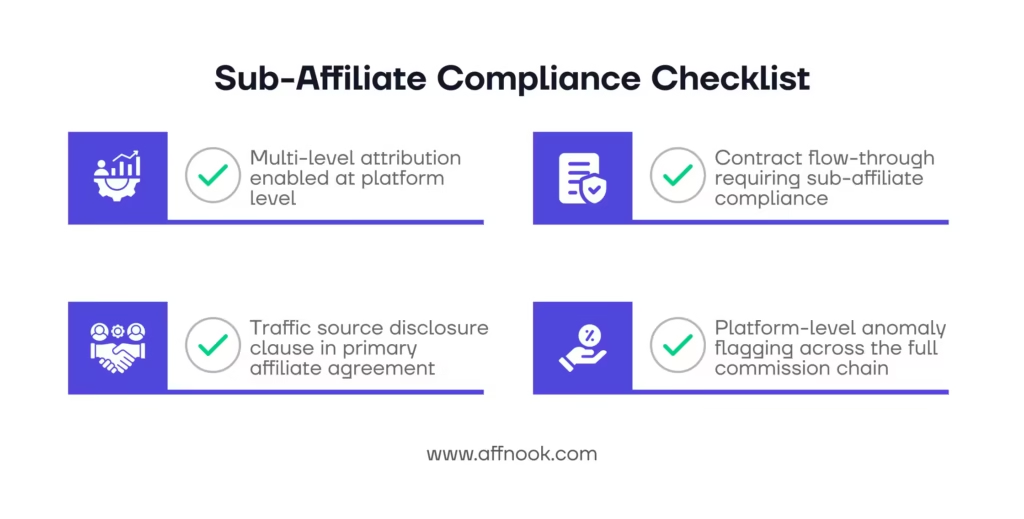
Multi-Level Attribution
Conversions need to be tracked at the sub-partner level rather than simply at the primary affiliate level, else commissions may not be complete, fraud can’t be detected, and regulatory compliance audits won’t have all their bases covered.
Contract Flow-Through
The first-level affiliates have to be capable of ensuring that their sub-affiliates comply with the same criteria for compliance as the operator has set for them, including geographical limitations, advertising regulations, and responsible gaming policies. However, compliance will be valid if it has been written into the contract.
Traffic Source Disclosure
Primary affiliates should disclose the traffic sources of second level affiliates on demand. The primary affiliates that do not want to adhere to this policy pose many risks, which increase with every sub-partner added.
Platform-Level Controls
Affiliate marketing platforms such as Affnook allow for multi-level tracking of second-tier affiliates, allowing platform operators to see the whole hierarchy of commissions earned, to identify any irregularities in commission tracking among these affiliates, and to track commission payments properly.
Final Thoughts
Second-tier affiliates provide reach and scale — but they provide a visibility dimension in the program that is always available to the regulators, even if not to the operators.
The answer isn’t to shy away from second-tier affiliates — it’s to construct the visibility infrastructure that will make them manageable. Contract flow through, multi-level attribution, and platform-level control are the dimensions that define compliance versus exposure.
Help Section
What is a sub-affiliate in iGaming affiliate marketing?
These can be defined as a partner who has been employed by a main affiliate to bring in business for them. The relationship between a main affiliate and them is managed by the main affiliate, who also pays out a part of their commission to their sub-partner.
How do these affiliate commissions work in iGaming programs?
The operator remits their contracted commission — CPA, RevShare, or hybrid — to the primary affiliate, who in turn, forwards a certain portion to the second-tier affiliate from their own share of the income received. The cost of the operator is fixed irrespective of the number of these affiliates who are working under the primary affiliate.
Are iGaming operators responsible for sub-affiliate compliance?
Indeed, UKGC and MGA guidelines hold operators liable for any affiliate activity endorsing their brand, encompassing even affiliates they have not been involved with directly. Promotional infractions, limitation of GEO-targeting, and false bonus claims by affiliates may expose the operator to regulatory risk.
What is the difference between a second-tier affiliate and an affiliate network?
A sub-affiliate works with one primary affiliate that has a direct relationship with it. An affiliate network brings together multiple affiliates in one system with a central tracking system, compliance system, and consistent agreements. Networks are basically second-tier affiliate systems at a larger scale.
How do operators track these affiliate conversions accurately?
Effective second-tier affiliate tracking can only be accomplished by multi-tiered attribution at the platform level — NOT manual reconciliation. The platform needs to track conversions through the sub-affiliate tier and distribute the commissions correctly. Failure to do so allows fraud to go unchecked, missing commissions, and reveals compliance audit issues that were otherwise unknown to the operator.