Launching an iGaming business in Europe is easier than ever. Staying compliant is the difficult part.
Many operators select the Malta iGaming License due to its established reputation, level of trust from players, and access to many countries operating under a regulatory framework. Obtaining an MGA License involves more than simply paying a fee and passing an audit.
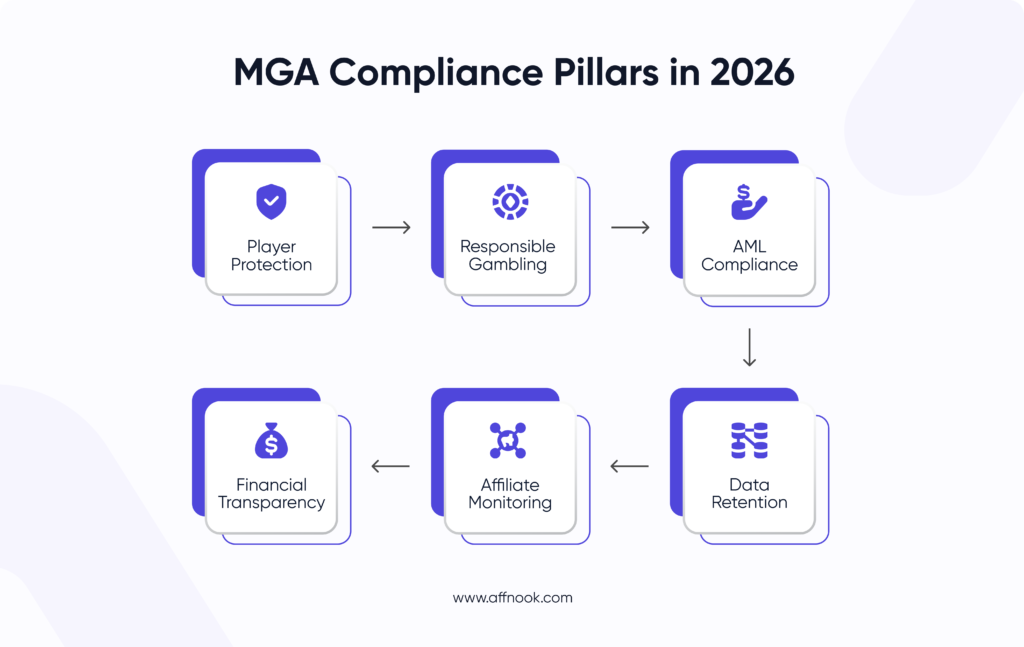
The Malta Gaming Authority has specific expectations from operators, such as having accurate, reliable records of activity, monitoring affiliates, advertising responsible gambling, and providing complete financial transparency.
Therefore, affiliate programs must do more than focus solely on acquiring new players; they must maintain sufficient documentation, verify the identity of affiliates, accurately calculate commissions, and be prepared for compliance reviews by maintaining proper records.
The guide will explain how the Malta iGaming License will be implemented in 2026 and the operational requirements associated with having a Malta license as an affiliate program. Also covered will be how services such as Affnook enable operators to streamline reporting, invoicing, and fraud prevention while remaining prepared for audits.
What is a Malta iGaming License?
A Malta iGaming License is also known as an MGA license. It is an official document that allows iGaming operators and brands to legally offer gambling services.
The MGA is one of the most highly respected regulators in the gaming industry due to its major focus on these key areas:
- Integrity and fairness of gaming;
- Player protection;
- Encouragement of responsible gaming;
- Anti-money laundering;
- Protection of customer data; and
- Transparency in the operation of the business.
Players, affiliates, payment processors, and investors view businesses that hold an MGA License as trustworthy.
Why is the Malta iGaming License So Popular?
When iGaming operators have decided to enter the regulated market, one of the most important considerations is the jurisdiction in which they would like to operate. In the iGaming industry, there are a number of licences available, but the Malta iGaming license is the most popular of the European licensing frameworks.
And the main reasons for its popularity are the combination of credibility, regulatory stability, and industry recognition.
1. Strong industry Presence:
Over the years, MGA has been one of the most respected regulators in the iGaming industry. They have established very strict standards around player protection, responsible gambling, and anti-money laundering.
As such, iGaming operators who have been licensed by the MGA are mainly known as more reputable organizations than other operators who do not have an MGA license, especially in areas like their relationship with players, iGaming affiliates, payment processors, and other stakeholders.
2. Enhanced Player Trust:
Online gambling relies heavily on trust. Players are more likely to deposit and continue playing on operators whose gambling activity is governed and regulated by agencies that are recognized for how they do business.
A qualified MGA-licensed operator must safeguard their player’s funds, offer fair gaming practices, and provide dispute resolution options to players. These three components will help improve player confidence and solidify the operator’s credibility in the industry.
3. Access to European and International Markets
While regulations can be different based on individual countries, a Malta Gaming Authority (MGA) licence is recognized globally throughout the iGaming and online gaming industries to help launch businesses in regulated jurisdictions.
It is also easier to form partnerships with game suppliers, payment processors, and affiliates due to its global recognition.
4. Strong Affiliate Ecosystem
While regulations can be different based on individual countries, a Malta Gaming Authority (MGA) licence is recognized globally throughout the iGaming and online gaming industries to help launch businesses in regulated jurisdictions.
It is also easier to form partnerships with game suppliers, payment processors, and affiliates due to its global recognition.
How Does the Malta Gaming Authority Licensing Structure Work?
The Malta Gaming Authority (MGA) follows a single-license framework, making it simpler for businesses to operate multiple gaming verticals under one regulatory structure. Broadly, the MGA issues two types of licenses.
B2C Gaming Service License
This license is designed for businesses that offer gambling services directly to players.
Examples include:
- Online casinos
- Sportsbooks
- Poker operators
- Lottery and bingo platforms
B2C license holders are responsible for player protection, responsible gambling measures, anti-money laundering procedures, and maintaining compliant marketing practices.
B2B Critical Gaming Supply License
This license is intended for companies that provide products or services to operators rather than players.
Examples include:
- Platform providers
- Game developers
- Affiliate software providers
- Odds and data suppliers
- Payment solution providers
The single-license framework gives operators and suppliers greater flexibility while ensuring they meet the same high standards expected by the MGA.
Which Businesses Benefit the Most from a Malta iGaming License?
A Malta iGaming License isn’t limited to online casinos. It supports a wide range of businesses across the iGaming ecosystem, from operators serving players directly to technology providers supporting licensed brands. The table below shows how different businesses can benefit from operating under the Malta Gaming Authority’s regulatory framework.
| Business Type | How a Malta iGaming License Adds Value |
|---|---|
| Online Casino Operators | Increases player confidence, strengthens brand credibility, and helps operate in regulated markets. |
| Sportsbook Operators | Demonstrates compliance with industry standards, making it easier to attract players and business partners. |
| Poker & Bingo Platforms | Provides a trusted regulatory framework that reassures players and commercial partners. |
| Game Developers | Makes it easier to supply games to MGA-licensed operators and build long-term B2B partnerships. |
| Affiliate Platforms & Tracking Software | Helps support regulated operators with transparent tracking, reporting, and compliance-ready affiliate management. |
| Payment Solution Providers | Builds trust with licensed operators by supporting secure and compliant payment processing. |
| Platform & Technology Providers | Enables partnerships with regulated operators by delivering compliant gaming infrastructure and services. |
How to Get a Malta iGaming License in 2026
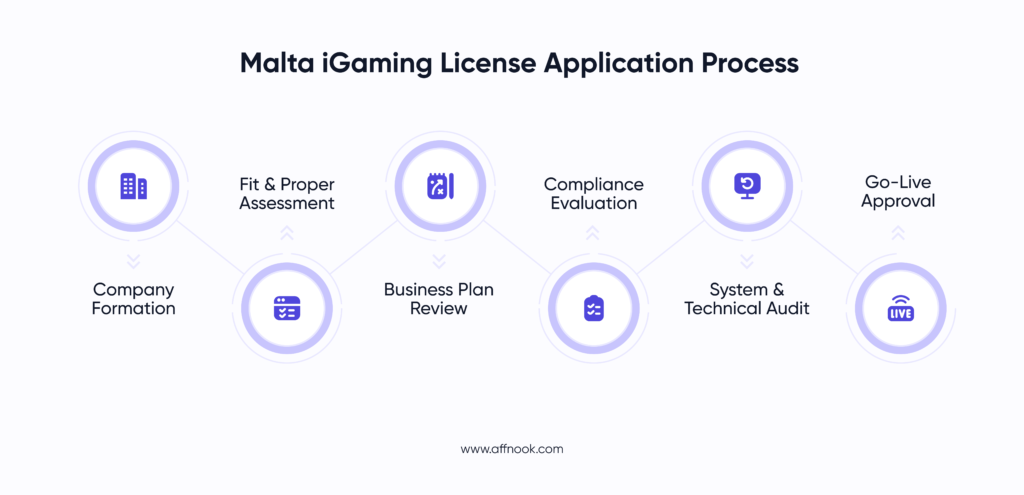
Obtaining a Malta iGaming License involves several stages, each designed to ensure that businesses are financially stable, operationally sound, and compliant with MGA regulations.
Step 1: Company Formation
Applicants must establish a suitable corporate structure and prepare the necessary legal documentation.
Step 2: Fit and Proper Assessment
The MGA conducts background checks on shareholders, directors, and key personnel to assess their integrity and financial standing.
Step 3: Business Plan Review
Applicants are required to submit a detailed business plan, including:
- Financial projections
- Marketing strategies
- Technical architecture
- Operational procedures
Step 4: Operational and Compliance Review
The MGA evaluates internal controls, anti-money laundering procedures, responsible gambling policies, and other compliance measures.
Step 5: System Audit
Before going live, gaming systems and technical infrastructure are independently tested to ensure they meet regulatory requirements.
Step 6: Go-Live Approval
Once all checks and audits have been successfully completed, operators receive approval to launch their gaming operations.
Relevant Fees and Taxation
Obtaining a Malta iGaming License involves more than the initial application fee. Operators should also budget for annual licence fees and gaming tax, depending on the type of licence they hold and the gaming services they offer.
| Fee or Tax | Amount |
|---|---|
| One-time, non-refundable Application Fee | €5,000 |
| Non-refundable Fixed Annual Licence Fee | €25,000 |
| Annual Licence Fee (Operators providing only Type 4 gaming services) | €10,000 |
| Gaming Tax | 5% of the gaming revenue generated from the gaming service |
How Does the Malta iGaming License Affect Affiliate Programs?
Many operators focus on player compliance when applying for an MGA license, but affiliate programs are equally important.
Under the Malta Gaming Authority’s framework, affiliate marketing isn’t treated as a separate activity. Affiliates are considered an extension of the operator’s acquisition and marketing efforts. This means operators are responsible for ensuring that their partners promote the brand responsibly and maintain proper records.
As a result, operators need complete visibility into their affiliate ecosystem, including:
Who Their Affiliates Are
Operators should know exactly who they are working with. This involves collecting and maintaining affiliate KYC information, tax documents, payment details, and signed agreements. Proper partner verification helps reduce compliance risks and creates accountability.
How Traffic Is Acquired
Traffic sources should be transparent. Operators need to understand where players are coming from and ensure affiliates are using approved marketing methods. Regulators expect businesses to monitor acquisition channels and prevent misleading or unethical promotional practices.
How Commissions Are Calculated
Commission structures should be clearly defined and supported by accurate tracking data. Whether an affiliate is paid on CPA, revenue share, hybrid, or custom models, operators should be able to demonstrate how payouts were calculated.
Whether Marketing Messages Follow Responsible Gambling Standards
Affiliates must comply with responsible gambling requirements and avoid misleading claims. Promotions should not target minors, encourage excessive gambling, or guarantee winnings. Operators are expected to monitor affiliate activities and ensure their partners represent the brand appropriately.
Whether Payout Records Are Properly Documented
Every commission payment should be backed by supporting records such as invoices, transaction histories, and performance reports. During audits, operators may need to demonstrate when payments were made, how amounts were calculated, and which partner received them.
Whether Historical Data Can Be Retrieved
Maintaining records is another important part of MGA compliance. Affiliate agreements, commission reports, invoices, and tracking data should be stored and easily accessible. Having a clear audit trail makes regulatory reviews much easier and helps resolve disputes quickly.
Ultimately, compliance under the Malta iGaming License goes beyond player KYC and anti-money laundering procedures. It extends to affiliate management, reporting, and financial transparency. This is why modern affiliate platforms are no longer just marketing tools. They have become an essential part of maintaining compliance and keeping affiliate programs audit-ready.
Why Affiliate KYC Matters Under MGA Requirements
Before onboarding affiliates, operators should know exactly who they’re working with.
Affiliate KYC generally involves collecting:
- Company information
- Registration certificates
- Tax documents
- Payment details
- Contact information
- Identification documents
These records help operators prove that affiliate relationships are legitimate.
Without proper KYC, compliance risks increase significantly.
Operational Challenge
As affiliate programs grow, manually managing hundreds of partner documents becomes difficult.
Keeping all partner information centralized becomes essential for audit readiness.
What Responsible Gambling Standards Mean for Affiliates
MGA expects operators to ensure affiliates market responsibly.
Affiliates should avoid:
- Misleading claims
- Guaranteed winnings
- Advertising to minors
- Aggressive promotions
- Irresponsible messaging
Operators should regularly review promotional materials and maintain communication records.
This means compliance teams need visibility into affiliate campaigns, traffic quality, and promotional behavior.
Why Is Data Retention Critical Under an MGA License?
One area many operators overlook is data retention.
Getting a Malta iGaming License isn’t just about passing the application process. Operators are expected to maintain records that demonstrate transparency long after they begin operating. During audits or compliance reviews, being able to access historical information quickly becomes essential.
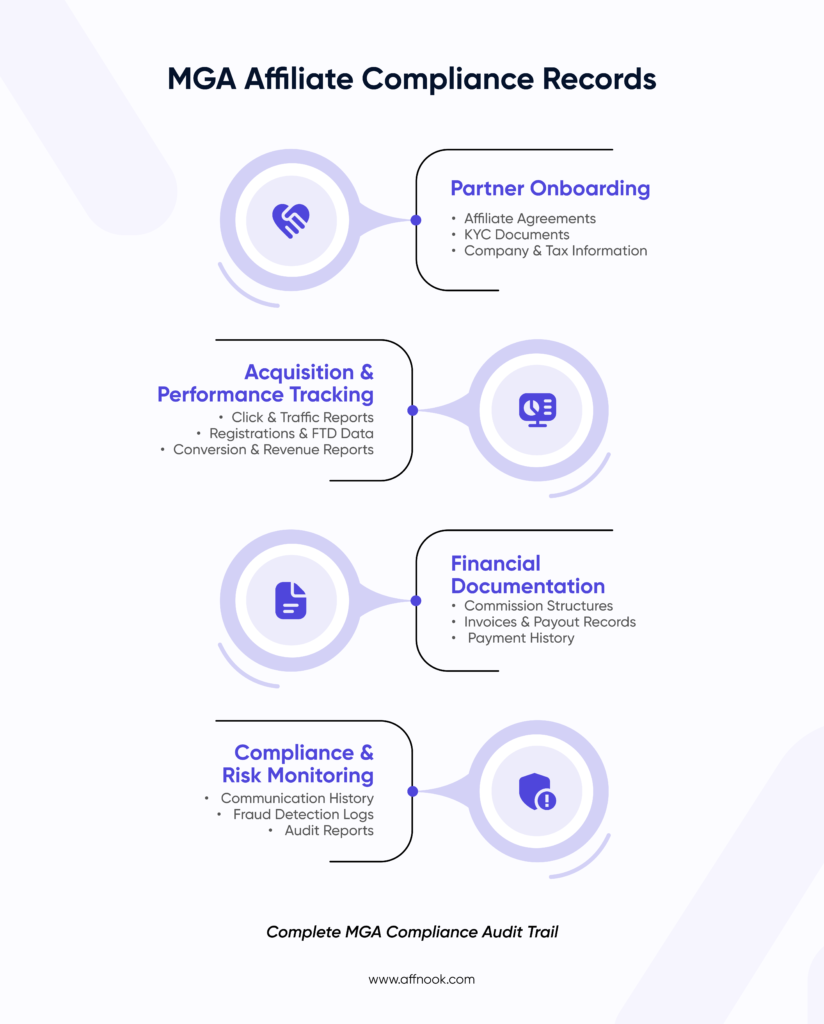
For affiliate programs, this means retaining records related to:
Affiliate Agreements
Signed contracts and terms should be stored securely to clearly define commission structures and partnership conditions.
Partner KYC Documents
Company details, identity information, tax documents, and payment information should be retained to verify affiliate legitimacy.
Commission Structures
Historical CPA, revenue share, and hybrid deals should remain accessible so operators can explain how commissions were calculated.
Invoice and Payment Records
Invoices, transaction dates, and payout histories create a clear financial trail and help resolve disputes.
Traffic and Conversion Data
Clicks, registrations, FTDs, and revenue records provide proof of affiliate performance and support commission calculations.
Communication and Fraud Logs
Emails, contract updates, and fraud reports add another layer of transparency and show that affiliate activities are actively monitored.
Ultimately, data retention is about creating a complete compliance audit trail. Operators should be able to demonstrate who their affiliates are, how traffic was generated, how commissions were calculated, and when payments were made. Without these records, proving compliance under MGA requirements becomes much more difficult.
How Does Affiliate Tracking Become Part of Compliance?
Many operators think tracking exists only to measure performance. In reality, tracking is also a critical part of compliance.
Every click, registration, deposit, and commission creates a record that may be needed during an audit or dispute. That’s why affiliate tracking isn’t just about optimization; it’s about building a reliable audit trail.
A robust affiliate platform should maintain records for:
- Traffic sources and clicks
- Registrations and first-time deposits
- Revenue generated
- Commission calculations
- Payment histories
Without these records, operators may struggle to prove how commissions were earned and paid. Good tracking creates transparency and makes audits much easier to manage.
Why Reporting Matters for MGA Compliance
For many operators, reporting is simply a way to measure campaign performance. But under an MGA-licensed operation, reporting serves a much bigger purpose. It creates the transparency needed to support compliance and maintain a clear audit trail.
During regulatory reviews, internal audits, or partner disputes, operators should be able to explain where traffic came from, how revenue was generated, and how affiliate commissions were calculated. Without accurate reporting, proving this information becomes difficult.
Some of the most important reports include:
Traffic Reports
These reports provide visibility into clicks, registrations, and traffic sources. They help operators understand how players are being acquired and identify unusual activity.
Revenue Reports
Tracking GGR, NGR, and overall affiliate performance ensures operators can demonstrate how revenue is generated and attributed.
Commission Reports
Affiliate earnings should always be backed by transparent calculations. Detailed commission reports help explain exactly how payouts were determined.
Payment History
Invoices, payout records, and transaction logs create a financial audit trail and make it easier to resolve disputes.
Fraud Reports
Monitoring duplicate accounts, suspicious traffic, and invalid conversions helps maintain clean data and accurate reporting.
Ultimately, good reporting isn’t just about optimization. It’s about maintaining transparency, supporting financial accountability, and ensuring your affiliate program remains audit-ready.
How Fraud Can Create Compliance Risks
Affiliate fraud doesn’t just hurt revenue. It can compromise data accuracy, distort reports, and create compliance risks.
When invalid traffic enters an affiliate program, operators may end up paying commissions on players that were never genuine. This affects not only profitability but also the integrity of the records that regulators expect operators to maintain.
Some common threats include:
Bonus Abuse
Players are exploiting promotional offers to create artificial value and trigger commissions.
Duplicate Accounts
Multiple accounts created by the same individual to manipulate bonuses or affiliate payouts.
VPN and Proxy Traffic
Masked traffic sources that distort campaign performance and hide suspicious behavior.
Click Fraud
Artificial clicks were generated to inflate traffic and affiliate earnings.
Incentivized Registrations
Low-quality or fake users created solely to trigger payouts without delivering real value.
Without proper fraud detection, operators risk inaccurate reports, invalid commissions, and unnecessary financial losses. More importantly, poor data quality can make audits and dispute resolution much harder.
That’s why fraud prevention is no longer just a performance safeguard. It’s an essential part of maintaining trustworthy data, protecting affiliate investments, and keeping an MGA-licensed operation compliant and audit-ready.
Final Thoughts
The Malta iGaming License continues to be the most popular European licensing structure in 2026, but compliance goes far beyond obtaining approval from the Malta Gaming Authority.
Operators are expected to maintain transparency across every stage of their affiliate program, from partner onboarding and responsible gambling messaging to commission calculations and payment documentation.
As programs grow, spreadsheets and manual processes become difficult to manage.
That’s why modern affiliate platforms have evolved from simple tracking tools into compliance infrastructure.
With real-time reporting, automated invoicing, fraud detection, and detailed audit trails, Affnook helps operators build affiliate programs that are not only scalable but also ready for regulatory scrutiny.
Help Section
How long does it take to obtain a Malta iGaming License?
The process typically takes several months, depending on the complexity of the application and how quickly the applicant meets the MGA’s requirements. Businesses must go through company formation, fit and proper checks, business plan reviews, compliance assessments, and technical audits before receiving approval.
Does the Malta Gaming Authority regulate affiliate marketing?
Yes. While the MGA does not license affiliates separately, operators are responsible for ensuring their affiliate partners comply with responsible gambling standards and advertising guidelines. Operators are also expected to maintain proper records, monitor traffic sources, and document affiliate payouts.
What records should operators keep for MGA compliance?
Operators should retain key records related to their affiliate programs, including affiliate agreements, KYC documents, traffic and conversion data, commission reports, invoices, payment histories, and fraud logs. Maintaining these records helps create a clear audit trail and simplifies compliance reviews.
How can affiliate software help with MGA compliance?
Affiliate software plays an important role in maintaining transparency. Platforms like Affnook provide real-time tracking, detailed reporting, invoicing automation, and fraud detection tools that help operators document affiliate activities, manage payouts, and create a complete compliance audit trail.