
Every business relationship should be based on ground rules and agreements. So is the case with important partnerships, such as those with iGaming affiliates.
In the online gambling industry, affiliates play a crucial role in helping operators reach new audiences and expand into new markets through their marketing efforts. These platforms include, but are not limited to, online casinos, sportsbooks, and poker platforms.
While affiliates add value to iGaming brands and operators, they also introduce a degree of complexity. Some of these potential complexities include –
- Commission disputes
- Compliance risks
- Unclear attribution rules
- Fraud concerns
If not addressed or if taken lightly, they can seriously affect the operator or the iGaming brand. This is where an iGaming affiliate contract becomes a necessity.
The role of such a contract is not just to set commission terms. It is also to ensure that –
- Expectations are set
- Both parties are protected
- Compliance responsibilities are defined
- There is no operational chaos
This happens when a contract clearly defines the guidelines. This article will walk you through what an ideal contract should be like and what it must include.
Why is an Affiliate Contract a Necessity
iGaming affiliate partnerships are slightly different from a traditional affiliate partnership because they include –
- Revenue sharing over long periods
- Regulatory compliance requirements
- Double the chance of fraud and traffic quality risks
- Promotions that are geographically restricted
- Responsible gambling obligations
These complexities should be taken seriously in order to avoid any sort of misunderstandings. An affiliate contract plays its role by making sure that –
- Commission disputes are avoided
- Clear expectations are set
- Compliance obligations are defined
- Platform is protected against fraudulent activities
- Clarity is established for long-term partnerships
In short, when an agreement is formulated for the affiliates, everything falls into place. When all the guidelines are predefined, the platform grows and hence scales. Because today’s preparation determines tomorrow’s achievements.
Key Requirements of an Affiliate Contract
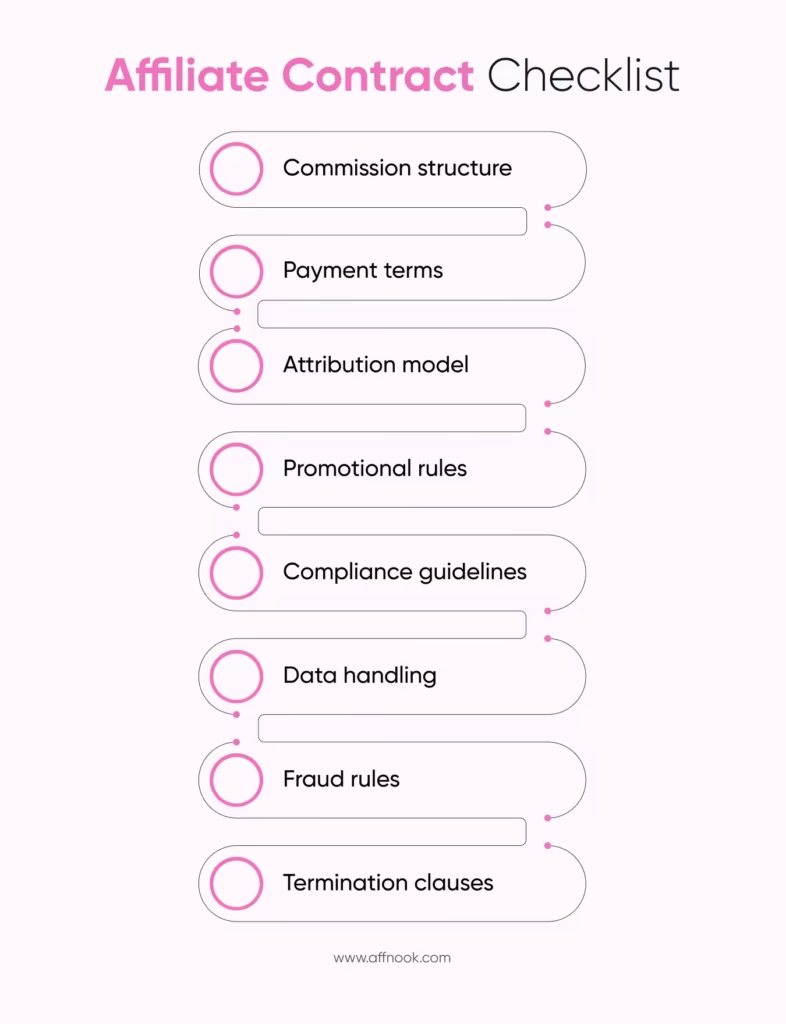
A strong affiliate template must include –
- Clear commission structure
- Payment terms and qualifying conditions
- Tracking and attribution rules
- Promotional guidelines and restrictions
- Compliance obligations
- Data handling and privacy clauses
- Fraud liability and traffic quality rules
- Termination and breach conditions
Let us now explore them in detail.
Clear Commission Structure
The end goal for an affiliate is to earn more money, and hence, the commission structure becomes the basis of every affiliate contract. Because if this section of the contract is not properly thought out, disputes become unavoidable. Three common commission models are offered in iGaming affiliate programs –
CPA (Cost Per Acquisition)
In the CPA model, certain requirements are set, and when a referred player fulfils them, the affiliate is paid for that action. Some of these conditions could be –
- Making first deposit
- Making a minimum amount of deposit
- Completing player verification
- Fulfilling minimum gameplay requirements
This can be used in the following way –
- $100 CPA per qualified first-time deposit
- Minimum deposit has to be at least $20
- Player must wager 3X deposits
Revenue Share (RevShare)
In the revenue sharing commission model, a part of the net revenue that is generated through referred players is shared with the affiliates.
There are three ways of assigning the revenue share –
- 20% to 50% of the percentage tied to NGR or GGR
- Tying the percentage to the KPI performance like traffic volume, its quality, NGRs, number of QFTDs, etc.
- A share of the lifetime revenue that is generated through the ongoing lifetime value created by the referred players
That being said, there should also be clarity around the NGR calculation formula, negative carryover policy, and bonus deductions.
For example, if a negative carryover policy is applied, losses from one period may be carried forward and deducted from future affiliate earnings. If this is agreed upon, the contract should specify how and when this applies. Similarly, if negative carryover is not enabled, affiliates should clearly understand that each period is calculated independently.
Platforms like Affnook allow operators to configure such conditions within affiliate agreements. For instance, negative carryover can be enabled or disabled depending on the agreement, which directly impacts automated commission calculations and invoice generation. This ensures that whatever is agreed upon in the affiliate contract is accurately reflected operationally.
Hybrid Model
The hybrid model is the combination of both CPA and revenue share. An example of this could be going for a $75 CPA and 20% of revenue share model. The aim here is to create a balance between immediate payouts and long-term incentives.
It is necessary for the affiliate contract to clearly state when the CPA is to be triggered, when the revenue share begins, and when both apply simultaneously.
If these requirements are already clearly defined in the agreement beforehand, disputes later are prevented. It can be mentioned in the affiliate contract in the following manner –
- The Affiliate shall be compensated under a Hybrid Plan consisting of –
CPA Component: A fixed fee of $70 for each New Depositing Player (NDP) meeting the baseline requirements in Schedule A.
Revenue Share Component: An ongoing 35% of the NGR generated by said NDPs for the duration of this Agreement. - CPA model – For every New Customer referred who completes a qualifying action, the company shall pay a one-time fixed fee of $80 (CPA Payment). A Qualifying Action is defined as:
Successful registration and account verification.
A minimum initial real money deposit of $40.
Minimum wagering of 2 times the initial deposit amount.
Payment Terms, Schedules, and Qualifying Conditions
As already discussed, payments are the most sensitive yet necessary part of the agreement. Affiliates would always want to have an estimate of their payment, and operators, on the other hand, want quality traffic, which they will only get when the affiliates are properly paid. It is a loop, as both parties depend on each other to function.
Apart from clarifying the payment model usage, the affiliate contract should also define –
- Both CPA and Revenue Share shall apply only to players meeting the Operator’s qualification criteria. Players flagged for fraud, duplicate accounts, bonus abuse, or non-compliant traffic sources shall be excluded from commission eligibility.
Payment Frequency
Payments are commonly made on a weekly, bi-weekly, or monthly basis. For instance, “payments are processed monthly on a net 30 basis.”
Minimum Payout Threshold
It is the minimum amount of commission that an affiliate must accumulate before they receive their final payment. If the earnings are lower than the minimum required amount, they are carried over to the next payment cycle.
The affiliate contract should mention it in the following way –
“Minimum payout: $100”
This, hence, helps reduce transaction costs as well.
Qualifying Conditions
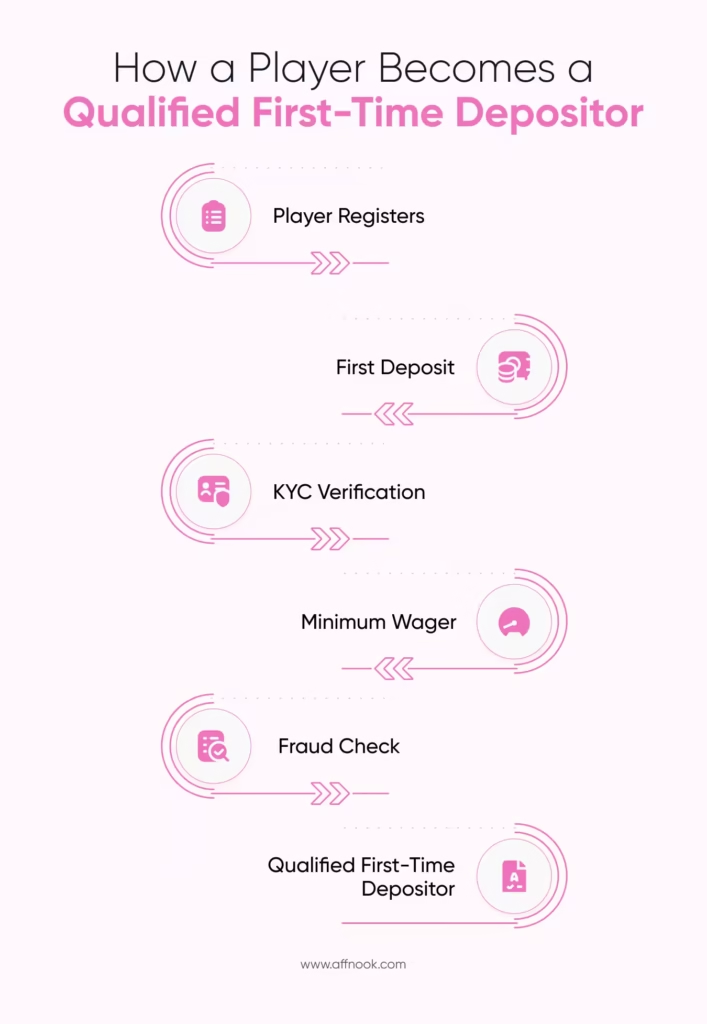
There are two types of players. One who makes a deposit but immediately withdraws, this type of player is of almost no use to the brand. The other type of player is the one who makes deposits and stays as well. Many iGaming programs use qualified first-time depositor (QFTD) logic because quality always wins over quantity.
Some of the typical conditions that can be set for the affiliates to ensure that the first-time depositor is of quality are –
- Player makes first deposit
- Player passes the KYC
- Player wagers the minimum amount that is set
- Player is not identified or flagged as a duplicate
All this should also be clearly defined in the affiliate contract.
NGR Threshold for Triggering Revenue Share
Before the revenue share commission model is shared, a specific amount of the net gaming revenue (NGR) is expected to be generated through the referred players. This is before the affiliate begins to receive their deserved percentage of revenue, as mentioned in the iGaming affiliate marketing agreement.
This can be mentioned in the affiliate contract in the following way –
- Revenue share applies only after $500 NGR
- Revenue share triggered after 10 active players
The NGR threshold acts as a filter here, and by doing this, the operators can protect their platform from low-quality traffic.
Tracking and Attribution Rules
An affiliate must know how and on what basis they are being credited. And this can be done when they know the brand or operators’ chosen methods of tracking and attribution. Hence, this too should be clearly stated in the affiliate contract.
Attribution Model
An attribution model helps figure out the basis of assigning credits to the most relevant affiliate. This is done in accordance with the multiple touchpoints that a player comes across before finally converting.
Considering all the touchpoints is important, especially in affiliate marketing, because an affiliate may click on multiple affiliate links before registering or making a deposit. If the attribution rules are not predefined, a situation of conflict can arise among affiliates, especially when they claim credit for the same player.
The most commonly used attribution models include first-click attribution, last-click attribution and multi-touch attribution. iGaming affiliate programs mostly rely on multi- touch attribution because it is –
- Straightforward
- Easily executed
- Preferred and accepted by affiliates
Mentioning the affiliate model that is being chosen in the affiliate contract minimizes disagreements and also makes the system more transparent.
Promotional Guidelines and Restrictions
Promotions are one of the best ways to reach your target audience and that’s what affiliates do the best. But this method has its own risks, especially in the niche of iGaming affiliate marketing. This is because they are sensitive to fraud and can even lead to regulatory penalties.
Hence, an affiliate contract must also strictly include what promotional methods are allowed and what actions are prohibited.
- Allowed promotional mediums – Defining approved mediums ensures that affiliates operate within channels that align with the operator’s brand and compliance requirements. These methods often include SEO websites, content blogs, social media promotions, and email marketing that is consensual.
- Restricted or poor promotional practices – The agreement should also define practices that may lead to penalties, commission reversals, or contract termination. These methods often include bidding a brand without approval, spamming emails, misleading bonuses, or bringing in traffic that has been incentivized or comes from restricted geographies, which makes it bogus.
By providing proper promotional restrictions, a brand can protect its reputation.
Compliance Guidelines
Just like promotional guidelines, compliance guidelines too are the protectors of an iGaming brand and its reputation. Not just that, they also protect the operators’ iGaming license and financial status as well.
The UK Gambling Commission is one of the most powerful regulators globally. Their 2025 updated guidelines focus on holding affiliates more accountable for any kind of content breach. If a situation like this occurs, the operators are fined, and the affiliate is completely dropped. Toavoid this, the affiliate contract must also define –
- Responsible gambling requirements – For instance, the affiliate must avoid targeting minors, they must include responsible gambling messaging, and they should avoid misleading claims.
- Geo-restrictions – Every jurisdiction has its own geographical restrictions as well. Hence, it is necessary for the contract to also specify the countries they are allowed to market in, the regions that are restricted to target, and the licensing compliance of that particular region.
- Content standards – The kind of content that the affiliates create should also be of a certain quality. The agreement should also include that the affiliates must avoid the depiction of content that has misleading offers, unauthorized bonuses, and use branding that is approved. This ensures a sense of brand consistency.
Data Handling and Privacy Clauses
Affiliate marketing also revolves around tracking and collecting user data.
Your affiliate contract should define:
- Data ownership – This clause ensures that the data received or shared by the affiliates is not being used by them for reselling or reusing. The data acquired through tracking is mostly claimed to be owned by the operator.
- Data usage restrictions – This clarifies how the affiliates use the data that is collected through referrals. This is done to ensure that the information is not being used for unauthorized marketing purposes or for competitor platforms.
- GDPR compliance – This ensures that the affiliates are following the data protection regulations while collecting data. This includes consent requirements, cookie disclosure and responsible data storage practices.
- Data sharing limitations – This restricts affiliates from sharing the data with any third party or sub-affiliates without getting a prior approval from the operator.
This is especially important when handling player data, tracking data and commission data.
Fraud Liability and Traffic Quality Rules
This part of the affiliate agreement is like a protective shield for the iGaming platform that fights all the potential “bad actors” who try to earn “unearned commissions”.
Since the payout amount is high in the iGaming niche, affiliates often go out of their way to cheat. That is exactly what must be avoided. The affiliate agreement should hence define –
What Comes Under Fraudulent Activities
It is necessary to clarify this so that there is no “gray area” when the decision of withholding payments is being made. These activities include but are not limited to –
- Self referrals
- Bonus abuse
- Bot or incentivized traffic
Traffic Quality Rules
Fraud is not always straight-out lying. It also goes beyond that. Traffic can be banned from specific countries and “adult” sites, which could hamper the reputation of the brand.
Affiliates should additionally also be prevented from bidding on the brand name itself on Google Ads so that the direct and organic traffic is not stolen.
Essential Legal Clauses Every Affiliate Contract Must Include
- Who are the parties involved?
- What are the obligations of each party?
- What is the relationship between these parties
- What are the expectations of the parties?
- What happens if the agreement is breached?
- What happens when the agreement ends
- What happens if there are any changes in the agreement?
Affiliate Agreement Template (Simplified Structure)
Typically, a simple affiliate agreement structure includes the following –
- Introduction
- Definitions
- Commission Structure
- Payment Terms
- Tracking and Attribution
- Promotional Guidelines
- Compliance Requirements
- Data Handling
- Fraud and Traffic Quality
- Termination
- Liability
- Confidentiality
- Amendments
- Governing Law
Conclusion
Affiliate partnerships are one of the most powerful growth channels in iGaming. But without a structured affiliate contract, these partnerships can quickly become difficult to manage.
A well-defined iGaming affiliate contract:
- Aligns expectations
- Prevents disputes
- Ensures compliance
- Protects revenue
- Enables scalable growth
As affiliate programs grow, managing commission structures, qualifying conditions, compliance obligations, and fraud risks becomes more complex. This is where having both a strong agreement and the right operational support becomes essential.
If you’re building or scaling an iGaming affiliate program, it’s important to ensure that your agreements are not just comprehensive but can actually be brought into action
Book a demo with Affnook to see how structured affiliate management, tracking, and compliance workflows can help you operationalize affiliate agreements and scale partnerships.
Help Centre
How often should an iGaming affiliate contract be reviewed or updated?
An iGaming affiliate contract should ideally be reviewed every 6-12 months. Regulatory updates, commission changes, new markets, and evolving fraud tactics can make existing terms outdated. Regular reviews ensure compliance, maintain fairness, and help operators adapt to market shifts while keeping affiliate relationships transparent and scalable.
Should an iGaming affiliate contract include performance benchmarks?
Yes, performance benchmarks help set clear expectations for affiliates. These may include minimum traffic levels, active player targets, or conversion thresholds. Including performance benchmarks allows operators to prioritize high-quality partnerships, optimize resources, and create tier-based incentives that reward affiliates contributing meaningful, long-term value.
How should intellectual property and brand usage be handled in an affiliate contract?
An affiliate contract should define how affiliates can use brand logos, promotional banners, trademarks, and messaging. This prevents misuse, protects brand identity, and ensures consistent communication across markets. It should also provide the outline for approval requirements for custom creatives and specify restrictions around modifying brand materials.
Should an affiliate contract define communication and reporting expectations?
Yes, defining communication expectations improves transparency. Contracts can specify the frequency of reporting, performance dashboards being used, escalation channels, and support timelines. This ensures affiliates receive timely updates and operators maintain visibility into campaign performance, helping both parties collaborate effectively and address issues before they escalate.
Why should dispute resolution terms be included in an iGaming affiliate contract?
Dispute resolution clauses help in the professional management of agreements. These clauses define mediation steps, arbitration processes, and jurisdiction rules. Including this ensures that conflicts related to payments, attribution, or compliance are resolved efficiently without damaging long-term partnerships or disrupting affiliate program operations.