What is Data Residency?
This indicates the geographical or physical location of data stored and processed by the company. In the case of iGaming, it has significance in terms of rules and regulations. That is to say that players’ personal information, KYC documents, transaction data, and account information must be located in the areas prescribed by local laws, not just in any place where the operator’s servers can be.
Why Location of Incorporation Doesn’t Determine Applicability
This is the most widespread false assumption that operators tend to believe when entering new markets. An operator founded in Malta, licensed in Curacao, and offering services to clients from Germany has to comply with GDPR regulations, as they apply to the area of the players, not the area of the business. It is the place of origin that matters.
What Data Is Affected?
The iGaming industry deals with sensitive materials, and this makes the data issue more important than in any other field:
- KYC documents: passport copies, proof of residence, identity verification
- Payment transaction records: deposit and withdrawal transaction histories for many years
- Behavioral data: user activity, betting behavior, responsible gaming alerts
- AML records: suspicious activity reports
Every document needs to be thought of from the point of residence in regulated markets, and companies should be aware of where exactly it is stored.
Data Residency vs. Data Sovereignty vs. Data Localisation
Three terms that appear interchangeably in compliance discussions — but mean different things operationally.
| Data Residency | Data Sovereignty | Data Localisation | |
| Definition | Where data is physically stored | Data subject to laws of the country where it’s stored | Regulatory requirement to store data within specific borders |
| Determined by | Operator choice or regulatory requirement | Country where servers are located | Local law — non-negotiable |
| Strictness | Low to medium | Medium | High |
| iGaming example | Operator chooses EU servers for player data | US-hosted EU player data falls under US surveillance law | Saudi Arabia PDPL requires data stored in-Kingdom |
| Key risk | Non-compliant storage location | Conflicting legal obligations across jurisdictions | Requires separate local infrastructure per market |
Why Operators Confuse Them
Many operators concentrate exclusively on where their data is situated without taking into account that storing data in a specific country means that it is automatically subjected to the laws of that country. Selecting a location for servers involves selecting a legal jurisdiction at the same time.
Why Data Residency Matters in iGaming
It is important because it involves all three important factors — licensing, player trust, and infrastructure — hence being one of the most highly impactful compliance decisions in business.
It Is a Licensing Obligation, Not Merely a Best Practice
In Tier 1 jurisdictions, regulators consider the location of data storage part of the licensing conditions. The iGaming sector generates extremely high volumes of data, including customer ID, payment history, and other information related to account management. In order to obtain or renew a license, it is mandatory for operators to show proof.
GDPR is Applicable Regardless of Your Location
It does not matter in which jurisdiction you are incorporated: it all comes down to the jurisdiction in which the data subjects are located. Most operators know this, but not as many of them check their infrastructure.
Cloud Hosting Creates the Most Common Gap
When using any service from AWS, Google Cloud, or Azure, the data will automatically be replicated to different regions. This may be quite problematic when it comes to GDPR since if there is no specific information about the region, any EU data may land in the US where there are no safeguards available.
Player Trust
Data breaches in the iGaming industry have the potential to inflict severe reputational damage. The data storage location can affect how quickly data breaches can be detected and acted on in accordance with the law. However, players expect the operators’ data handling practices to be responsible.
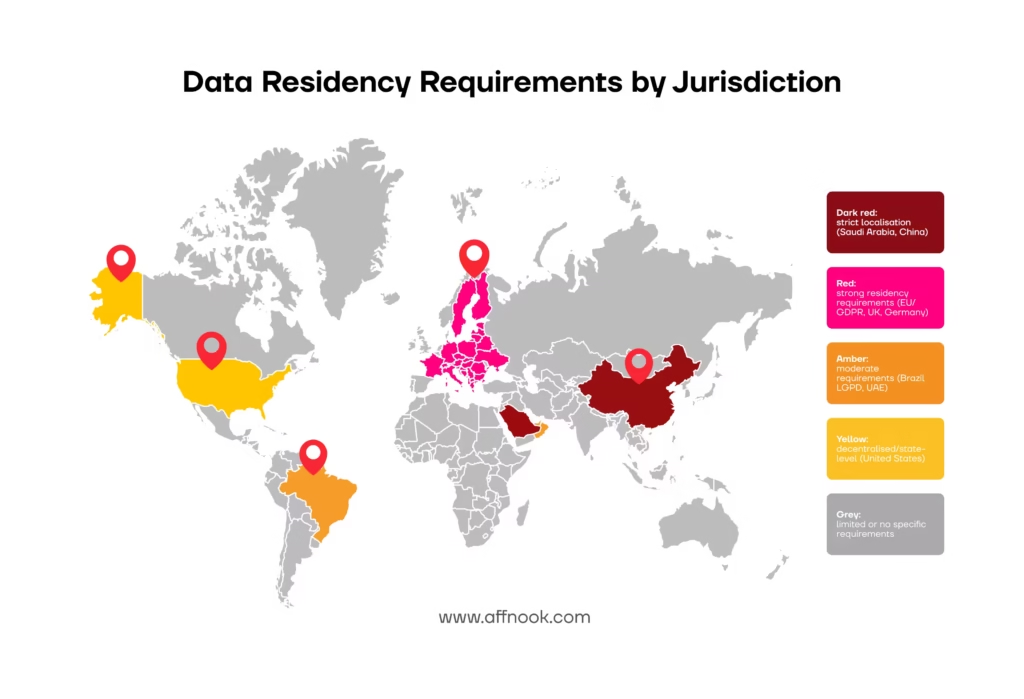
Data Residency Requirements by Jurisdiction
Regulatory regimes differ greatly from one market to another — and the disparity between Tier-1 markets and the emerging ones is huge.
The European Union and GDPR
Data of EU citizens must be processed according to GDPR requirements. In case data is transferred outside the EU, appropriate measures should apply, including standard contractual clauses (SCCs) or an adequacy decision of the EU.
United Kingdom — UK GDPR
After Brexit, UK GDPR functions separately from the EU GDPR. Transfers of information to non-adequate regions will necessitate separate protections; businesses working in both markets (EU and UK) must comply with regulation regarding the transfer of data to both the European Union and the UK at the same time.
Germany
Severe localisation tendencies on top of the GDPR requirements. All operators offering services to players in Germany need to comply with both GDPR and BZGA responsible gambling rules, and German regulators have always been strict interpreters of the rules regarding cross-border data transfer.
Brazil — LGPD
The model is very similar to that of the GDPR. There are two options for cross-border data transfer: getting customer consent or ensuring equivalent data protection levels as per LGPD. There is an increasing demand for iGaming companies to undertake data residency planning before the market launch.
Middle East
As per the PDPL in Saudi Arabia, it will enforce rules for processing personal information in-Kingdom from 2024. On the other hand, the UAE’s free zones are under a distinct framework where data can be transferred to a jurisdiction with adequate protection in line with DIFC or ADGM laws.
United States
Decentralized laws exist on a state basis. California’s CCPA is one of the most important laws for
operators with players in the US, as it regulates the collection, processing, and rights of consumers. There are no federal standards. In case a lot of states are used by “conductors”, there is a set of requirements that vary from one state to another.
The Compliance Risk Operators Underestimate
The consequences of non-compliance are real — in 2021, the Reserve Bank of India prohibited MasterCard from issuing new cards after it violated data localisation rules — a precedent that regulated industries, including iGaming, cannot afford to ignore.
There are privacy policies regarding data residency in place for most providers, but there are hardly any providers that have verified the functioning infrastructure of the company they have chosen.
The Cloud Hosting Gap
The major players like AWS, Google Cloud and Azure replicate the information in all possible regions. If the regions are not explicitly locked, the data of EU players may easily be kept on servers based in the USA, which automatically results in a cross-border transfer that can only be implemented with the mechanisms required by GDPR.
Third-Party Vendor Risk
KYC service providers, payment processing companies, and CRM systems all deal with the data of players. Operators are the ones that need it regarding vendors, not only where their own servers are located. KYC service providers processing data of EU players in countries that are not considered suitable put the operator at risk towards GDPR, regardless of whether the vendor complies with the regulation.
Affiliate Data
The information that is sent by players through the affiliate tracking platforms needs to conform to the requirements of data residency. In case the affiliate platform holds information about EU players on US servers, there is the risk of having an out-of-bounds issue in terms of data transfer.
The Audit Trail Problem
It is not the regulators who audit the policies; it is the actual storage of that data as claimed by the operators. The operators who are not able to prove the storage of data at any given point in time will have a loophole in the compliance aspect, no matter how good their paperwork is.
What Operators Need to be Compliance Ready
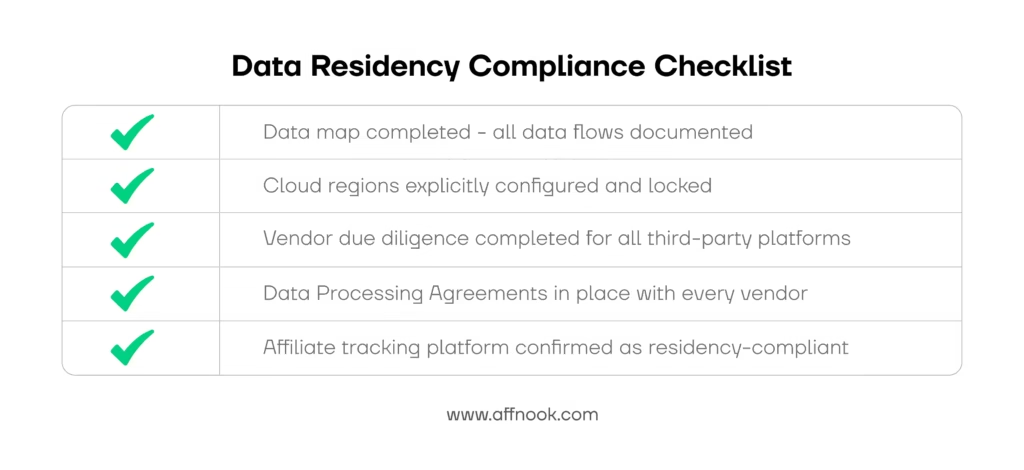
The compliance for residency entails more than just having a privacy policy and a cloud service account.
Data Mapping
Have complete clarity regarding what data is being collected and how that data is being used. Failure to have an accurate map of data flows on your platform means that there will be no way for you to show data residency compliance in front of a regulator.
Cloud Region Configuration
Hosting should be configured such that data replication is limited only to regions that comply. The default configurations for AWS, Google Cloud, and Azure do not comply with residency – region locking needs to be explicitly enabled and checked.
Vendor Due Diligence
Any external provider that deals with player information (KYC providers, payment providers, CRM software, affiliate software) must provide written confirmation of the storage location and transfer process for the data.
Data Processing Agreements
GDPR requires this document from all vendors processing player data on behalf of the operator. Without a DPA, data transfer is not GDPR compliant, nor is there any protection against regulatory scrutiny or breaches.
Platform-Level Controls
Data storage and processing in affiliate tracking software must be done according to compliance requirements. Affiliate tracking solutions such as Affnook are designed keeping in view data residency compliance requirements so that affiliate-level data does not expose them to cross-border data transfer problems.
Final Thoughts
It is during this stage that the difference between having a privacy policy and being compliant infrastructure-wise becomes a licensing issue.
In regulated iGaming markets, residency of data gets as much scrutiny as how data is gathered, and it’s auditors who check infrastructure and not documentation. Companies that see it as an infrastructure issue right off the bat do not have to deal with the vulnerability that comes with making compliance retroactively.
Help Section
What is data residency in iGaming and why does it matter?
It describes the physical place where data for the players is stored and processed. In terms of iGaming, the regulatory authorities in Tier-1 regions consider residency of data as one of the requirements for issuing licenses; hence, it is not enough to have a privacy policy in place.
What is the difference between data residency, data sovereignty, and data localisation?
Residency of data refers to the physical location of data storage. Data sovereignty is defined by the laws applied to data in the country in which it is stored. Data localization refers to regulations requiring that data be kept within designated borders. Each of these definitions has separate requirements for compliance purposes that operators tend to confuse with one another.
Does GDPR apply to iGaming operators based outside the EU?
Indeed, GDPR is concerned with where data subjects live, not where the operator is established. Therefore, a company from Curaçao processing data related to clients from Germany will also be bound by GDPR. The incorporation place does not matter, only the players’ whereabouts do.
How does cloud hosting affect data residency compliance for iGaming operators?
Large-scale cloud service providers ensure replication of data within different regions across the globe. The absence of any region locking would result in player data from Europe being located on servers not within the European Union. This is an issue due to GDPR compliance.
What documents do iGaming operators need for data residency compliance?
There must be an authenticated data map for all data flows, Data Processing Agreements for all third-party vendors processing players’ data, information about the configuration of cloud regions, and due diligence documentation from vendors that proves the locations of data storage. The regulators review the infrastructure and documentation, not just privacy policies.