What kind of market does an iGaming brand look for?
A place that has the most accessible licenses for iGaming operators and is also cost-effective.
Curacao is one such place. The Curacao iGaming license is one of the most popular licenses among operators. It is popular because it is accessible. Yet, despite the ease, not obtaining a gambling permit is not an option.
Curacao might be a small country in the northern Caribbean, but it is actually one of the oldest, most cost-effective, and biggest markets for iGaming.
One must not hesitate to reach out to this territory, as the country’s economy relies on the iGaming sector.
In the current context, the Curacao license is not only affordable but also associated with a more reputable jurisdiction.
This is because the Curacao Gaming Authority has recently updated its license requirements and policies, making it important to understand both how the system operated earlier and what has changed now.
This guide aims not just to understand what this license is, but also to answer questions like –
- What it takes to apply
- What are the costs beyond the surface
- How it works in practice
- Where the operators might go wrong and the consequences
What is a Curacao iGaming License?
The license is a legal authorization that allows operators to run their online gambling business, be it –
- Casino
- Sportsbook
- Hybrid betting platforms
- Poker
- Esports
- Bingo
The iGaming industry has been legalized in Curacao for the past 30 years. This makes it one of the oldest licensing frameworks in the industry.
Evolution from Sub Licenses to Direct Regulation
Earlier, Curacao operated under a master license system. A small number of master license holders were given the authority to provide sub-licenses to operators. While the process became fast and scalable because of this, it also led to inconsistencies in how operators were vetted and monitored.
In the new regulatory system, the old model will be phased out and will be replaced by direct licensing.
Operators do not necessarily have to go through the intermediaries; they can instead directly apply to the regulator. It is because of this shift that there is more transparency and a sense of accountability in the system.
B2B and B2C Distinction
Another necessary change is that the B2B and B2C licenses have been formally separated now.
- Operators who serve iGaming players directly fall under the B2C license category.
- Providers that offer platforms, games or infrastructure fall under the B2B category.
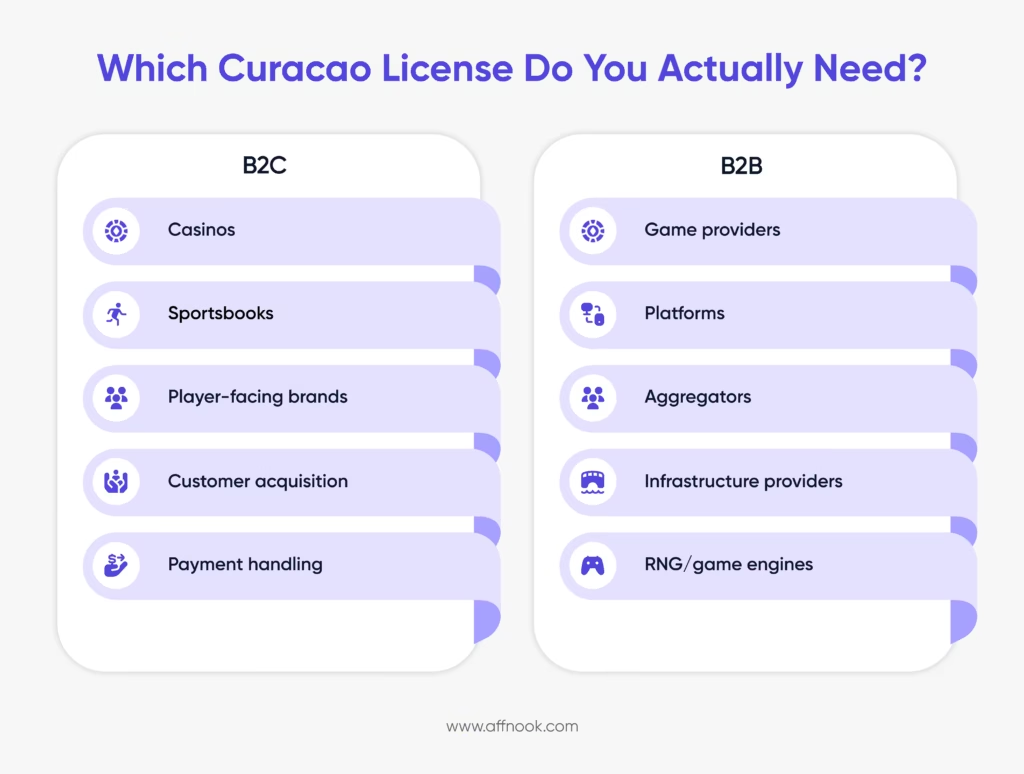
This brings Curacao closer to the more mature jurisdictions and also sheds light on the increasing complexity in the iGaming sector.
Who Chooses Curacao Today
Despite becoming stricter with time, the Curacao iGaming License continues to attract operators because it prioritizes speed and flexibility. This includes –
- Startups entering the market
- Crypto casinos experimenting with new models
- Affiliate-driven brands that want traffic from new markets without heavy direct investment.
Why Do Operators Go for a Curacao iGaming License?
Online gambling regulations are increasing these days and are also getting stricter. In such cases, it takes a lot of time for a platform, brand, or even an update to go live. Curacao solves this problem because it leaves no room for excessive upfront friction.
Speed and Accessibility
While licensing in jurisdictions like Malta takes months and also has multiple layers of approval, Curacao offers a route that is faster.
Tier 1 licensing process involves multiple stages, like –
- Business plan approvals
- Financial audits
- System certifications
- Iterative regular feedbacks
The process is hence stretched to 6-12 months. Curacao compresses this by narrowing its set of checks. The reason why it is less time-consuming is because it provides –
- Unified application
- Streamlined bureaucracy
- Moderate compliance burden
- Business-friendly structure
- Remote friendly
The process in this case is not just operational but also strategic.
Why is speed necessary for an operator? For them, speed means –
- Launching before an event or season
- Testing the market when the demand is hot
- Starting the acquisition campaign before the competitors
In iGaming, timing directly impacts revenue. Through the Curacao iGaming license, the real advantage for operators will be to capture that timing and not miss it.
Low Entry Costs
What is cost-effective is convenient and would attract attention. Curacao is a comparatively cheaper license. The cost advantage comes from three structural factors –
- Lower regulatory expenses: Tier 1 jurisdictions require multiple audits, certifications, and ongoing reporting infrastructure, and meeting these requirements is costly.
Despite the changes in compliance guidelines under the LOK, that is the Landsverordening op de kansspelen (National Ordinance on Games of Chance), Curacao does not require the same number of financial audits, which may increase costs to over 200,000 Euros. - Simplified scope of licensing – In many jurisdictions, iGaming operators would require separate approvals for different niches, be it casino, sportsbook, poker or any other vertical. Curacao brings the different gaming verticals under the roof of a single license.
This reduces licensing complexity, additional application costs and time spent on regulatory approvals. - Tax efficiency – Curacao charges 0% tax on gross gaming revenue, and the government, on the other hand, charges 0% value added tax on international wagers. The companies, however, must pay a 2% corporate income tax on the net profit.
This improves margins for operators who are especially targeting international markets. What is important here is that Curacao is low-cost to enter and not low-cost to run poorly.
If one doesn’t invest in compliance, payments, and infrastructure, the cost advantage begins to disappear due to operational friction.
Operational Flexibility
Due to its flexible nature, the Curacao license has become the first choice for startups and operators that prioritize crypto gambling and need to pivot quickly. Some of the core pillars of flexibility are as follows –
- One business license covers all gaming activities (casino, sports, live dealer, lottery). Not just that, operators are also open to adding new game types on their platform without any additional permits.
- Many tier 1 regulators hesitate when it comes to crypto and blockchain integrations. Curacao, on the other hand, is highly permissive towards cryptocurrency payments and blockchain-based gaming mechanics.
- The Curacao iGaming license is like the catch-all license, which permits operators to accept players coming from international markets where specific local licensing is not a compulsory requirement.
- Operators can manage their business through a Curacao offshore entity. This makes banking and payment-providing and processing partnerships more flexible when compared to those of the European offshore hubs.
While Curacao offers a flexible banking environment, most global payment processors (like Visa and Mastercard) are hesitant to contract directly with Caribbean offshore entities.
To bridge this gap, operators typically establish a payment agent. This entity acts as the intermediary and handles the flow of funds. This ensures a smoother integration with European banking networks and payment gateways. Without this bridge, securing reliable credit card processing can be nearly impossible.
Pro-Tip for Operators
- Factor in dual-company costs: Budget for the incorporation and maintenance of both the Curacao license holder and the EU payment agent.
- Intercompany agreements: Ensure you have a legal contract between the two entities to satisfy AML requirements.
Curacao iGaming License Requirements
After the recent updates by the “National Ordinance on Game of Chance,” the Curacao iGaming authorities have led the licensing process to be more structured, especially in the aspect of transparency and compliance systems.
Curacao is aligning with international FATF standards. The requirements are now set in accordance with that.
Corporate Structure and Ownership
The operator should be established as a legal entity in Curacao and should be able to define their ownership by having a local presence.
The CGA also demands to see the individuals who are actually at the end of the chain.
- The individuals who own more than 10% of the business must be revealed.
- They must ensure that their source of money is legitimate
- The ultimate beneficial owners must register details like their name, nationality, and ownership percentage. The local Curacao Chamber of Commerce then manages these details.
They must also be able to pass the fit-and-proper checks that are conducted by the regulators, where the character and history of the owners are verified. This requires the proof of –
- Clean criminal records with no major offenses
- Detailed CV and professional references
- Passport copies and proof of address
The fit and proper check will be passed if the business owners can successfully prove that they have enough money to pay for the player’s winnings and can meet any potential claims.
Compliance Framework
Compliance is not a requirement that must be fulfilled just for the sake of it. It is, in fact, a functional requirement.
Operators must implement AML and KYC systems that help manage and monitor risks. This includes –
- Verification of player identities
- Tracking transactions
- Identification of suspicious behaviour
Responsible gambling is also part of the requirement here. Operators must ensure that user activity is controlled and does not hamper them in any way. This can be done by putting limits on their deposit activity or by utilizing self-exclusion mechanisms.
Technical and Infrastructural Requirements
The business or operator must be able to prove that their business is legitimate. As in, the games are fair and the data is secure. Some of these requirements include –
- At least one Curacao-based server must be maintained in a tier 4 certified data center to store important player and transaction logs.
- All gaming software and Random Number Generators (RNGs) should be tested and certified by accredited labs like GLI (Gaming Laboratories International).
- The Curacao Gaming Authority should have real-time or on-demand access to the local servers for compliance auditing.
While Curacao is not as prescriptive as some jurisdictions, the expectation is clear, and that is, the system should work reliably and securely at scale.
How to Apply for a Curacao iGaming License
The application process for acquiring the license is pretty straightforward. This can be understood through different steps as mentioned below –
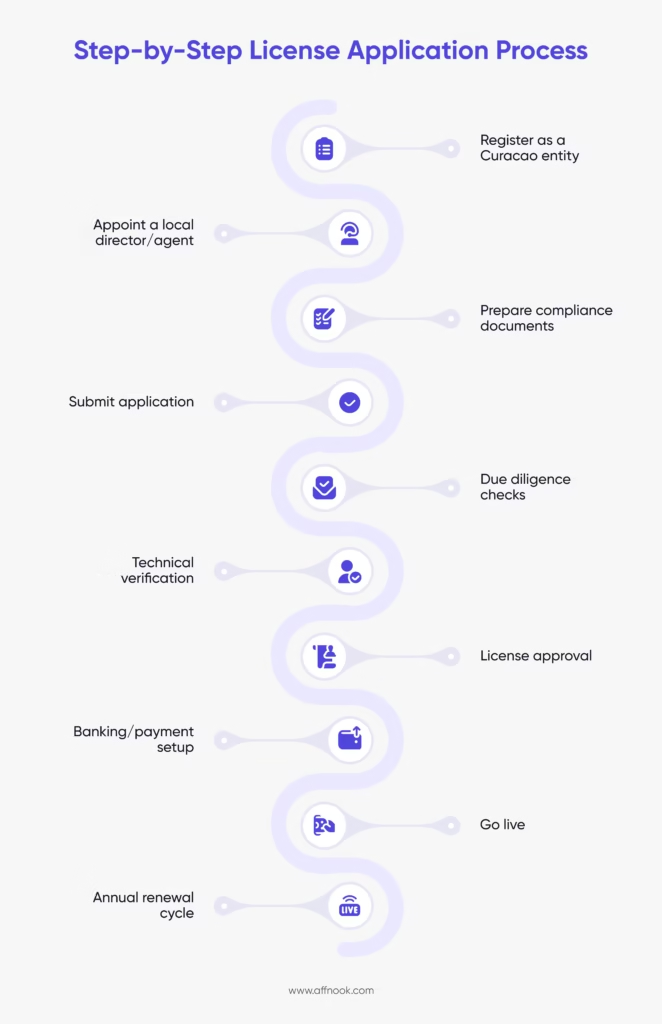
- Register your company in the region and appoint a local agent or a trusted resident as the director.
- Collect the important documents like copies of passports, criminal records, applications, business plans, KYC or AML policies, and software certificates, etc.
- Submit the application to the Curacao iGaming Authority with the documents and pay the fees.
- The documents are then sent for verification. Once approved, the company will receive a license that is valid for up to 1 year.
- Once the license is received, it is important to open e-wallets and merchant accounts so that financial transactions take place conveniently. Now the company can start operating.
- As the license will expire after one year, ensure that the company applies for a renewal every year with updated documents. The verification cycle is repeated, and the license is extended once approved by the authorities.
Curacao iGaming License Cost
Due to its easy accessibility, one may misinterpret the Curacao license to be cheap, but that is not the case. The upfront cost may not be that high, but the total cost of operation must not be underestimated.
As discussed, with the introduction of the LOK, Curacao has moved to a direct licensing model. The introduction of this model has altered who you pay and what you may be paying for.
The cost structure has clearly defined components; these include –
- Upfront application fee
- Due diligence for each key person
- Fixed monthly and annual licensing fees
- Separate costs that are domain-related
- Hostings and infrastructure
This reflects the shift that has now been made towards accountability. Operators are now paying for a regulated framework and not just the access.
Additionally, there are also hidden costs that add up. This includes compliance that requires continuous investment or technical maintenance, which cannot be ignored.
New Fee Structure
Under the older LBH system, despite paying high monthly fees, operators benefited from bundled services like multiple domains under a single license.
In the new system under the LOK framework, the structure becomes more granular.
There is now an application fee of around EUR 4,600, along with due diligence fees per individual involved in the business. Monthly fees have decreased, but annual fees have increased. This creates a balanced yet long-term cost structure.
Operators now pay a fixed annual fee for multiple domains. This simplifies scaling but also removes earlier cost advantages that were tied to volume.
- Older (LBH) model: EUR 63,000 annually
- New (LOK) model: EUR 55,000 annually
It must be noted that these numbers are indicative, not exact. The real takeaway is not that Curaçao has become cheaper or more expensive; it has become more predictable and standardized.
Maintaining a Curacao iGaming License
This is one of the most prominent updates. Curacao is not a passive license anymore that can be ignored once obtained. A few things must be taken into account.
Ongoing Compliance
Operators must frequently –
- Monitor transactions
- Enforce KYC rules
- Maintain a player protection system
It must be understood that compliance is not a one-time setup but a system that is ongoing.
Reporting and Accountability
Reporting must be a regular practice. Regulators can request information and can also conduct interviews without any prior notice. In such situations, the operator should always be able to provide accurate information with clarity
Operational Responsibilities
Beyond compliance, operators must manage renewals, notify changes in ownership or structure, and seek approval for expansions such as new domains or products.
All in all, the business must simply remain transparent and controlled at all times.
Reasons Why Licenses Get Suspended or Revoked
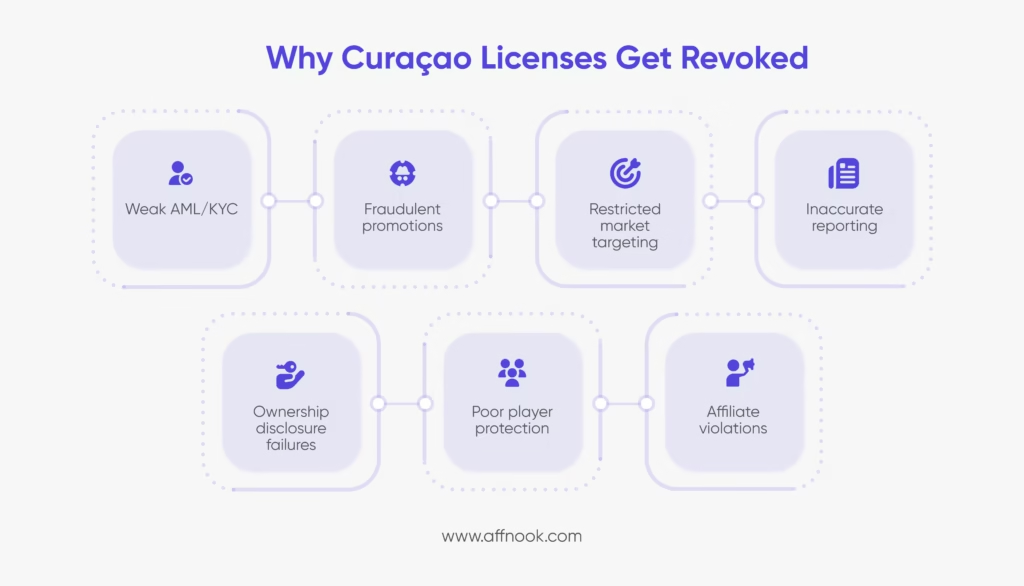
Licenses are not cancelled because of a single violation but repeated small failures.
- Weak AML and KYC systems are common triggers. Difficulty in monitoring transactions or inconsistency in identity verification are signs of a lack of control.
- Practices and tactics that are fraudulent, especially for players, can also create problems. Unclear and misleading promotions cause complaints that further lead to regulatory investigations.
- Operating in restricted jurisdictions is another major risk. Just because Curacao allows global operations does not mean every market is fair game.
- Reporting failures, incorrect disclosures, missing reports, or providing inaccurate information shatters trust with the regulator.
The consequences? Penalties that can range from fines to complete revocation of the license.
The impact? Apart from not being able to operate anymore, there are also secondary damages like loss of payment processing, banking issues and damage to reputation.
Grey Areas – Unclear Responsibility
There are certain situations where the law applies, of course, but the execution becomes messy.
- Crypto gambling – Using Bitcoin does not exempt you from anti-money laundering laws. It still must be proved where the money is coming from.
- White label setups – Buying a ready-made business from a provider can lead to a blame game. If something goes wrong, it becomes unclear who is legally responsible: the software provider or the operator
- Affiliate Risks – If an affiliate advertises a site in a banned country, the operator gets fined, not just them.
To Conclude
The Curacao iGaming license is changing from a quick way into a more organized regulatory system. While it still provides one of the simplest paths into the industry, the standards for compliance and operations are rising.
Now, the key to success isn’t just about acquiring the license. It’s really about how you run your business afterward. Operators who think of Curacao as an easy solution often face issues.
In contrast, those who use it as a solid base and develop effective systems around it are the ones who thrive and grow.
Help Centre
Is getting a Curacao iGaming license still a good idea in 2026?
The Curacao iGaming license continues to be one of the quickest and most budget-friendly routes into the online gambling scene. That said, with the introduction of the new LOK framework, there’s been a rise in compliance requirements. This means that operators now need to put stronger systems in place for things like Anti-Money Laundering (AML), Know Your Customer (KYC), reporting, and ensuring responsible gaming practices to stay credible and avoid running into legal troubles.
Can crypto casinos operate legally with a Curacao license?
Yes. Curacao is known for being welcoming to cryptocurrencies, allowing operators to use crypto payments and blockchain gaming. However, they still need to abide by AML and KYC rules. This means operators must verify the legitimacy of the funds used and keep an eye out for any suspicious activities to align with international standards.
What risks come with a Curacao iGaming license?
The main risks include weak AML practices, inadequate KYC procedures, misleading promotions, and targeting areas where they shouldn’t. If an operator fails to comply consistently, they could face fines, difficulties with payment processing, harm to their reputation, or even suspension of their license. Transparency and regular reporting have become even more vital under the updated regulations.
What documents do you need when applying for a Curacao iGaming license?
Typically, operators are required to provide passport copies, proof of address, criminal background checks, business plans, AML and KYC policies, software certifications, and details regarding ownership. Regulators also perform checks on key individuals to ensure they’re financially solid, operating legitimately, and have a clear source for their operational funds.
What is a Curacao iGaming company?
A Curacao iGaming company is a gambling business that is incorporated in Curacao and operates under a license issued by the Curacao Gaming Authority. These companies can offer services such as online casinos, sportsbooks, poker platforms, bingo, and other gaming products to international markets, in accordance with local regulations