
“Mobile first this…” “Mobile first that…” have become commonly used phrases for almost all digital platforms and services. Platforms are going mobile first because the users are going mobile first.
This is also the case with betting. Retail betting was replaced by online betting through PCs, and now that too is getting replaced by mobile betting. This is because one may or may not have a laptop, but they surely would have a mobile phone with a strong internet connection.
The gap between computers and mobile phones continues to widen. For iGaming brands and operators, this is not an upcoming shift that they must prepare for. It is, in fact, the reality of 2027.
For sportsbook operators specifically, this raises a question, and that is: Is your affiliate marketing infrastructure built for a mobile-first betting economy, or is it still catching up to one?
This guide will answer this question. It aims to examine what the mobile betting shift means for affiliate strategy, the operational challenges it introduces, and how a purpose-built platform such as Affnook helps brands and operators translate mobile betting growth into measurable acquisition.
The Scale of the Mobile Betting Shift
If we say that the market is leaning towards mobile betting, then the argument also has to be substantial. As per research, around 80% of all online gamblers had started switching to mobile betting in 2025. In fact, in the US itself, 80.3% of the total online gambling revenue was led by mobile devices.
Globally, mobile and tablet devices account for more than half of the online gambling revenue. Even live and in-play wagering formats that are exclusively consumed on mobile have overtaken pre-match betting for the first time.
Reports suggest that the global sports betting market was valued at USD 191.66 billion in 2025 and will reach USD 385 billion by 2033.
All this has a direct implication for the operators. This is because their –
- Acquisition strategies
- Creative formats
- Affiliate infrastructure
are primarily built around desktop-friendly users, which is misaligned to some extent with where their active audience actually is. Mobile betting, hence, is not just one segment of the gambling market but is a whole separate market in itself.
What Are the Regional Dynamics Behind the Mobile Betting Curve?
While a global shift toward mobile betting is established, it is not uniform across all regions. Operators must take note of these differences when building their marketing strategies, whether in-house or through affiliates. In order to globalise, they must localize. Blanket strategies, hence, cannot work in this scenario either.
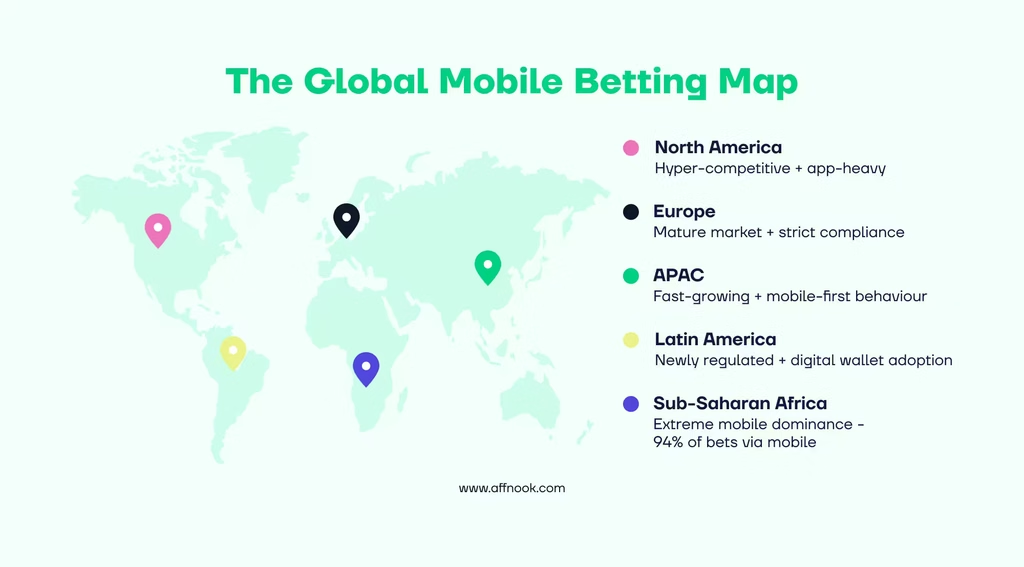
North America: Hyper Competition and State-by-State Rollout
North America has rapidly expanded, boasting a 38.7% share of the global online gambling and betting market and projected to grow at a 15.4% CAGR.
- The regulatory climate – The US has been operating as a patchwork market ever since the repeal of PASPA. In order to succeed, iGaming brands should be able to manage localised compliance. This could involve rapid shifts that take place when states abruptly ban or restrict collegiate prop betting.
- Media and league integration – Growth in the USA is exceptionally high because it is closely associated with prominent operators like DraftKings and FanDuel that engage in structural integrations with major leagues like the NFL and NBA.
- Technological Sophistication – Low-latency 5G infrastructure allows over 78% of gambling spend to flow through apps, with a heavy emphasis on micro-betting and Same-Game Parlays (SGPs).
Europe: The Mature, High-Compliance Stronghold
Europe holds roughly more than 40% of the global sports betting market share, which makes it one of the largest global revenue generators in the niche.
Just as the whole world cannot have the same type of market, Europe in itself cannot be viewed as a single market. While the European market is considered a mature market as a whole, it is also multi-tiered.
- Western Europe acts as a highly consolidated yet saturated foundation.
- Nordic countries are undergoing structural shifts.
- Eastern Europe serves as the primary engine for high-velocity growth.
In addition to this, European countries also have their own distinct yet strict compliance frameworks. Nations are, in fact, imposing rigid and standardized tax bands, mandatory but safe gambling tools, and tight bans on sports sponsorship.
Asia-Pacific: High Velocity Amidst the Fragmentation
The APAC region is the fastest-growing mobile market, expanding at a 10% CAGR. Additionally, its share in the global mobile gaming revenue is high enough that it has also started flowing into the wagering niche as well.
- Mobile-first wagering system – The population here has almost completely started to rely on smartphones. This is why iGaming platforms have started utilizing integrated multi-language interfaces and have started integrating with local digital wallets as well.
- The esports and cricket phenomenon – The Western market revolves around traditional football or American football. This is not the case with the Asian audience. The APAC market’s curve is instead more inclined towards esports tournaments such as VALORANT and sports like cricket.
- Regulatory bifurcation – While users’ interests may overlap, regulations differ sharply across regions. On the one hand, there are tightly regulated or licensed hubs like the Philippines, but on the other hand, there are also restrictive yet grey-zone mainland markets like China.
Latin America: The Newly Regulated Frontier
Latin America is transitioning from an unmonetized grey market into an institutionalized powerhouse and is expected to yield over 23 billion by 2033.
This market is rapidly shifting from a grey-market space to a highly regulated environment. This transition is specifically being highlighted because of Brazil’s regulated fixed-odds betting market that was recently launched. The reason behind this is Brazil’s deeply rooted enthusiasm for its football-dominated culture. This is further paired with the widespread adoption of digital wallets.
The Sub-Saharan African Market
The Sub-Saharan African market operates as a hyper-localised mobile pocket which is defined by extreme mobile dominance. As per research, an overwhelming majority of 94% of online bets are placed through mobile phones.
Due to this, the regional market here relies on data-light app architectures with minimal data consumption. To add to that, the entire system here is structurally dependent on telecom-driven mobile money infrastructure such as Kenya’s M-Pesa. These platforms are responsible for handling frictionless cash-ins and payouts, which allows them to bypass traditional banking systems entirely.
Why Does This Specifically Matter in Affiliate Marketing?
Affiliate marketing is a primary acquisition channel in the iGaming niche. Still, this shift to mobile devices changes the fundamentals of how the channel performs and how it must be measured.
There are several factors that must be taken into account in this scenario.
Attribution Complexity Increases
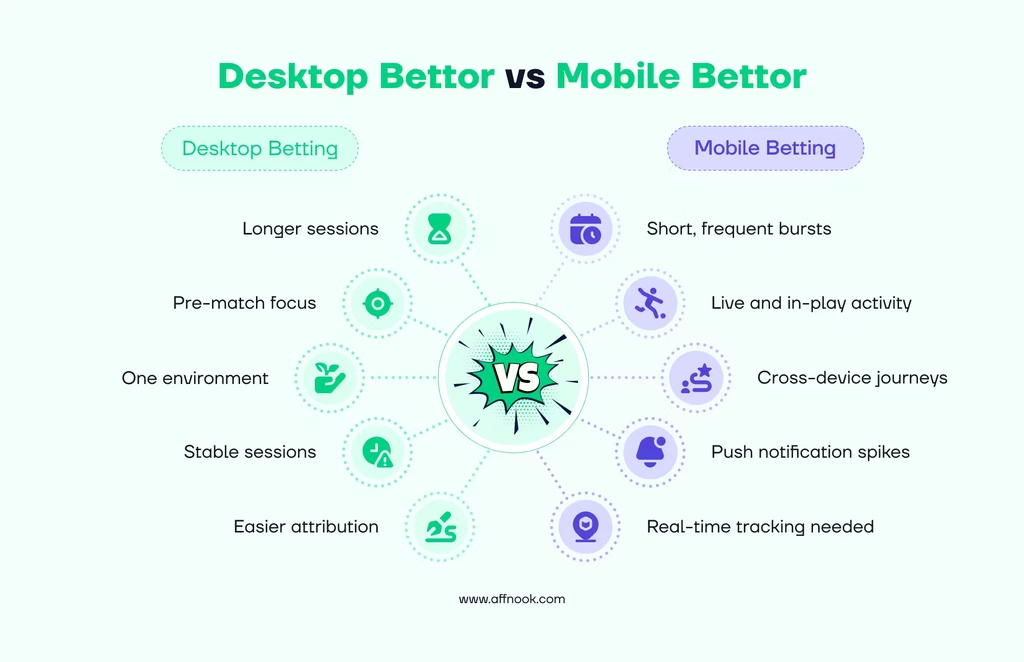
Let us consider an instance of a player clicking an affiliate link on a mobile browser, downloading the mobile gambling app days later, and then finally registering through the app. This presents an attribution challenge that does not occur often on desktops.
Cross-device and cross-environment journeys have become the norm now instead of being an exception they were earlier. This includes –
- Browser to app
- App to in-app purchase
- Session to session across multiple days
Session Behaviour Has Changed
The behaviour of a mobile bettor is different to that of a desktop bettor. These players engage with live and in-play markets. The bets that they place are short but in frequent bursts instead of longer single sessions. Additionally, there have also been spikes due to push notifications. All of these changes have raised the stakes of real-time tracking. This, hence, affects what the report shows under the “conversion” and “engagement” section.
A delay of even a few minutes in reflecting an in-play wager can materially distort affiliate performance data during high-traffic events.
Fraud Risk is More Pronounced
Mobile betting leads to more exposure to some categories of affiliate fraud, such as –
- Device farms
- Emulator traffic
- Multi-accounting through app-based sign-ups
These frauds are also harder to detect because –
- Devices have rich hardware sensors
- Apps run in sandboxed environments that hide system modifications
- SDKs lack deep visibility into the operating system core
Operators who rely on affiliate tools without mobile-aware fraud detection are more exposed to inflated CPA payouts on traffic that never even converts into genuine and retainable players.
Creative and Landing Experience Requirements are Stricter
Promotional content that is not optimized for the correct device glitches, takes longer time to load, and eventually ruins the experience. A bad experience lowers the conversion rate where the largest share of traffic now originates.
Affiliate Diversity has Expanded Alongside Mobile Adoption
The affiliates who drive mobile betting traffic today are expected to do more than just reviews and comparison websites. They have, in fact, become a more meaningful representation of the acquisition channels. This could be –
- iGaming influencer partnerships
- Mobile native content creators
- App-store optimisation specialists
All of them have different tracking requirements and payout structures. Affiliate infrastructure that was designed around a narrower set of traditional publisher relationships often struggles to accommodate this mobile-centric partner mix without manual kludges.
These factors show that a mobile betting acquisition strategy does not mean simply transporting what is being shown on a big desktop screen to a small mobile screen. It requires infrastructure that is purposefully built to track, verify, and optimise performance in accordance with the behaviour that mobile bettors exhibit.
Payments in a Mobile-First Funnel
Getting a bettor to register is just half of the acquisition story. Converting a registration into an active and funded account depends heavily on how conveniently they can deposit from their phone.
While some use local mobile native payment methods, mature markets use Apple Pay and Google Pay, Pix has gained immense popularity in Brazil, and mobile money services in parts of Africa. Additionally, mobile-based crypto wallets are also gaining prominence and have become a practical requirement due to the increasing popularity of online crypto gambling.
An affiliate program can send high-quality traffic to a mobile landing page, but if the deposit flow does not support the payment method the player uses on their phone, that traffic can be considered to be wasted.
Core Priorities of Building a Mobile-First Affiliate Strategy
Operators who are looking to align their affiliate platforms with the realities of mobile betting must consider the following as priorities –
Precise Real-Time Attribution
Considering the prevalence of in-play betting and short mobile sessions, it is necessary for attribution systems to capture conversions in real time and should also account for multi-touch, cross-device journeys.
S2S postbacks and pixel-based tracking must function reliably on both, mobile browsers and native apps, not just desktop environments. Otherwise, the operators could risk –
- Misattributing revenue
- Underpaying high-performing affiliates
- Overpaying for traffic that does not show genuine player value
Additionally, cookie-based tracking is not meant for mobile due to its unreliability. Apple’s Intelligent Tracking Prevention (ITP) and similar browser-level privacy controls on mobile Safari and other mobile browsers routinely limit or expire third-party cookies. This happens well before a bettor completes their registration and makes a first deposit.
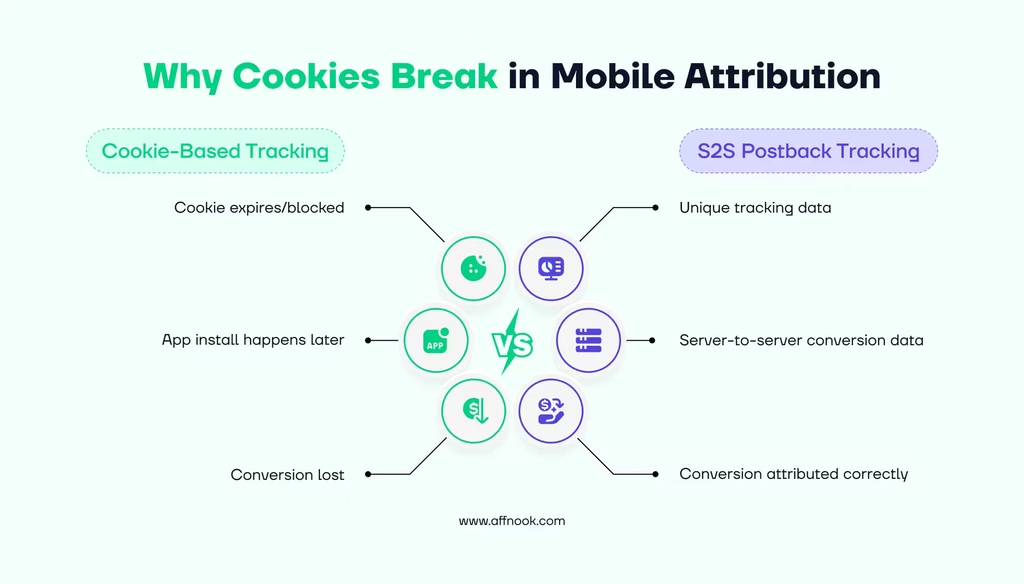
It is through S2S postbacks that this gap is filled. As the conversion data gets directly passed between the operator’s server and the affiliate platform, the data is less exposed to this kind of data loss.
This is why it has now become a baseline requirement instead of being an optional upgrade for mobile betting attribution.
This is why attribution windows need reconsideration. A bettor may –
- Click on an affiliate link on a mobile network
- Delay app installation until connecting to WiFi
- Not register until several days later
Mobile-Aware Fraud Detection
Fraud detection and prevention tools need to be standardised for mobile-specific risk patterns like –
- Device fingerprinting – Scammers tend to constantly delete and reinstall apps to fake new user sign-ups. The tools must look past the basic data to identify the actual device to catch multi-accounting in its tracks.
- Emulator and proxy detection – Fraudsters prefer using desktop emulators and data center networks to simulate mobile traffic at a massive scale. Hence, systems should be utilised to instantly flag and block disguised users.
- Real-time blacklisting – Static lists fail fast. The IP and device blacklists must update dynamically in real time to adapt to emerging fraud patterns before they drain the brands’ budget.
Optimised, Fast-Loading Affiliate Funnels
The more time it takes for a landing page to load on a mobile landing page, the more the probability of conversion gets reduced. This is why affiliate programs’ evaluation should go beyond the quality of the traffic sent. It should also focus on how well the operator’s own mobile funnel converts that traffic.
This is a factor operators can directly control through –
- Landing page design
- Form simplification
- Pre-filled data where necessary
Industry conversion studies commonly show that even a three-second delay in mobile page load time can reduce conversion rates by close to 53%. This makes Core Web Vitals like –
- Load speed
- Interactivity
- Visual stability
a direct revenue lever rather than a technical metric for affiliate-driven landing pages.
Additionally, registration friction affects this too. Short sign-ups hence work better because –
- Small phone screens make long forms annoying to fill out.
- Quick text codes and simple ID checks save time.
- Easy steps mean more people finish signing up, which implies more sales.
This is also extended to the app-store layer for operators with native betting apps. Affiliate traffic is not expected to directly land on the app listing instead of a browser-based landing page. This is because it adds an extra conversion step of installation before registration even begins.
When companies overlook the app store step in their funnel analysis, they blame the wrong source. They assume affiliates are delivering low-quality leads, but the real culprit is friction during the download handoff.
Transparent, Fast Payment Processing
As affiliate networks expand globally alongside mobile betting, fast and automated payments have become a major selling point for attracting top talent. High-performing affiliates expect to be paid accurately and on time. Any delay or friction can push them straight to a competitor.
This gets even trickier as mobile betting explodes in newly regulated markets. Operators must navigate unfamiliar local payment methods and currency conversions, making reliable affiliate payouts a complex but vital puzzle to solve.
How Affnook Addresses the Mobile Betting Shift
Affnook is built specifically for iGaming affiliate marketing, and its feature set maps directly onto the priorities mobile betting growth demands.
- Mobile tracking through MMP integrations – Tracking native in app behaviour like installs and in-app sessions requires a designated Mobile Measurement Partner (MMP). This is because browser-based tracking alone can’t capture what happens inside a betting app. Affnook’s tracking infrastructure comes with premade integrations for major MMPs, and a two-way API for operators who need to connect a less common or in-house MMP setup.
- Dual tracking for omnichannel bettors – Operators don’t necessarily have to be pure mobile or pure desktop. They can have an existing base on laptops, which can be later pivoted to mobile. It is a fact that a bettor keeps switching between both. Affnook tracks both environments in parallel rather than treating them as separate funnels. This prevents the same player from being double-counted as two separate conversions across channels, and it gives operators an accurate lifetime engagement view.
- Built-in fraud detection – The platform includes fraud prevention tools that block data-center traffic, blacklist suspicious IP addresses, and filter unknown or anomalous device traffic. This directly addresses the multi-accounting and fake-traffic risks that are more pronounced in mobile affiliate environments. For operators managing affiliate spend, continuously updated filtering reduces the manual review burden that would otherwise fall on internal fraud and compliance teams.
- Automated multi-currency payment – Affnook automates payment and invoicing processes across more than 50 currencies. This reduces the administrative friction that can otherwise slow affiliate payouts as programs expand into mobile-heavy regulated markets.
- Real-time reporting and predictive analytics – The platform’s reporting tools are built to reflect performance as it happens, supporting the kind of fast decision-making that in-play, mobile-driven betting activity requires, while predictive analytics help operators anticipate which affiliate relationships are worth scaling.
Conclusion
Mobile betting is no longer a channel operators are migrating toward. It is the channel their audience already lives in. This is because growth is now happening on phones and not desktops.
In a market where success is measured in seconds, mobile-first changes everything. It changes how conversions are tracked, how fraud is caught, and how landing pages perform. Operators trying to manage mobile traffic with old desktop-era systems are losing money but are also completely misreading their data.
The brands that come out on top will completely rebuild their affiliate setups to make themselves mobile-friendly. That means instant cross-device tracking, mobile-smart fraud prevention, smooth funnels, and global payout systems.
Affnook bridges this exact gap. By wrapping precise tracking, fraud prevention, global payments, and instant analytics into a single platform, it lets operators lead the charge in mobile betting’s fastest-growing markets instead of constantly playing catch-up.
FAQ
An MMP (Mobile Measurement Partner) is a tool that tracks native in-app behavior. This includes installs, in-app events, and sessions that browser-based tracking cannot capture. Since a large share of mobile betting happens inside apps rather than mobile browsers, MMP integration is necessary for accurate attribution.
Yes. Mobile-specific fraud includes device farms, emulator traffic, and multi-accounting through app reinstalls, which are harder to detect than desktop fraud because mobile devices and sandboxed apps limit visibility into underlying system modifications.
Mobile betting changes how conversions must be tracked and measured. Bettors move across devices before converting, engage in short in-play sessions, and are harder to attribute using traditional cookie-based methods. All of this requires affiliate infrastructure built specifically for mobile, not adapted from desktop.
Apple’s Intelligent Tracking Prevention (ITP) and similar privacy controls on mobile browsers limit or expire third-party cookies before a bettor completes registration and deposit. Server-to-server (S2S) postbacks, which pass conversion data directly between the operator and affiliate platform, avoid this data loss.