
Crypto and Bitcoin investments are the new trend. So is the case with the iGaming industry, as iGaming players want to earn more and earn quickly and hence, they are switching to crypto betting. It is, in fact, expected to grow at a compound annual growth rate of approximately 12- 15% by 2033.
It is the kind of betting that is often discussed in terms of faster transactions, digital wallets, and the growing use of cryptocurrencies in online wagering. For operators, the matter of putting this development on their platform is just a part of the broader equation. The challenging part here is to make sure that the entire betting operation and its digital assets are handled without any unnecessary complexity for the players or the internal teams.
Crypto-enabled sportsbooks operate within the rules of their target market. What makes it different from other forms is the way its processes interact with cryptocurrency transactions, changing asset values, and the blockchain infrastructure.
It is important for operators to understand these differences and their requirements so that they can evaluate whether crypto betting fits their model.
How Does Crypto Betting Change Sportsbook Operations?
Crypto gambling is different from the traditional way of gambling. Standard sportsbooks generally display balances in trust-based fiat currency like dollars or euros. The only concern is if the chosen team wins or loses. Crypto brings in another layer to this, and that is the change in value of the digital assets themselves.
In simpler terms, when an iGaming player bets with cryptocurrency, they are taking two risks at the same time. One is that of the bet itself, and the other is the risk of the crypto’s price changing.
Consider a player who deposits Bitcoin when its market price is $60,000. If the price rises to $63,000 before the player withdraws, the value of the remaining Bitcoin balance in dollar terms will have changed, even if the player has not placed another bet.
Hence, a distinction gets created between betting performance and asset performance that the operators must keep note of. A sportsbook might generate a particular amount of gaming revenue while the value of the cryptocurrency it holds moves in a different direction.
Sorting these two factors is important when evaluating business performance. Otherwise, movements in crypto prices could make financial results appear stronger or weaker than what the betting activity actually suggests. The choice of account currency becomes an important decision in this scenario. Operators must be clear about where the balances, odds, wagers, and winnings will be displayed. Will it be crypto? Fiat equivalents? Or both.
Crypto Betting and the Challenge of Managing Currency Variability
Cryptocurrency volatility affects more than the value of a deposit. It also impacts how operators manage their financial exposure, communicate balances, and reconcile transactions.
- One approach is to let players hold and wager in the same cryptocurrency.
- The other approach is to convert deposits into a designated accounting currency, where the platform and payment setup support that arrangement.
Both approaches have different implications when it comes to treasury management and player experience. For instance, a sportsbook that accepts several cryptocurrencies may need to decide –
- When the exchange rates are applied
- How long a quoted conversion rate remains valid for
- Which rate is used to calculate the withdrawal
Without proper rules, players might see inconsistencies in the deposited amount, displayed balance, and the final amount received.
There is an option of utilizing stablecoins as well, which protects the user from price swings of normal crypto, but they also have their own risks. Their value can drop below the currency they are supposed to match. Additionally, the company managing the coin might fail, or it might become difficult to trade or cash out. By taking this into consideration, businesses must review each stablecoin individually instead of assuming they are all equally safe.
What Happens When Crypto Betting Meets Live Sports?
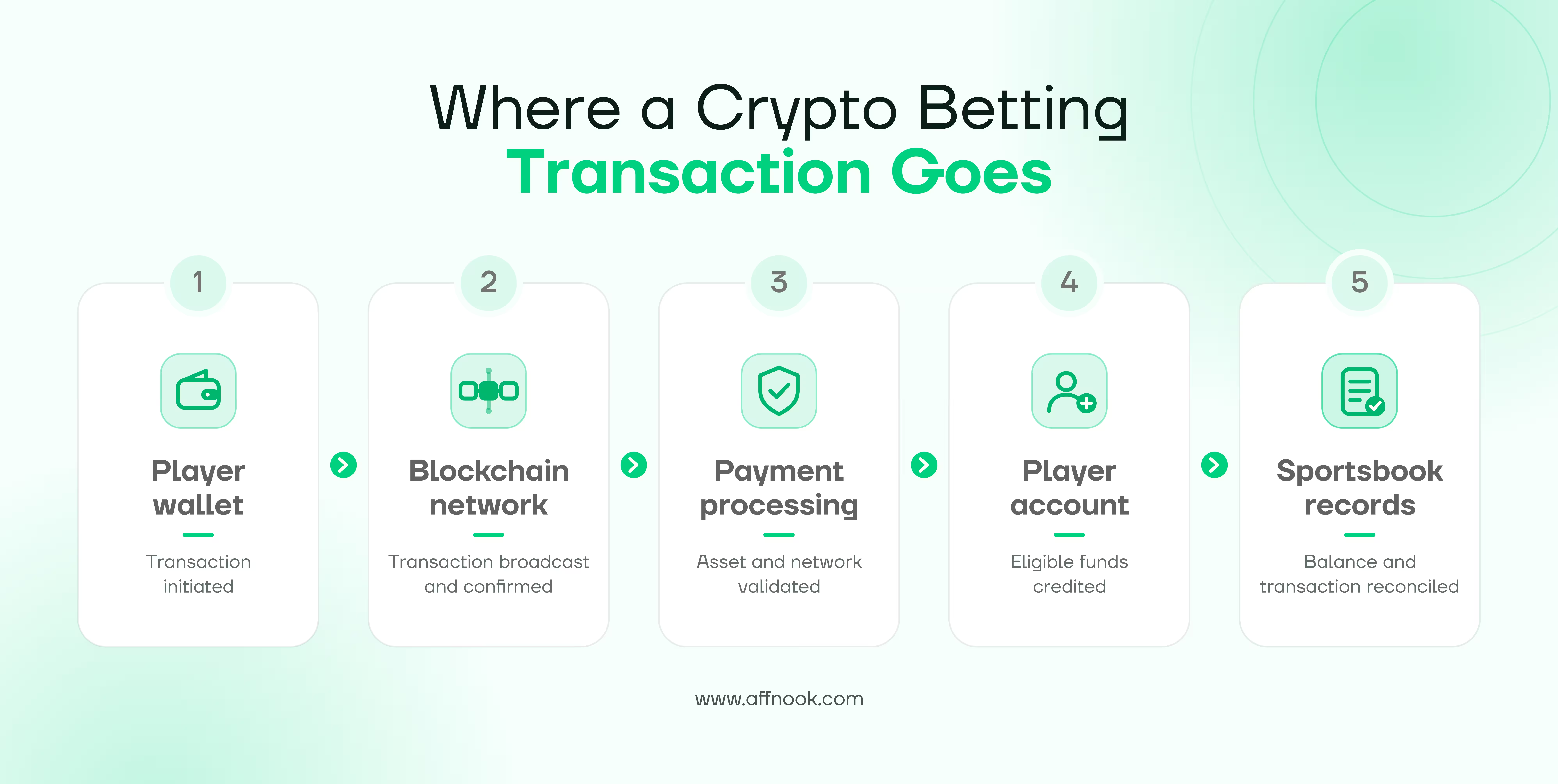
Live sports betting is fun, but it also comes with its own complexities. Odds change within seconds as a match starts gaining ground. Crypto transactions, on the other hand, require network confirmation and may involve variable fees or processing times, which makes it difficult to keep up the pace with the game.
These are two separate processes. An iGaming player may be able to view and accept an in-play market quickly, but that does not mean a deposit or withdrawal will be confirmed at the same speed.
This distinction matters when a player transfers funds just before they place a live bet. If the transaction remains unconfirmed, the sportsbook needs clear rules about when those funds become available for wagering. This also applies when a bet is accepted while a later transaction is still in process.
The operators should consider how their platform handles –
- Deposit confirmation – When the incoming funds become available for betting.
- Odds changes – How the platform handles price changes between selecting a market and confirming a wager.
- Bet settlement – How the final outcome is calculated and credited to the player’s account
- Withdrawals – How the processing status is communicated when the confirmation of blockchain takes longer than expected
- takes longer than expected.
These processes need to work together, even though they may rely on different systems. Clarity of status messages and consistent settlement rules can prevent players from confusing a pending transaction with a rejected bet or an unpaid winning wager.
How Should Operators Evaluate Crypto Betting Markets?
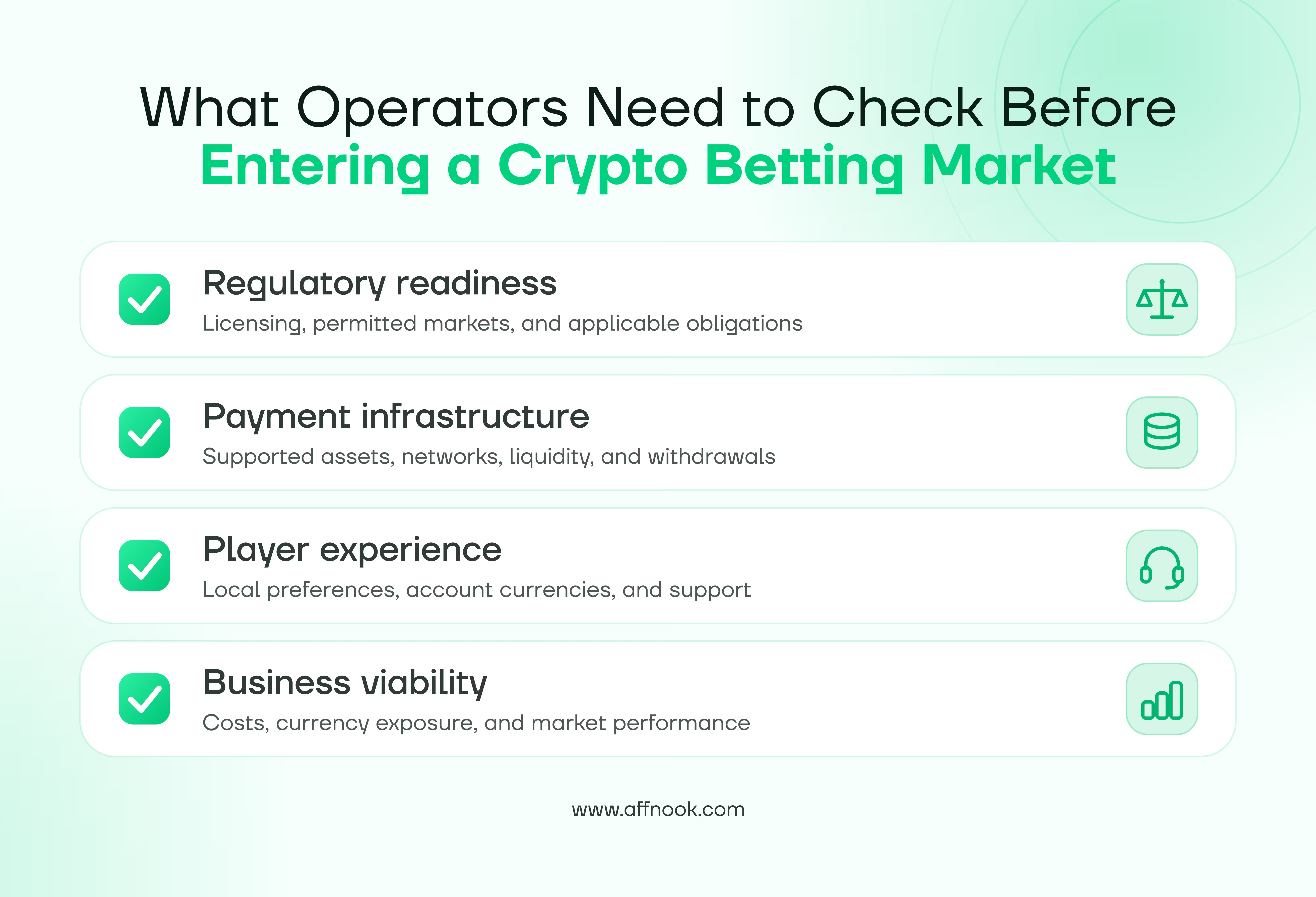
Choosing a crypto betting market involves more than identifying where cryptocurrency is popular. Operators must go into the depth of it and should understand how betting markets function, how outcomes are settled, and what financial and regulatory conditions could affect their operations. Some areas that require particular attention are –
Market Liquidity and Betting Limits
A betting market needs enough funds to encompass wagers without creating significant pricing difficulties. For sportsbooks this means –
- Assessing the depth of available odds
- The volume of betting activity
- The potential impact of larger stakes on risk exposure.
In exchange-based betting models, liquidity directly affects whether players can match wagers at their preferred odds. Thin markets may produce wider spreads and greater price movements, but also experience difficulty managing larger bets.
Operators should therefore evaluate the sporting events and betting markets they intend to offer, considering expected demand, pricing reliability, and the limits they can support. A market that attracts a moment of popularity may not justify the same investment as one with consistent player activity.
Outcome Verification and Settlement Rules
Players need to know how a winning bet is determined and are even more keen to know when their resulting balance will be credited. This is especially important when a platform combines blockchain-based transactions with conventional sportsbook settlement processes.
- Operators should establish clear rules for postponed matches, abandoned events, disputed results, and other situations in which the outcome may not be immediately clear.
- They should also identify the authoritative data source used to confirm results and define how corrections or discrepancies are handled.
For localised prediction markets, this assessment must also include clarity of the governance mechanism responsible for resolving outcomes. The objective is to make settlement decisions consistent, explainable, and traceable, reducing uncertainty for both players and operational teams.
Regulatory Classification and Market Access
Not every product involving crypto-based wagers falls under the same regulatory framework. Based on its structure and jurisdiction, a platform can either be treated as a –
- Gambling operator
- A betting exchange
- A provider of a financial product
These categories can carry different licensing and operating requirements.
Before entering a new market, operators must clarify the classification of their specific product. They also need to determine whether their licence covers the intended betting activities and whether their cryptocurrency arrangements introduce additional commitments.
The Financial Action Task Force’s guidance on virtual assets and virtual asset service providers offers an international reference for understanding relevant anti-money-laundering responsibilities. However, it does not replace local legal advice or determine whether a particular betting product is permitted in a given jurisdiction.
This matters because regulatory approval for a cryptocurrency infrastructure or exchange-based model does not automatically authorise a sportsbook to offer betting, and a gambling licence does not necessarily resolve every requirement associated with cryptocurrency services.
Financial Exposure and Fund Security
Crypto betting can introduce financial exposure beyond the outcome of a wager. Operators need to factor in changes in asset values, fluctuating transaction costs, and the security of funds held across wallets or other infrastructure
Before expanding transaction volumes or supporting additional assets, operators should establish clear processes for managing these risks –
- Asset Valuation and Conversion: Define when cryptocurrency is converted, which exchange rate is applied, and how balances are valued for accounting purposes. Differences between transaction values and internal records should be investigated systematically.
- Wallet and Fund Security: To make sure that the money is safe, it must be checked that the platform can handle who has cash control, who approves cash-outs, and what the backup plan is
- Smart Contract Security: Where smart contracts are part of the platform, review their security and any independent audit findings. This consideration applies to systems using smart contracts and not every crypto sportsbook automatically.
- Promotional and Token Liabilities: Establish clear accounting and redemption rules for promotional balances or token-based rewards. Operators should understand when these become payable and how the associated liabilities are recorded.
What Should Operators Monitor After Launch?
Once a crypto sportsbook is operational, the next challenge is understanding how its payment model affects the wider business.
Looking at deposit volume alone will not show whether the operation is performing well. Operators need to distinguish between payment activity, betting activity, and the financial impact of holding or converting digital assets.
Some of the useful areas to monitor include –
- Deposit completion: The proportion of initiated deposits that are successfully confirmed and credited.
- Transaction processing time: How long deposits and withdrawals take, including the time spent waiting for network confirmations.
- Payment-related support requests: Recurring issues involving missing deposits, incorrect networks, conversion differences, or delayed withdrawals.
- Currency exposure: How changes in supported crypto assets affect the value of funds held by the business.
- Betting performance: Wagering activity, settled bets, and gaming revenue, measured separately from changes in cryptocurrency prices.
- Market-level performance: Differences in transaction completion, player activity, and operational costs across permitted markets.
These indicators help operators identify where complications may occur and whether it originates in the payment process, the sportsbook platform, or the underlying asset.
Building a Crypto Betting Operation That Can Scale
Operators need processes that can handle increasing transaction volumes, new markets, and additional digital assets without making the platform harder to manage.
Start with a limited set of supported assets.
Rather than accepting every available cryptocurrency from the outset, operators should evaluate which assets their target audiences use and whether their payment infrastructure can support them reliably.
Standardize payment and reconciliation processes
As transaction volumes increase, manual checks become harder to manage. Operators should establish consistent procedures to confirm deposits, credit player accounts, process withdrawals, and match blockchain transactions with internal records. Automated reconciliation g workflows can help teams manage growth without creating unnecessary operational complications.
Monitor performance across the entire player journey
Deposit completion rates alone do not reveal whether a crypto betting operation is working well. Operators should also monitor transaction processing times, withdrawal delays, payment-related support requests, player activity, and performance by market and supported asset. Reviewing these indicators together helps identify where the experience breaks down and which improvements are likely to have the greatest impact.
Build flexibility into the platform from the beginning
Payment integrations, reporting systems, and account management processes should be able to accommodate new assets and markets without requiring major changes to the entire operation. Clear ownership of each process, documented procedures, and regular reviews of payment-provider performance can also help teams respond as requirements evolve.
To Conclude
Ultimately, scaling a crypto betting operation is about making expansion repeatable. Operators that introduce changes gradually, measure the results, and strengthen their underlying processes can make better-informed decisions about where to grow next. The objective is not simply to support more cryptocurrencies or enter more markets, but to build a sportsbook that can accommodate growth while maintaining reliable transactions, accurate records, and a consistent player experience
Help Centre
Crypto betting odds generally work like odds at traditional sportsbooks. They indicate the potential return on a wager and reflect the platform’s assessment of an event’s likelihood, market conditions, and risk exposure. Odds may be displayed in decimal, fractional, or American formats, while cryptocurrency is used to fund wagers or receive payouts. Using crypto does not necessarily change how the underlying odds are calculated.
Provably fair betting uses cryptographic methods that allow players to verify certain game outcomes against information provided by the platform. Depending on the implementation, this may involve server seeds, client seeds, and cryptographic hashes. However, provably fair mechanisms are more commonly associated with crypto casino games than conventional sports betting. They do not independently prove that sportsbook odds are fair or that a sporting event’s result was settled correctly.
Some crypto-enabled sportsbooks support in-play betting, allowing players to wager while an event is underway. Available markets and supported cryptocurrencies vary by platform and jurisdiction. Live betting also involves rapidly changing odds, so the markets available when a player places a wager may differ from those available moments earlier.
A custodial platform holds or controls users’ cryptocurrency through wallets managed by the operator or its service provider. A non-custodial model gives users greater control over their assets through their own wallets and, in some implementations, smart contracts. The distinction affects how transactions are authorised, who controls access to funds, and which technical and security responsibilities apply. Actual arrangements depend on the platform’s architecture.
Operators should assess whether a cryptocurrency suits their intended markets, player preferences, and payment infrastructure. Relevant considerations include network availability, transaction fees, confirmation requirements, liquidity, price volatility, and the reliability of conversion or custody services. They should also establish whether the asset and associated payment arrangements can be supported under the applicable regulatory framework.