iGaming market analysis reveals that crash games saw a quarter-to-quarter growth of 34% through 2025 in Latin America, making them one of the fastest-growing formats in online gambling. The game concept is simple: observe an increasing multiplier and cash out before the result crashes; otherwise, you lose your money.
Traditional casino games use RNG to determine their outcome in a predetermined fashion. On the other hand, in multiplier (crash) games, players have the ability to use timing and make choices to influence their outcome.
Moreover, the game is transparent through its provably fair technology and the fact that each round lasts seconds, all of which attract a new generation of players searching for fast-paced and skill-based gaming opportunities.
For iGaming operators and affiliates, it is critical to understand the mechanics of such games so as to take advantage of this rapidly growing segment.
What is a Crash Game?
A crash or multiplier game is a form of gambling played online where you place bets on an increasing multiplier that could “crash” at any time without warning or notice whatsoever.
The game starts with a value of 1.0x and increases in increments, for example, 1.5x, then 2.0x, then 5.0x and so on, until the player makes his decision to remove his money (cash out) before he crashes (loses).
Players can think of this type of gambling game like a balloon inflating with money: the bigger it gets, the more you can win—but it can pop at any second, and you lose everything if you’re still holding on.
The format emerged in cryptocurrency casinos around 2014-2015, gaining popularity for its transparency through provably fair technology and fast-paced gameplay lasting seconds to minutes.
Key Components of Crash Games
Multiplier
Multiplier begins each round at 1.0x, increasing till it crashes. Movement of multipliers may reach 2.0x, 10.0x, 50.0x or sometimes even higher. Your winnings equal your initial bet multiplied by the value at cash-out—a $10 bet at 5.0x yields $50.
Cash Out
Once a player clicks the cash-out button, they will lock in their currently earned winnings. Many games offer auto cash-out options, allowing a player to set their predetermined value up (e.g., 2.5x) to help the player avoid making emotional decisions and help the player stay disciplined.
Crash Point
The crash point is the randomly generated multiplier at which the round will end. The crash point is generated using either an RNG or a provably fair algorithm and will remain hidden until the round is complete.
Crashes can occur at a multiplier of 1.01x (instant loss) or can occur at a multiplier over 100x, adding to the unpredictability and suspense of the game.
How Crash Games Work
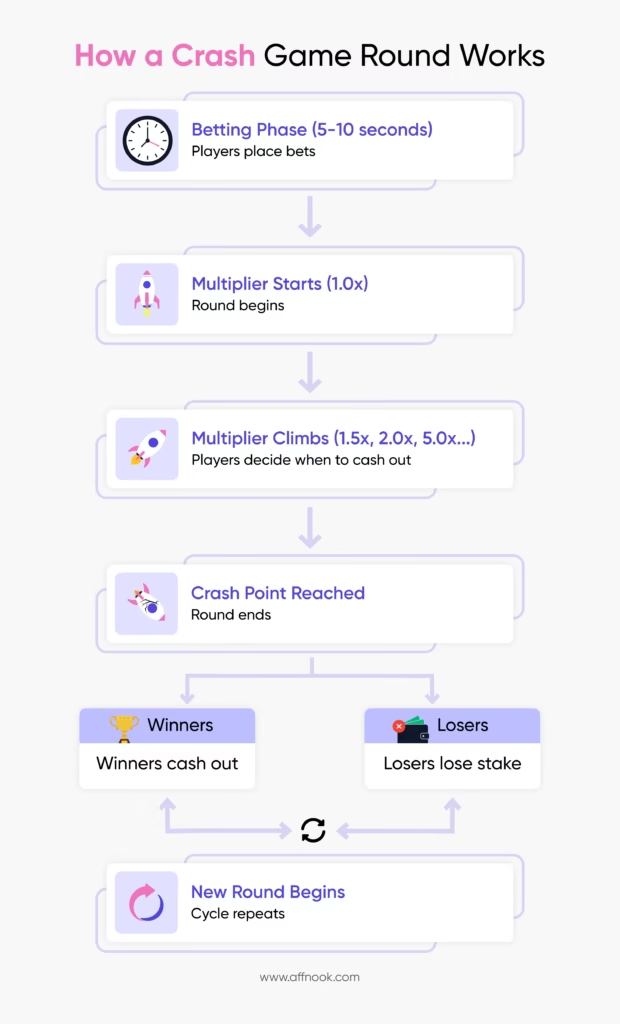
Each round of the game consists of different phases. Players can place bets and set their automatic cash-out preferences during a betting phase (which usually lasts 5 -10 seconds). Once betting has closed, the multiplier starts to increase during the multiplier-growth phase. Players must cash out before the crash occurs; otherwise, they lose their stake.
A crash occurs when the multiplier fails, like a flying plane suddenly crashing down. If a player cashed out before a crash occurred, their winnings were based on the multiplier they exited with; otherwise, they lost their entire bet. After the crash, another betting phase begins immediately. Therefore, players may keep playing over several rounds in succession.
Core Technologies Used
There are two primary technologies that are used in crash games to guarantee fairness and transparency.
Provably Fair Systems uses cryptographic algorithms to produce a crash location for each game round prior to the start. An electronic verification hash (commonly referred to as a Crypto Hash) is generated so that players may verify that the round’s result was not manipulated.
This level of transparency is not generally available in traditional casino games but has become commonplace in the new generation of crypto-based traction games.
Random Number Generator (RNG) determines when a game experiences a traction event (i.e., crash), creating randomness across all games and ensuring that no outcomes or past traction events can affect how the RNG works on future rounds.
Licensed and regulated traction games are regularly tested by independent third-party testing companies, who confirm that the RNG is operating without regard to the outcomes of past games or the influence of the casino or operator.
Popular Crash Game Variants
Aviator remains the most recognized multiplier game globally, featuring an airplane theme where a plane ascends as the multiplier increases. Developed by Spribe, it set the standard for such game mechanics and user interface design.
Spaceman by Pragmatic Play uses an astronaut travelling through space, offering similar gameplay with distinct visual themes and slightly different multiplier ranges.
JetX introduces a jet fighter aesthetic with enhanced graphics and social features, allowing iGaming players to see others’ bets in real-time.
Platform-specific games like Stake.us Crash and Roobet Crash offer proprietary versions with unique features, bonus systems, and community chat functions tailored to their user base.

Crash Game Strategies
The Conservative Strategy uses low multipliers (1.5x – 2.5x) to get small, consistent wins rather than big payouts from high-risk plays. This strategy puts emphasis on steadily increasing the bankroll over getting big increases.
For example, consistently cashing out at 2.0x means doubling your money half the time—similar to flipping a weighted coin in your favour.
The Auto Cash-Out feature removes emotional decision-making from the game by providing preset cash-out points prior to starting the round. Players have already determined their cash-out multiplier before they play, so they are less likely to change their mind based on how high the multiplier climbs.
Bankroll Management requires setting strict loss limits and bet sizes relative to total funds. Professional players typically risk no more than 1-5% of their bankroll per round. For example, if you have $100, risk only $1-5 per round to survive losing streaks.
Balancing Risk vs. Reward involves understanding that high-risk plays have higher payouts; however, by the time they reach those payouts, they usually crash before they get to that level, so players must find their cash-out zone.
Think of it like this: while a 10.0x multiplier pays ten times your bet, it occurs far less frequently than 2.0x—like choosing between a likely $20 win or a rare $100 win on the same $10 bet.
Conclusion
Crash games offer a rapidly evolving, transparent gaming option to existing casino products and allow players to exert control over their play while using provably fair methods.
As the multiplier game format increases in popularity with both operators and iGaming affiliates, it is important that they are educated about how such games work and what trends are occurring globally. Especially with regard to crypto-native and younger players who are looking for interactive, skill-based gambling experiences.
Help Centre
What is the difference between crash games and traditional online slots?
With crash games, players control their timing to cash out, unlike slot machines, where players receive pre-determined outcomes based on random number generation (RNG). In crash games, the operators use provably fair methods for a transparent result, with near real-time amount increments and a quick cycle of seconds instead of spins.
How do provably fair crash games ensure transparency and prevent cheating?
Provably fair systems generate crash points using cryptographic algorithms before rounds begin, creating verifiable hashes. Players can audit these hashes post-round to confirm results weren’t manipulated. This transparency allows independent verification that operators cannot influence outcomes or favour specific players.
What is the average crash point multiplier in most crash games?
Most crash games will have catastrophic multipliers that occur between 1 and 2.5x in around 70% of instances. There will be higher catastrophic multipliers of between 5 and 10x that occur about 20-25% of the time, while multipliers higher than 50x only result in less than 5% of total games played. This ensures that players can manage risk/reward ratios.
Can crash game strategies actually improve your winning odds or reduce losses?
While crash games use RNG, making outcomes unpredictable, strategies like conservative cash-outs (1.5x-2.5x), auto cash-out features, and bankroll management (risking 1-5% per round) help control risk exposure and extend gameplay. No strategy guarantees wins, but disciplined approaches minimize losses.
Are crash games legal for iGaming operators to offer in regulated markets?
Crash game legality is contingent upon proximity to gaming regulatory bodies. Licensed operators in a regulated environment can therefore legally offer crash games, provided they have a valid gaming licence, use responsible gaming tools, implement certified RNG systems, and conform to jurisdictional fairness standards.