
Crypto casino wagering reached $26 billion in Q1 2025 alone, nearly double compared to the same time last year. This is no longer an early-stage market—it’s actively evolving. The operators capturing most of the value will not necessarily be those that offer better games, but those that have developed superior affiliate marketing programs.
However, many crypto affiliate programs are designed improperly. The companies bring on affiliates before their tracking systems are in place, define commissions in general terms only, and then wonder why affiliates quit or dispute commissions six months later.
This guide is about doing it the right way. Not a generic overview of what affiliate marketing is—but a practical, step-by-step breakdown of how to launch and scale a casino affiliate program. One that actually holds up: from getting your S2S tracking right, to NGR transparency, player lifecycle integration, and reporting centralization.
If you’re building this from scratch, start here.
Why Crypto Casino Affiliate Programs Are Different
If you’ve run a traditional iGaming affiliate program before, don’t assume the same playbook applies here. There are many ways crypto can change the dynamics of affiliate marketing, starting with how affiliates get paid to how affiliates evaluate which affiliate programs to promote.
The biggest difference is in the payment structure.
In traditional programs, payment relies significantly on banking systems with additional fees and delays. In a crypto affiliate program, payments will be processed directly using the blockchain, allowing for direct peer-to-peer payments.
Affiliates benefit because they get paid faster than with traditional banking, with fewer fees to worry about, and transparency in transactions. If your program can’t deliver that, you’re already at a disadvantage against operators who can.
The audience is different, too.
Players playing at crypto casinos are more technically literate, privacy-conscious, and also distributed globally. The affiliates serving them reflect that. They’re more demanding about transparency, quicker to spot discrepancies in commission reports, and far less tolerant of vague NGR explanations or delayed payouts than your average traditional iGaming affiliate.
The opportunity, though, is real. Commission structures in crypto casino affiliate programs are generally 25% – 50% revenue share, and LTV for players on crypto platforms has the potential to exceed that of traditional casinos. But you only capture that upside if your program is built to track, attribute, and report it accurately from day one.
That difference starts with payments — and how you structure them from day one.
A Word on Crypto Payment Logistics
Before each new affiliate program starts, decide on the cryptocurrencies to be allowed.
You should also determine the rate at which you will convert cryptocurrencies during the payout period (if real-time conversions are not in the picture). For example, is it a flat rate based on one of the cryptocurrencies, or do you convert it to USD whenever the affiliate is paid? Make sure to include these details in your affiliate contract, not after.
Once your payment structure is defined, the next step is ensuring your tracking infrastructure can support it.
Get the Technical Foundation Right
Recruiting affiliates before you have infrastructure is one of the biggest mistakes. By bringing on 20 partners, you get the traffic going, but nothing gets attributed—registrations won’t fire, FTDs won’t be tracked, and you will be manually reconciling spreadsheets at month-end.
Establish your infrastructure before recruiting affiliates for your crypto casino affiliate program.
Why S2S Tracking is the Standard
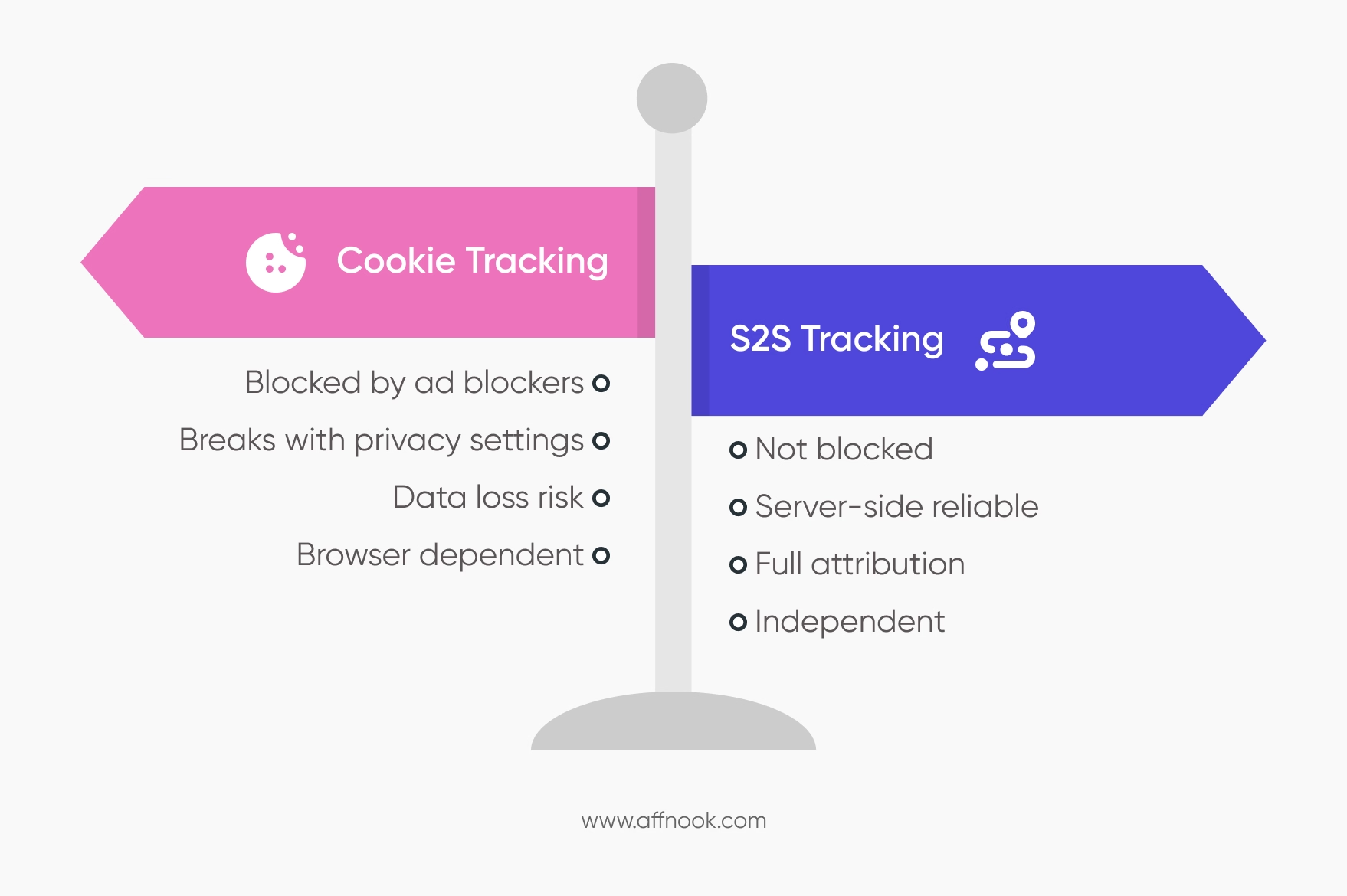
Cookie-based tracking breaks constantly. Browser privacy policies, along with ad blockers, which typically exist in almost every crypto-related audience, block or interfere with cookie-based attribution. You’ll lose conversions you’ll never know you lost.
S2S tracking completes the entire tracking request at the server level so that it cannot be blocked by ad blockers or browser privacy settings. Once an affiliate directs a player to your casino, a click ID is generated, and every subsequent action fires a server-side postback tied to that ID.
Each event is verified independently, server-side. If any step is missing, your commission calculations will be wrong—and your affiliates will notice before you do.
S2S cookieless tracking continues to be an industry standard; however, its execution must have the necessary infrastructure in place. Operators predominantly use affiliate platforms that allow tracking via server-to-server postbacks, click-through ID tracking, and real-time event attribution (out-of-the-box).
Platforms like Affnook are built around this model, allowing operators to track every step—from click to NGR—without relying on fragile, cookie-based systems.
Once tracking is reliable, the next risk to address isn’t missing data—it’s bad data.
Set Up Fraud Detection From Day One
Crypto casino affiliate programs often attract fraud early, including bonus hunting, fake registrations and self-referrals. Before going live, you should establish minimum deposit amounts to convert users, enable a system to detect duplicate accounts created by the same person, and flag any registrations created using the same device or IP address.
Identifying this issue at 15 affiliates is manageable, but identifying iGaming fraud at 1500 affiliates is a crisis. With tracking and fraud controls in place, the next layer is how that data is interpreted—and shared with your affiliates.
Transparency as a Competitive Advantage
Affiliates quitting programs is predominantly due to NGR dispute occurrences, which in separate situations originate from a lack of specific definitions given by operators to clarify the deductions made and the reasons for the same.
Net gaming revenue is calculated as:
NGR = GGR − Bonuses − Payment Processing Fees − Chargebacks
Simple enough in theory. In practice, the ambiguity creeps in at every deduction. Let’s understand this through an example:
An affiliate sends a player who deposits $500, loses $300, and claimed a $100 welcome bonus. Your GGR is $300. After deducting the $100 bonus and a 3% payment processing fee ($9), your NGR is $191. On a 35% Revshare, the affiliate earns $66.85—not $105 (which is what they’d expect if they calculated off raw GGR).
Disputes may arise in your crypto casino affiliate program if an affiliate is not made aware of any bonus deductions before the agreement is initiated. All affiliate contract deductions should be defined clearly and be in writing. Ambiguity regarding taxation, fraud or bonus-related expenses can quickly turn into unhappy partners.
An excellent way to share an affiliate’s profit calculation is by describing the formula for NGR in your affiliate agreement. Which deductions apply, how chargebacks will be processed, and how bonuses will be charged. The affiliates that are generating high-quality traffic should appreciate having a clear, well-defined methodology to work with. However, there is no tolerance for hidden deductions on the affiliate’s first commission payment.
Transparency here isn’t just good ethics—it’s a competitive advantage. Most programs bury this in vague terms. Being the operator who spells it out plainly is a genuine differentiator when recruiting serious affiliates.
Once your NGR is clearly defined, you can build commission structures on top of it with confidence.
Choosing the Right Commission Structure
You won’t find an accurate single solution—the ideal structure is based on factors such as player LTV confidence, available budget, and types of affiliates being targeted. Here are the possible options for your crypto casino affiliate program:
Revenue Share
- Affiliates receive a percentage of net revenue (NGR) produced by their player referrals, usually ranging from 25% – 50% across the different crypto casinos.
- This model works best when you have an understanding of the player’s lifetime value (LTV) and desire long-term affiliate alignment.
- The downside is that you are paying continuously for each referred player, including your most valuable ones.
CPA
- A set amount will be paid for each new customer, no matter what the player does afterwards.
- Best for controlling costs early or in markets where LTV is harder to predict.
- Risk: Affiliate partners who specialize in sending players to earn a CPA based on volume can find players that meet your FTD threshold and leave very quickly.
Hybrid
- A lower CPA on first deposit plus a reduced ongoing Revshare
- My recommendation for most crypto casino launches—you cap upfront exposure while still giving affiliates a reason to care about player quality long-term
A practical example of how a hybrid commission might look in your crypto casino affiliate program:
$50 CPA on every verified FTD + 20% Revshare on that player’s NGR going forward. An affiliate who sends 30 FTDs in a month earns $1,500 upfront, plus ongoing Revshare as those players continue to deposit. Both sides have skin in the game.
Before You Go Live, Define These in Writing:
- Minimum amount deposited to be considered an FTD
- KYC completion requirement to trigger CPA
- Approved payment methods—some operators exclude some cryptocurrency tokens
- Attribution window—how long after a click does a conversion still count
- Negative carryover policy—whether negative NGR months roll into the next month
Getting these terms right at the agreement stage saves significant reconciliation time later—especially when your affiliate platform is automatically calculating commissions based on these exact parameters rather than someone doing it manually in a spreadsheet.
But defining commissions is only part of the equation—how those numbers are tracked and communicated matters just as much.
Reporting Centralization
Once you have your tracking set up properly and commissions are defined, the next question you need to ask is: Where does all of this data reside, and who has access to what?
Fragmented reporting is one of the most common operational problems in a crypto casino affiliate program. Your player data will reside in your PAM. Your click or conversion data will reside in your affiliate platform.
Payout records will reside with your finance department. Therefore, they do not effectively communicate with one another, leading to costly reconciliation cycles that waste valuable time and resources for your team.
What Centralized Reporting Should Give You in Real Time
- Affiliate-level performance—clicks, registrations, FTDs, and NGR per partner and per campaign
- Player cohort data—which affiliate sourced which players, and how those players are performing over 30, 60, and 90 days
- Commission calculations—automatically derived from your NGR formula, not manually computed
- Fraud flags—suspicious registration patterns, duplicate accounts, bonus abuse signals
- Payout status—what’s been paid, what’s pending, what’s in dispute
What It Looks Like in Practice
A practical example for your crypto casino affiliate program:
An iGaming affiliate emails you claiming their NGR for the month looks wrong. Without centralized reporting, answering that takes you into three different systems—pulling player data from your PAM, cross-referencing conversion data from your tracking platform, and reconciling against your payout records manually.
With centralized reporting, you pull up that affiliate’s dashboard, click into the NGR breakdown, and show them exactly which players contributed, what was deducted, and why the final number is what it is. The conversation takes five minutes instead of two days.
The Affiliate Transparency Angle
A centralized reporting system is not only helpful for internal operations; it is also what your affiliates are experiencing on their end. The highest calibre of crypto affiliates will evaluate the quality of your reporting dashboard when determining whether or not to partner with your program.
When an operator provides its affiliates with close to real-time reporting with clearly defined terms, top-level partners will be more engaged. If an affiliate is provided with subpar reporting and poorly communicated terms, then they are more likely to leave the program quickly.
Affnook provides a single source of truth for all affiliates through the use of one dashboard for affiliate-sourced registrations, NGR calculations, and payout reconciliation. In addition, Affnook provides affiliates with the transparency they expect from a crypto-native affiliate program.
Only once this foundation is in place should you begin bringing affiliates into the program.
Recruiting the Right Affiliate Types
Infrastructure is up and running, tracking is confirmed, and commission terms have been documented. You can now actively recruit partners—but proceed slowly and intentionally.
Optimal Plan: Bring on 10-15 initial partners. Verify that each FTD produces accurate postbacks, NGR deductions are calculated as anticipated, and payouts reconcile properly. Fix any issues at this scale before opening to hundreds of partners.
Who to Target First for a Crypto Casino Affiliate Program
- Crypto content publishers—review and comparison sites with blockchain-native audiences who are already researching where to play
- YouTube and Twitch streamers—crypto gambling content has a dedicated, high-intent following that converts well
- Telegram and Discord community managers—crypto audiences live on these platforms; a single post to the right community can outperform a week of display ads
- Media buyers with proven crypto traffic—they move volume fast, but they’ll stress-test your tracking setup immediately. If your postbacks aren’t firing cleanly, they’ll know within days.
What Serious Affiliates Will Ask You
Top affiliates want to know the following before signing up:
- How fast can they expect their statistics to update after a conversion?
- How do you calculate NGR deductions, and how can they be verified?
- What is your payment schedule, and what is your supported cryptocurrency?
These aren’t unreasonable questions but simply standard questions that any reputable program should have answers to.
Affnook offers real-time reporting on their dashboard and transparency with respect to NGR tracking, which means that your affiliates can confirm their measurements on their own, providing the type of transparency that serious crypto affiliates expect prior to driving traffic to your program.
After validating your setup with a small group of partners, the next step is scaling—without losing control of data or quality.
Scaling With Data
Once your program is running smoothly and can accurately measure results, it’s time to move into the optimizing phase. This is a great opportunity for those operators who have built out their foundation properly because they now have a wealth of information from the data they have gathered since the launch. They know how to best double down on their efforts and when they should pull back.
Important metrics at scale:
- 30 and 60-day player retention by affiliates: FTD numbers may look good on the surface, but the player quality beneath may be poor. Retention provides insight into the LTV of each affiliate’s players based on their traffic.
- NGR-to-FTD ratio per partner: If the ratio is consistently low, that means players are either churning shortly after signing up or they are bonus hunters, so you will want to address both of these issues quickly.
- Geo performance: The market has large differences between crypto audiences. Increase your investment in Geos with the strongest conversion and retention performance rather than disperse your entire budget across multiple Geos.
- Bonus cost impact: Track how much bonus cost affiliates are generating relative to their NGR. This is often how the profitability of the program slowly diminishes.
As your program grows, not all affiliates should be treated the same—this is where structured tiering becomes essential.
Building a Tiered Partner Structure
Flat commission structures may work for a while, but as your business grows, they’ll become less feasible. The way you should consider tiering is:
- Top tier: A proven track record of NGR and high player retention. Gets increased Revshare rates, dedicated account management, and exclusive promotional offers.
- Tier 2: Performance is good but has potential to grow. Provide standard terms, and will be assessed for movement to tier 1.
- New Partners: To be placed on a testing basis with a monitoring period to verify traffic quality prior to moving them up to a higher level.
The goal isn’t just more affiliates—it’s more of the right affiliates, incentivized in a way that keeps their interests aligned with yours long term. If you’re operating at an even larger scale—across multiple brands or partners—these principles need to be applied at the network level.
A Note for Those Building a Crypto Affiliate Network
If you’re managing a direct operator program, the conditions above apply. In addition, if you’re managing a network of multiple affiliates and operators, there are a few points to consider:
- Isolate your tracking per operator—Make sure each operator can access their own click ID, postback URL, and reporting view.
- Standardize your NGR formula—Or at least try to establish some clear way to differentiate it for each operator. Affiliates get confused quickly if NGR means something different across properties.
- Build fraud rules at the network level—You will see patterns that would have been missed at the individual program level.
- Your value to affiliates is consolidation—A single log-in, unified report, and pay with the same cryptocurrency. If they have to log into multiple dashboards to see their overall performance, you have lost all of your value.
- Your value to operators is traffic quality—50 vetted, high-performing affiliates beat 500 unverified ones every time.
At this point, every core component—from tracking to payouts to scaling—should be working as a unified system rather than isolated parts.
Conclusion
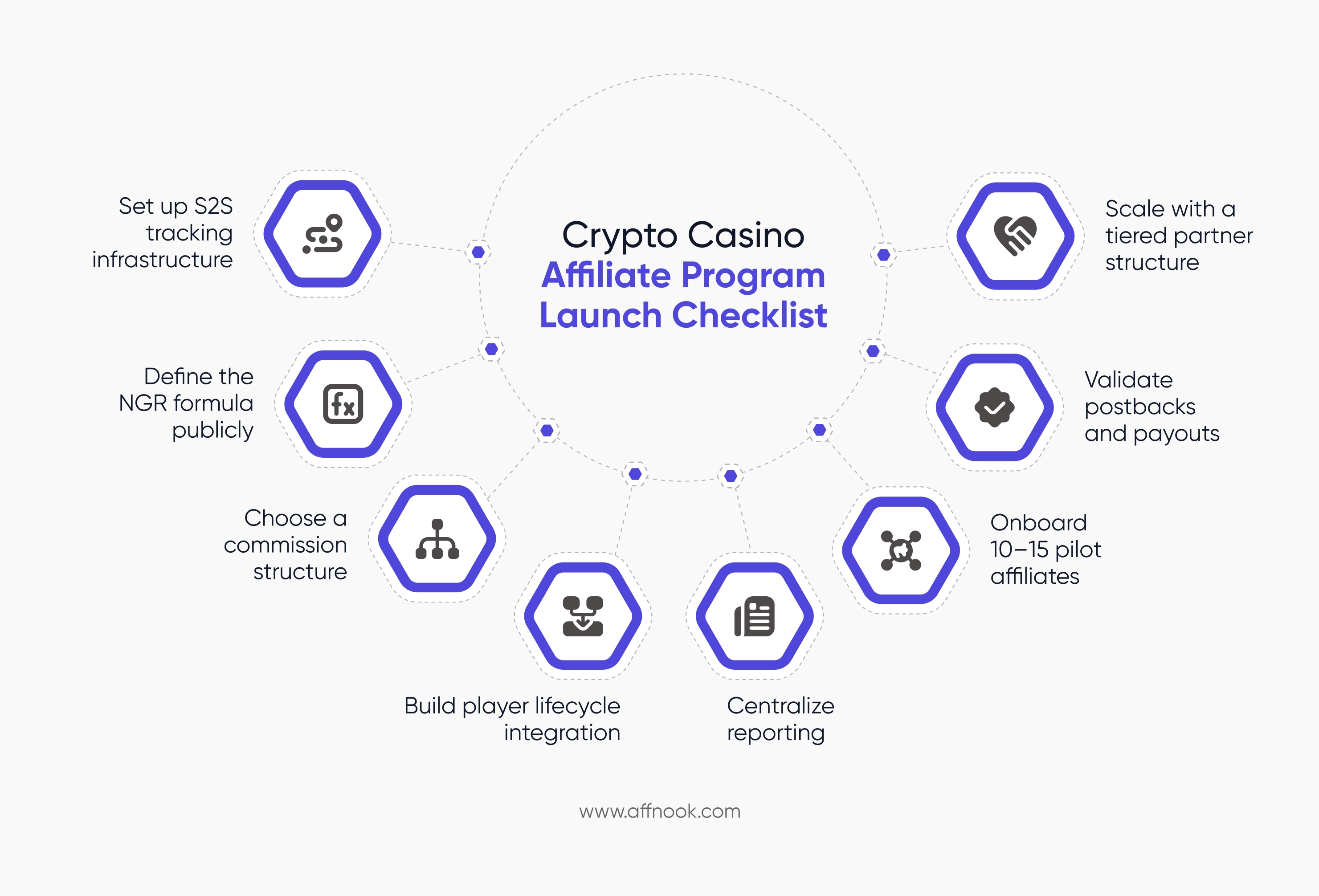
Starting an affiliate program for a crypto casino is not difficult, but it must be executed in the right order. The first step is establishing your infrastructure, then the formula for calculating NGR, recruiting affiliates, and finally scaling.
In the crypto affiliate industry, it pays to have a technically sound and transparent business model. Those who do this well will find it much easier to attract and retain partners who will drive revenue growth.
Track everything. Pay on verified value. Be transparent about how you calculate it.
Help Centre
What is a crypto casino affiliate program, and how does it differ from traditional iGaming affiliate programs?
A crypto casino affiliate program pays partners in cryptocurrency for referring players, offering faster peer-to-peer payouts, lower fees, and on-chain transaction transparency—making it significantly more attractive to blockchain-native affiliates than traditional banking-dependent programs.
What tracking method should I use when launching a crypto casino affiliate program?
S2S (Server-to-Server) tracking is the industry standard. Unlike cookie-based tracking, it fires conversion events directly between servers—making it immune to ad blockers and browser privacy restrictions that are common among crypto-native audiences.
How should NGR be calculated and communicated in a crypto casino affiliate program?
NGR is determined by taking your GGR and subtracting bonuses, payment processing costs, and chargebacks from it. Every item used to calculate NGR should be defined in advance in your affiliate agreement. Most disputes between affiliates and the original business are due to how affiliates calculate NGR.
What commission structure works best for a newly launched crypto casino affiliate program?
Most product launches will benefit from a hybrid model that lowers the CPA (Cost per Acquisition) for the first deposit and reduces the ongoing revenue share. This structure has low upfront costs and incentivizes the affiliate to send high-quality, long-term players rather than quick-churning traffic.
How do I scale a crypto casino affiliate program without losing tracking accuracy or affiliate trust?
Scale by building a tiered partner structure based on verified NGR performance and player retention data. Centralized real-time reporting, clean S2S postback infrastructure, and transparent commission calculations are what keep top-tier affiliates committed as your program grows.