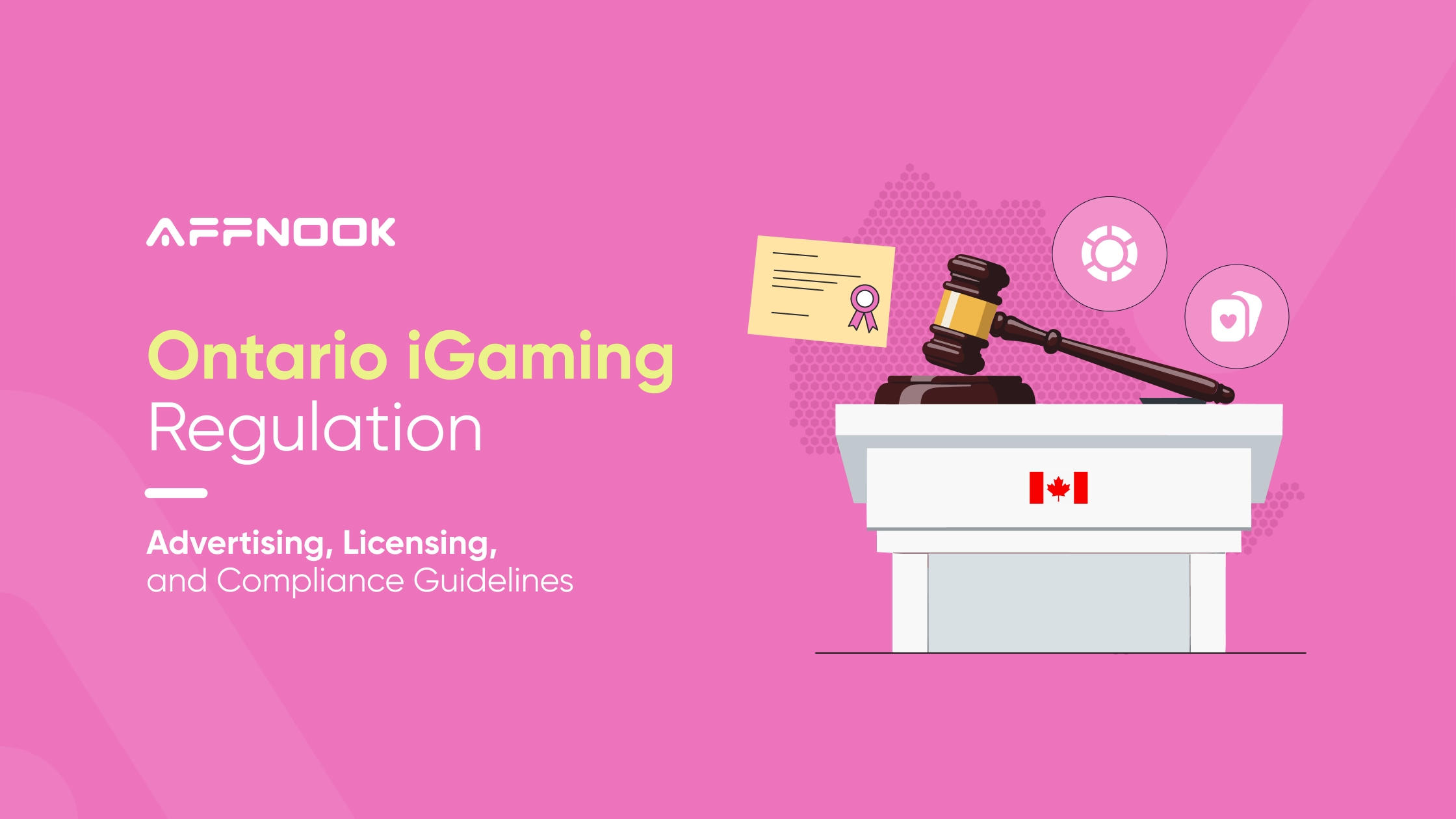
In less than three years, Ontario built a 10-figure iGaming market from scratch. In 2025, the province was expected to generate CAD $4 billion from regulated iGaming revenue, a yearly increase of approximately 34%. That places Ontario as one of the biggest regulated iGaming jurisdictions in North America.
That type of growth is no accident. It occurred due to proper regulation, and operators who were able to comprehend the regulations and enter the market before the iGaming market matured.
However, getting into Ontario is not simply turning on a light switch. It is a multi-step process with regulations to meet, ongoing obligations to remain in compliance with, and a significant risk of costly consequences for violations that are highly publicised.
The AGCO not only warns you about an infraction, but will also let everyone know what kind of enforcement action they have taken.
This guide will tell you everything that an operator needs to know about being licensed to operate a business in Ontario, how the regulations work, how to be compliant, and what you are allowed to do or not do when marketing your business. If you are serious about opening a gambling business in Ontario, start here.
Understanding Ontario’s Regulatory Framework
Ontario’s iGaming market has been operating since April 4, 2022, when it became the first regulated online gambling market in Canada. Prior to being regulated, approximately 70% of all online gambling that took place within Ontario occurred on unregulated and unlicensed offshore gambling websites.
According to recent research by Ipsos on behalf of AGCO and Ontario iGaming, 83.7% of Ontario online gamblers are utilizing regulated sites.
The Two-Body Regulatory System
AGCO (Alcohol & Gaming Commission of Ontario) is the main regulatory agency responsible for establishing the standards, providing registration and enforcing compliance.
iGaming Ontario (iGO) is a subsidiary of the AGCO that handles the management of commercial agreements with operators. Under Bill 216 (Building Ontario For You Act, 2024), the iGO will become an independent organization separated from AGCO by the beginning of 2025.
Legal Foundation
- Gaming Control Act, 1992 (GCA) and Regulation 78/12
- Registrar’s Standards for Internet Gaming (effective April 4, 2022)
- Standards-based regulatory model (outcome-focused)
What’s Regulated
Internet casino games, single-event sports betting (legalized federally under Bill C-218, June 2021), fantasy sports, eSports betting, and peer-to-peer poker.
Market Performance
The Ontario iGaming market generated a grand total of CAD $82.7 billion in total wagers and CAD $2.9 billion in gross gaming revenue at FY-end 2024-25 (March 31, 2025). There are currently 50 licensed operators, with a total of 84 gaming websites and 2.6 million active player accounts.
Licensing Requirements: How to Become a Registered Operator
Becoming a licensed iGaming operator in Ontario requires navigating a dual-authorization process with both iGaming Ontario and the AGCO. Here’s the step-by-step breakdown:
Step 1: Dual Application Process
Operators must secure two separate authorizations:
- An iGaming Ontario (iGO) Operating Agreement that provides commercial authority to operate in Ontario.
- Registration with AGCO is the regulatory approval that confirms compliance with all applicable standards.
Registration Fee: $100,000 per site per year, paid at time of application. This is a one-time non-refundable fee regardless of the outcome of approval. Operators can choose either one or two-year terms with adjusted fees for Ontario iGaming applications.
Step 2: Entity and Ownership Disclosure
Applicants must provide complete transparency on corporate structure and beneficial ownership:
- Corporate documents (articles of incorporation, partnership agreements, joint venture agreements)
- 5% ownership rule—disclose all individuals or entities holding 5% or more interest in the company
- Relationships between shareholders, partners, and associated companies
- Background checks on all key personnel and decision-makers
- Financial statements and source of funds documentation
Step 3: Gap Analysis Submission
Submit a compliance gap analysis showing:
- Current status of your operations in relation to AGCO’s Registrar’s Standards for Internet Gaming
- The specific requirements you are not currently meeting
- Detailed remediation plan with timeline to achieve full compliance
- Commitment to bridging the gap with regard to technology, processes, controls, and staff training
Step 4: Control Activity Matrix (CAM)
This is an audit report that will show what type of controls you put in place to comply with your regulator’s requirements. Your CAM can come from either an internal audit function or an external auditor and can cost as much as $100k in regulated markets such as Ontario iGaming because of the complexity of your controls.
Step 5: Technology Certification
All critical gaming systems and games must be certified by an AGCO-approved Independent Testing Laboratory (ITL) before launch:
- Approved labs: iTech Labs, GLI (Gaming Laboratories International), eCOGRA, BMM Testlabs
- Testing includes Random Number Generator (RNG) certification, game fairness, game payout accuracy, and server-to-server integration with AGCO’s monitoring system.
Testing costs range from $10000 to $50000, depending on system complexity.
Step 6: Demonstrate Competency
Within 6 months of launch, operators must demonstrate controls for key compliance priority areas:
- Responsible gambling measures
- Anti-money laundering (AML) protocols
- Game integrity and player protection
- Incident reporting and change management
AGCO provides advance notice before competency assessments, allowing operators time to prepare.
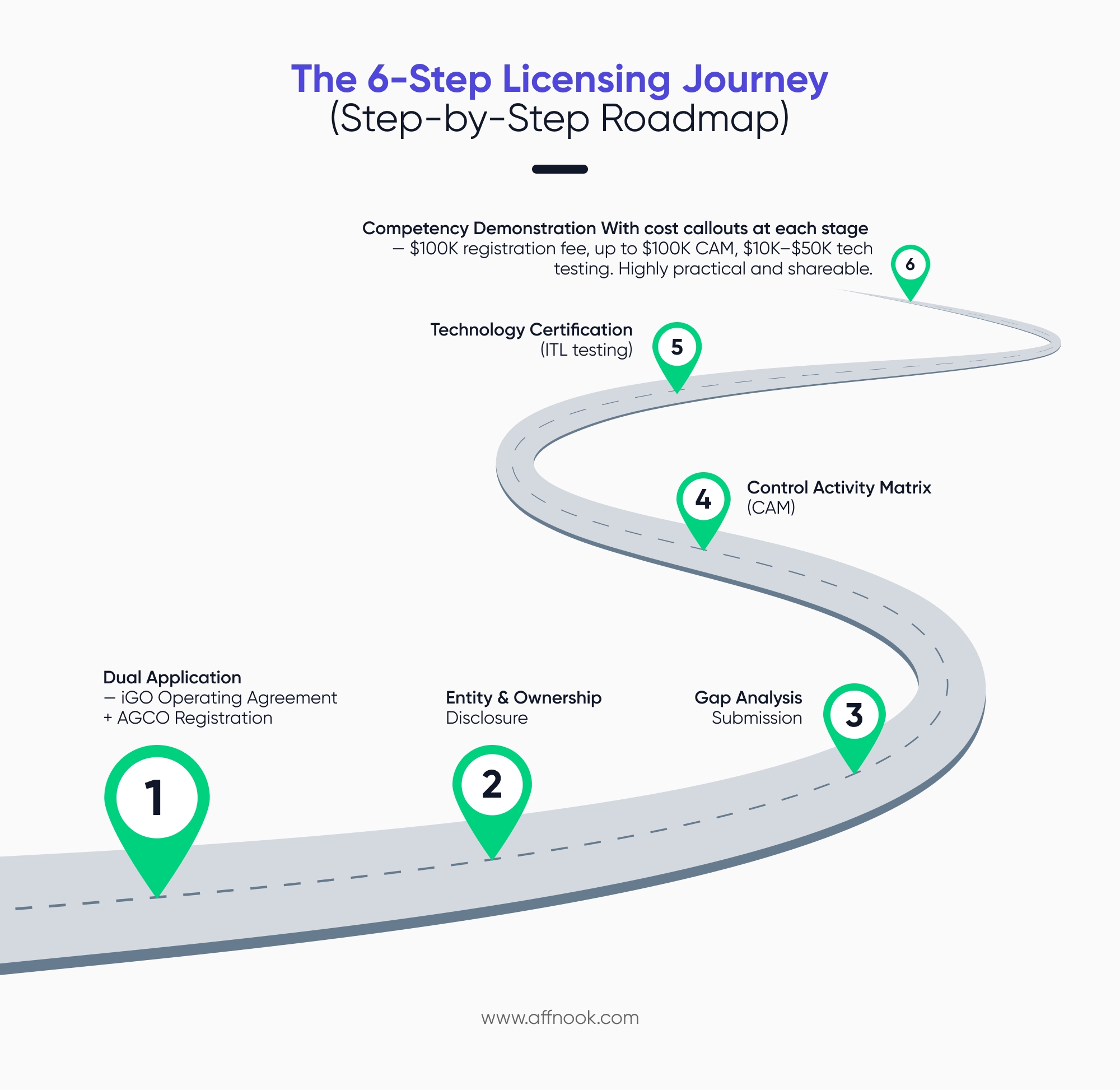
Application Timeline: The AGCO will approve applications anywhere between three and six months from the date of submission, based upon the quality of the application and the type of risk being assessed.
AGCO may also impose other costs on you beyond the registration fee of $100,000 (e.g., the costs to conduct its investigation of your application). According to the AGCO, these costs “may be significantly greater than the regulatory fee.”
Advertising & Marketing Restrictions
Ontario iGaming’s advertising rules are some of the strictest ones across North America and are in place to help keep vulnerable groups (mainly minors and people with gambling problems) safe from harm and create market transparency.
The February 2024 Amendments
In February 2024, the AGCO implemented significant amendments to Standard 2.03 that reshaped how Ontario operators can market their platforms:
- Athletes and celebrities: Both active and retired, with the exception of responsible gambling messaging, are completely prohibited from all iGaming advertising. Influencers who could appeal to minors are specifically excluded from any advertising.
- Bonus advertising: Public promotion of bonuses, inducements, or credits is strictly prohibited across TV, billboards, social media, affiliate content, and search. Bonuses can only be promoted on the operator’s own platform or via direct marketing to consented players.
- Required elements: Every form of advertising must include the iGaming Ontario logo, a responsible gaming message, and a disclaimer for geo-restrictions.
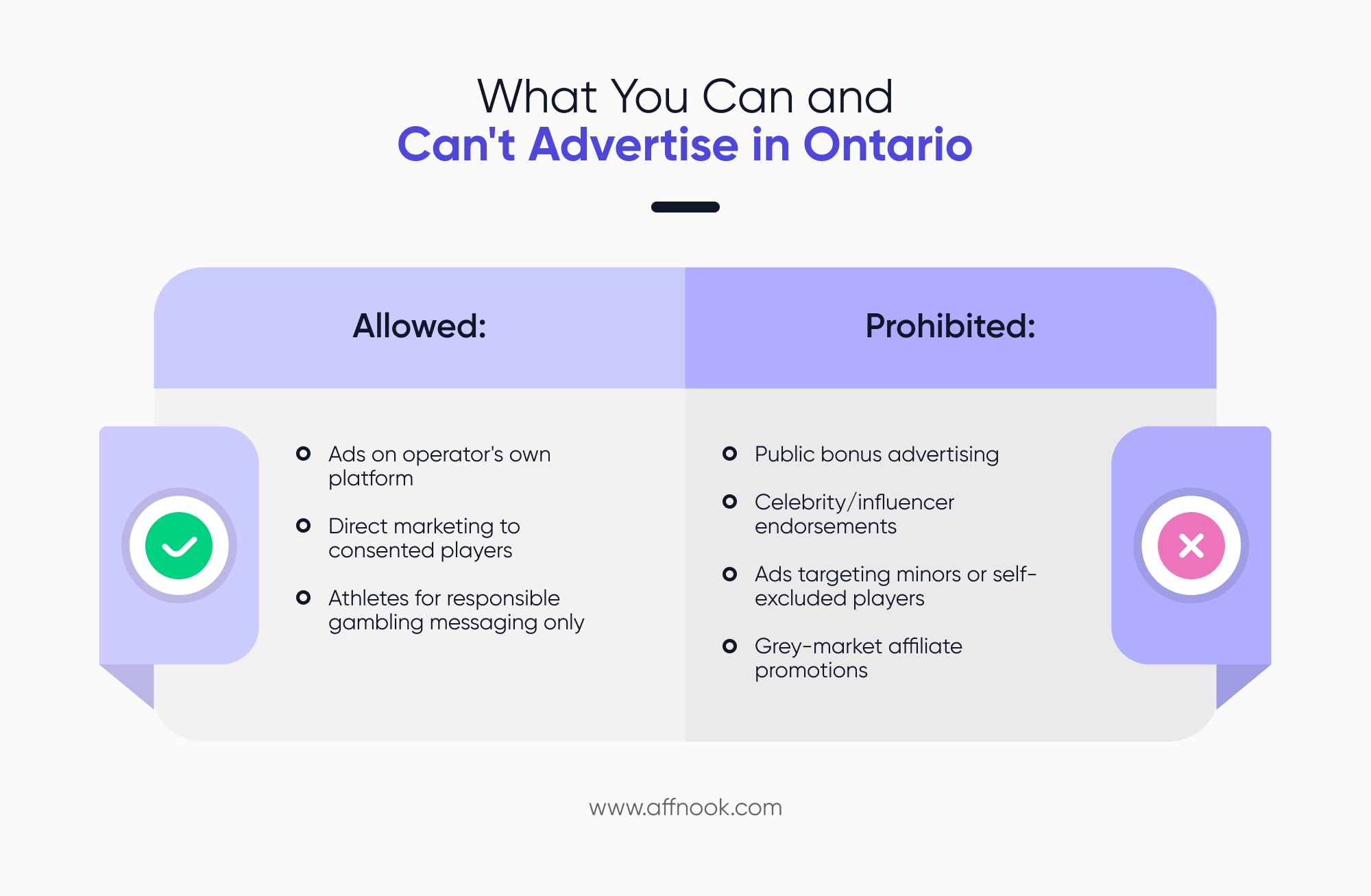
Affiliate Accountability (Standards 1.19, 1.21)
Within Ontario iGaming, operators are fully responsible for ensuring their affiliates meet all AGCO standards. Affiliates promoting Ontario-licensed operators cannot simultaneously advertise grey-market sites, and operators must actively monitor affiliate content. For programs spanning multiple jurisdictions, platforms like Affnook help manage geo-specific advertising rules and centralize compliance tracking.
As per Ad Standards Canada, Ontario resulted in the highest number of gambling advertising complaints in Canada for 2024; however, this year, the complaints for gambling advertising have transitioned from volume to content, thereby indicating that the market is maturing.
Ongoing Compliance Obligations
Getting registered is step one. Staying compliant is the ongoing operational reality—and in Ontario, the AGCO actively enforces.
Mandatory Reporting
All operators shall submit independently audited CAMs reporting the process for how they are situated to meet all of the registration standards’ outcomes. Additionally, operators have ongoing tasks such as: financial reconciliations, managing player data, notifying the appropriate agencies of incidents, and reporting suspicious betting activity for sports betting entities.
Responsible Gambling Requirements
Mandatory requirements for gambling platforms in Ontario iGaming include:
- RG Check accreditation
- Mandatory spend on responsible gambling marketing initiatives
- Participation in a centralised self-exclusion registry
- Sharing anonymous player data for research purposes
Deposit limits, time limits, reality checks, and access to Connex Ontario resources are all mandatory on the platform level.
Grey Market Prohibition & Supplier Standards
Registered operators cannot enter into agreements with unregistered entities serving grey-market operators. Administrative monetary penalties for violations can reach up to $200,000 per breach, with registration revocation possible in serious cases.
Real Enforcement, Real Consequences
The AGCO doesn’t just publish rules—it acts on them. BetMGM Canada was fined $110,000 as a result of affiliate marketing running inducement campaigns that are not allowable under AGCO regulations. One affiliate created 377 new registrations and paid out $127,180 in commission to affiliates through non-compliant promotions.
This is a direct reminder that operators bear full liability for affiliate conduct under Standard 1.19. For programs managing affiliates across multiple jurisdictions, having geo-specific compliance controls and centralized affiliate monitoring—like what Affnook provides—isn’t just operationally convenient, it’s a safeguard against exactly this kind of enforcement action.
Best Practices for Maintaining Compliance
Ontario iGaming’s framework is outcomes-based—operators are given the flexibility to design their own compliance controls, but bear full accountability for not meeting every standard the AGCO sets.
Build Compliance Into Operations From Day One
Compliance is not simply a legal obligation but rather an operational function. The use of results-oriented methods allows the operator to create controls tailored to their situation. Therefore, it is their responsibility to establish and document processes that comply with all applicable Registrar’s Standards.
In practice, this means:
- Assign a dedicated compliance officer from day one
- Run regular internal audits against the Registrar’s Standards
- Train all staff on responsible gambling, AML obligations, and advertising rules
- Review your Control Activity Matrix regularly, not just during submission
Documentation is Everything
The AGCO audits are based on what you can prove, not what you intend. Maintain complete records of:
- All advertising content, placements, and dates
- Affiliate agreements and monitoring activity
- Responsible gambling interventions and player communications
- Full audit trails for player transactions
The documentation workload for Ontario iGaming operators managing affiliates in more than one market can build up rapidly. Keeping all affiliate activity, approval of creative, and campaign records in a single location (for example, Affnook’s compliance-ready dashboard) makes it much less painful to prepare for an audit.
Engage With the AGCO Proactively
The compliance program relies on proactive engagement and transparent dialogue between registrants and the AGCO. When uncertain about new campaigns, a new affiliate arrangement or a product change, do not wait until a problem emerges—simply reach out for clarification.
The AGCO has expressed a preference for working with operators to achieve compliance rather than reaching for enforcement tools immediately.
Monitor Regulatory Changes Continuously
The AGCO is focused less on onboarding and more on integrity, accountability, and increased regulatory oversight now that there are unprecedented wagering volumes and stronger enforcement.
The Ontario regulatory framework continues to evolve with updates addressed from stakeholder input or market data—such as the advertising amendments that were published in February 2024. It is advisable to subscribe to AGCO updates, remain up to date on industry legal developments, and consult with an attorney knowledgeable in Ontario iGaming rules.
Conclusion
Ontario is a hugely profitable regulated iGaming marketplace within the world; however, Ontario’s compliance framework is one of the strictest across most of North America.
The $100k registration fee, tight advertising restrictions, and full accountability of operators for their affiliates, as well as responsible gambling requirements, are not obstacles but rather the minimum standard.
Every operator that is successful within Ontario recognizes compliance as being part of a building structure, as compared to an afterthought. They establish the right foundation for compliance, anticipate regulatory changes, and maintain proper documentation of everything.
Ontario’s market is maturing fast. The window to establish a strong, compliant presence is open—but it won’t stay that way indefinitely.
Help Centre
What are the licensing requirements for Ontario iGaming regulation, and how long does approval take?
Ontario iGaming regulation requires dual authorization—an iGaming Ontario operating agreement and AGCO registration. The $100,000 non-refundable fee applies per site per year, and approval typically takes three to six months from submission.
Can iGaming operators advertise bonuses and promotions to players in Ontario?
No. Under Ontario iGaming regulation, public promotion of bonuses across TV, billboards, social media, and affiliate content is strictly prohibited. Bonuses can only be communicated on the operator’s own platform or via direct marketing to consented players.
Are iGaming operators in Ontario responsible for their affiliates’ advertising compliance?
Yes. Ontario iGaming regulation holds operators fully liable for affiliate conduct under Standards 1.19 and 1.21. Affiliates cannot simultaneously promote grey-market sites, and operators must actively monitor all affiliate content and maintain compliance documentation.
What responsible gambling requirements must Ontario iGaming operators meet?
Operators must obtain RG Check accreditation, implement deposit and time limits, integrate with a centralized self-exclusion registry, run mandatory responsible gambling campaigns, and provide access to Connex Ontario resources—all as non-negotiable platform requirements.
What penalties can Ontario iGaming operators face for non-compliance with AGCO standards?
Penalties under Ontario regulation include administrative monetary fines of up to $200,000 per breach, registration suspension or revocation, and public enforcement actions—as demonstrated by BetMGM Canada’s $110,000 penalty for affiliate marketing violations.