What are Microservices?
The microservices method is based on the idea of breaking down a full-fledged platform into small, separate services. Each service performs only one process and communicates with others through APIs, without the need to establish any relationship between them.
All services are separate entities technically, and they function independently, passing the data and results to one another.
What is the Alternative to Microservices — Monolithic Architecture
A monolithic system has every function within the same code base. This includes various function models such as the wallet, lobby, rewards engine, and KYC process.
However, there’s one problem: If you change one model, you will have to change the whole platform. In case of a failure of one model, the whole platform may eventually crash.
But guess what? Microservices address both of these problems altogether. A research case study on migrating a mission-critical system from a monolithic architecture to microservices found that scalability was positively affected by the transition.
What This Looks Like in iGaming
A microservice-based iGaming system processes every essential process as a unique, independent microservice:
- The wallet service: it manages deposits, withdrawals, and balance oversight
- The gaming aggregation service: the model interacts with game developers via APIs
- The KYC and compliance service: conducts identification validation and AML monitoring
- The bonus engine: issues, monitors, and invalidates promotions
- The affiliate tracking service: tracks FTD, QFTD, and NGR data separately from games and payments
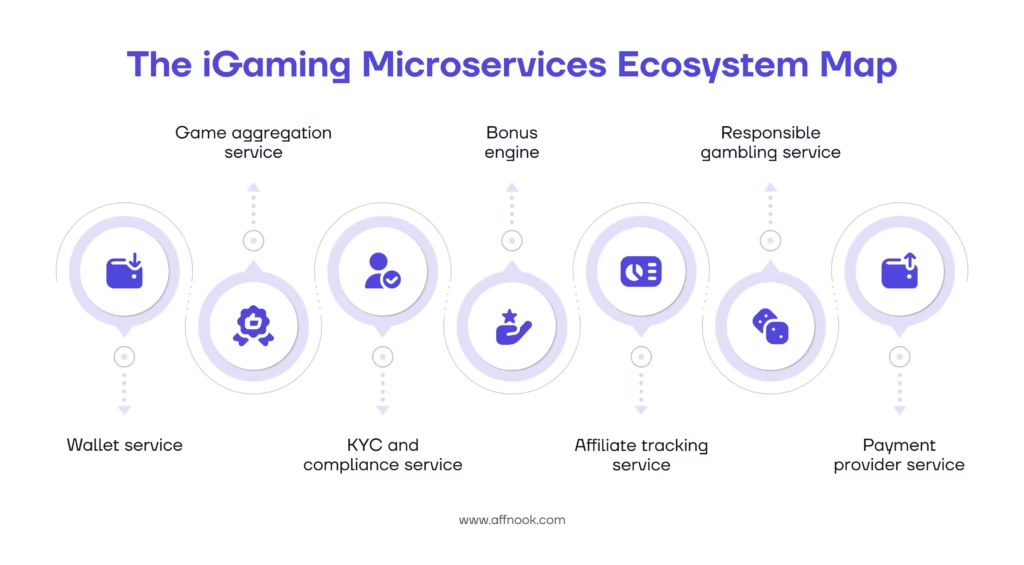
Each individual service can be altered in its functionality or size without interfering with other processes. That means, even if one process breaks down, it won’t affect the other. Think of it like a circuit in parallel connection.
Why are Microservices Now Essential?
Netflix, Amazon, and Uber have all transitioned to this service architecture to address the same scalability issues that the iGaming industry now faces:
- high transaction volumes,
- numerous integrations,
- and an absolute resistance to downtime.
The architecture may have originated a while ago. However, the necessity for the iGaming industry to use it has now become very urgent.
How Microservices Work in Practice
The manner in which things work is quite straightforward:
- Each service is assigned a particular task,
- presents the API and
- makes use of it to talk to other services.
Each service relies exclusively on its public interface to communicate with each other instead of using its inner code for any communication.
The API Gateway
The API gateway is the one point of entry for every request that the player makes. The player’s browser does not connect directly to specific services. Every request is handled by the gateway before being sent to the appropriate service.
When a player logs in, makes a deposit or starts a game, it causes the services to execute their functions, with the API serving as the middleman.
Independent Deployment in Practice
Every service has its own deployment pipeline. Each time the bonus engine requires an update — like a new wage calculation or regulatory change — only the bonus engine will be redeployed. The wallet, the game lobby, or the affiliate tracking service will keep working continually.
Real-World iGaming Example
During the important Champions League final, there will be a significant increase in traffic to the betting service. When working with monolithic architecture, scaling occurs for the entire workflow, including casino games, which do not need it at all. However, with this architecture, only the betting service is going to scale according to the heavy load, while the rest of the system is going to function normally without image loss.
How Services Communicate
- Synchronous communication occurs when service A communicates with service B, waiting for a response, which is suitable for real-time activities such as payments.
- In asynchronous communication, service A sends a request, places it in a message queue, and moves on without waiting for a response.
Microservices vs. Monolithic Architecture in iGaming
The bottom line for distinguishing between these two is quite simple: What happens when problems or changes occur?
| Monolithic | Microservices | |
| Deployment | Entire platform redeployed for any update | Individual services deployed independently |
| Failure impact | One failure can bring down the platform | Failure isolated to one service |
| Scaling | Entire platform scaled together | Individual services scaled on demand |
| Development speed | Slower — teams depend on each other | Faster — teams work independently |
| Complexity | Lower upfront | Higher — requires strong DevOps capability |
What This Means Operationally
In iGaming, a monolithic architecture means that a problem in the bonus engine can only be fixed by updating the whole platform, causing services to stop working from the gaming wallet to the sportsbook. However, with service-oriented architecture, the issue can be solved independently from the other components of the platform.
The need for maintaining regulatory differences in numerous markets has made it imperative for the providers to use isolation, which helps in the development of compliant platform versions without having to create new ones for each of the different markets.
Why iGaming Operators Are Moving to Microservices
The change is not motivated by technological choice but by what large platforms are incapable of achieving at scale.
Scaling Across Multiple Markets
Each market is fully responsible for its own compliance, payments, and responsible gaming solutions without having to redesign the platform itself. This makes entering a new market a process of deployment rather than one of engineering.
Availability and Dependability
When a bonus engine breaks down, it does not actually bring the wallet or game lobby down with it. The repercussions of the fault remain within the operation process where it happened, and players in unaffected verticals do not notice anything about it.
Quick Product Development
New game providers, even payment methods or integrations, become possible with the introduction of new services. The work that used to take weeks with monolith systems can now be completed in a matter of days.
Compliance with Regulations
The KYC, AML and responsible gambling systems are independent and therefore easy to update in accordance with regulatory changes. For instance, if there are new requirements imposed by the UKGC, these changes apply to only one of the solutions rather than the whole system.
The Challenges Operators Need to Know
They tackle scaling issues but add operational complexity that monolithic systems do not experience.
Operating Burden
The greater the number of services, the greater your ability to watch out for, install, and manage them. In order to handle a microservices architecture, one should have a sophisticated DevOps toolchain that would provide logging, monitoring, and notifications of all the different services simultaneously.
Data Consistency
Consistency between services, which entails making sure that the wallet, bonus engine, and affiliate tracking service are synchronized using the same player status, is an issue that the services must take into consideration when creating the API to ensure that everything is done in time, without any delays in synchronization.
Latency
Using APIs for communication between services causes additional delay in the total time the process takes. It is often found that badly designed service-oriented architectures are slower than a normally functioning monolith — especially when it comes to high-frequency operations such as in-play bets or live casino games.
Cost
Running several independent services requires more support structures than a single monolithic deployment. Therefore, for smaller operators, in terms of costs, they do not always bring benefits until the complexity of the platform itself makes this solution favorable.
Microservices and Affiliate Tracking in iGaming
Under service-oriented architecture, affiliate tracking operates independently from other systems like the game layer, payment processing, or player management.
Why Isolation Matters
The FTD, QFTD, NGR, and conversion statistics are calculated without any influence of the switch of payment provider, the application of game aggregation or any other changes regarding the tracking of affiliates and any data relevant to their payment of commissions.
Integration at the Level of Service
The affiliate network is connected to PAM, wallet, and players’ data microservices through the API connection, which helps in getting real-time conversion information without requiring access to the platform. In this way, integration done at the service level, as in the case of Affnook, helps get the affiliate performance data.
The Compliance Benefit
KYC processes, responsible gambling limits, and self-exclusion alerts provide their separate services. Most importantly, there is no need for any manual input, as players who appear in the compliance list as self-excluded will be recognized automatically and are thus excluded from any commission calculations regarding the affiliate program.
Final Thoughts
Microservices are an architecture that allows iGaming platforms to be scalable, compliant, and resilient at the speed demanded by regulated markets.
No doubt, the initial complexity is significant, but for operators that have to scale through multiple integrations and markets, the only option left is a monolithic platform that will be increasingly hard to maintain, update and regulate with each passing quarter.
Help Section
What are microservices in iGaming and how do they work?
They are a way of organizing an iGaming platform into small services that can be deployed independently, each of which performs only one function (e.g. payments, KYC, client management). These services communicate with each other through APIs, which allows independent updating and scaling as required.
What is the difference between microservices and monolithic architecture in iGaming?
In the case of a monolithic platform, there is one codebase for all processes, thus one failure or alteration changes everything. In this case, the processes work independently, so failures are isolated and updates do not affect anything else, and services can scale up without affecting the platform.
Why are iGaming operators moving from monolithic platforms to service-oriented architecture?
With the use of these, operators can scale particular services as required, introduce compliance updates without having to experience downtimes of the entire client interface, and make the realization and establishment of new markets or integrations easier and faster.
What are the main challenges of service-oriented architecture for iGaming operators?
The main issues encountered are operational complexity, which means there are more services needing monitoring and support, data consistency across services, API latency in terms of real-time activities like in-game betting, and rising infrastructure costs. These require a well-developed DevOps capability for superior management.
How does microservices architecture affect affiliate tracking in iGaming?
In such an architecture, affiliate tracking operates independently as a service — separate from the gaming and payment services — to track FTD, QFTD, and NGR information. Therefore, there won’t be interruptions in commission attribution as a result of changes in the platform and compliance data such as self-exclusion flags are capable of blocking payments to affiliates without manual interference.