In iGaming, many gambling campaigns look successful when they are live.
The dashboard showcases growth in traffic, and the number of registrations is increasing simultaneously
And weekly summaries look positive
But when the quarter ends, the campaign’s result does not match the expectations.
And one of the most effective reasons for this result is the lack of coordination between marketing strategy and business performance.
Unlike other industries, in iGaming, players do not generate an instant result, like if a player signs up today, he might deposit later, or he wants more time to trust the iGaming platform, or he may churn from the platform. If ROI is measured too early with the wrong metrics, you may get the wrong result, and you will lose money
That is why measuring ROI in online gambling is not just about tracking numbers
But it’s all about understanding player behavior, revenue timelines, and real value creation.
In this article, you will learn more about how to measure ROI in digital marketing for online gambling campaigns in a way that reflects true performance, not surface-level success.
Why ROI Measurement is Different in Digital Marketing for Online Gambling
If we talk about other industries, the calculation method of ROI is very simple, like when a user clicks on an advertisement and buys a product, and the revenue is recorded instantly.
But in the case of online gambling, it does not work like that,
Here is what makes digital marketing for online gambling fundamentally different:
- Revenue is spread over time, not instant
- Bonuses distort early performance data
- Player behavior matters more than conversion volume
- Retention defines profitability
- Fraud can silently destroy ROI
- Regulations affect attribution and tracking
Because of this, applying traditional digital marketing ROI models to gambling campaigns leads to poor decisions.
To measure ROI correctly, gambling brands must think in terms of player lifetime value, not just campaign performance.
The global online gambling market size was estimated at USD 78.66 billion in 2024 and is projected to reach USD 153.57 billion by 2030.
Understanding ROI in Digital Marketing for Online Gambling
At its core, ROI (Return on Investment) answers one fundamental business question:
For every dollar spent on marketing, how much real value did the business get back?
The standard ROI formula looks like this:
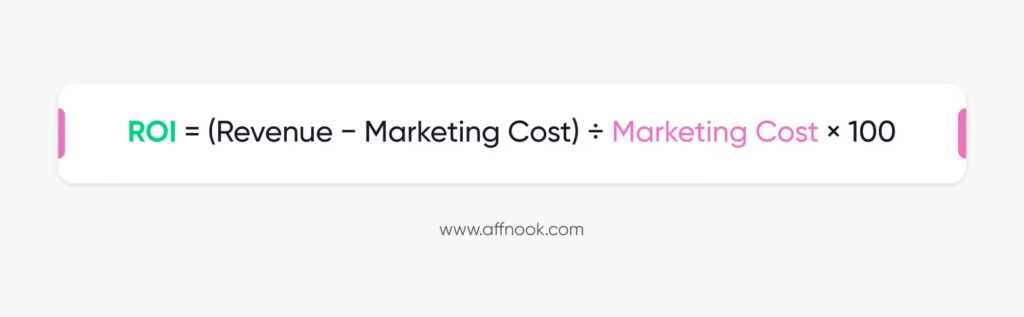
This formula still applies to online gambling. The challenge is not the calculation.
The real challenge is accurately defining revenue.
In most industries, revenue is easy to identify. A user clicks an ad, buys a product, and the transaction is complete. Online gambling works very differently.
Why Revenue is Tricky in Online Gambling Marketing
In digital marketing for online gambling, revenue is generated over time, not at the moment of conversion. A player may register today, deposit a small amount tomorrow, and only become profitable weeks or even months later.
That is why many campaigns look successful on the surface but fail to deliver real ROI.
In online gambling, revenue is NOT:
- Sign-ups (they show interest, not value)
- Clicks (they indicate reach, not profitability)
- Bonus-triggered deposits (they are incentives, not earned revenue)
These metrics are useful for optimization, but they do not represent actual returns.
What Revenue Really Means in Online Gambling ROI
When measuring ROI correctly, revenue should include:
- Real money deposits: Deposits made with actual funds, not just bonus credits.
- Net Gaming Revenue (NGR): Revenue after deducting bonuses, chargebacks, payment fees, and fraud-related losses.
- Long-term player value (Lifetime Value or LTV): The total revenue a player generates over their entire lifecycle, not just the first deposit.
For example, a campaign that brings in players who deposit once and churn quickly may look profitable early on. However, a campaign that attracts players who deposit smaller amounts but return consistently often delivers far better ROI over time.
How ROI is Measured in Digital Marketing for Online Gambling
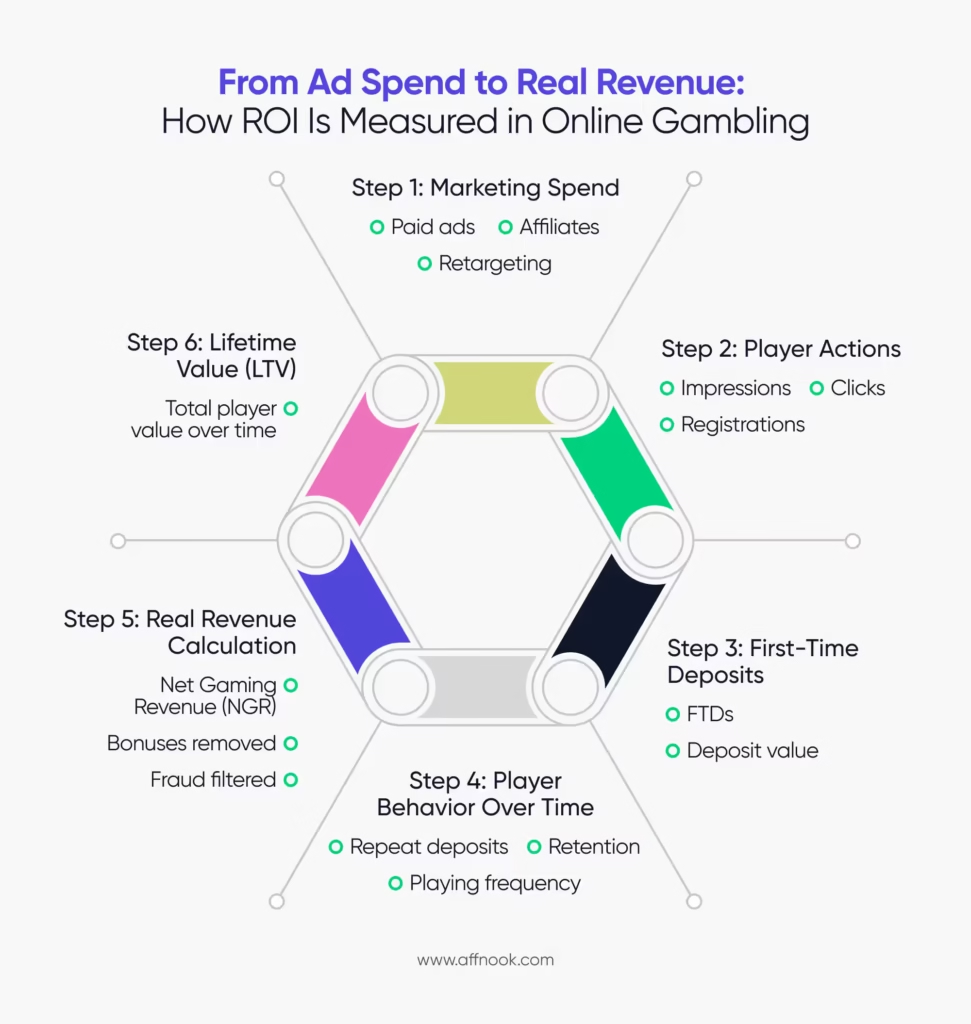
Measuring ROI in digital marketing for online gambling is not a single calculation. It is a structured process that connects marketing spend with real player value over time.
To get an accurate picture, iGaming brands must move step by step, ensuring that every part of the player journey is tracked, attributed, and evaluated correctly.
Step 1: Clearly Define What Success Means
Before measuring ROI, you must define what success looks like for your campaign.
In online gambling, success is not:
- Maximum traffic
- Cheapest clicks
- Highest number of sign-ups
Success should be defined as:
- Profitable First-Time Depositors (FTDs)
- Sustainable Net Gaming Revenue (NGR)
- Strong Lifetime Value (LTV)
Without a clear definition of success, ROI data becomes misleading and difficult to act on.
Step 2: Track Every Marketing Cost Accurately
ROI starts with knowing exactly how much you are spending.
This includes:
- Paid media spend (search, display, native, social)
- Affiliate commissions
- Retargeting costs
- Creative and platform-related expenses
Using platforms like Affnook, iGaming brands can centralize marketing costs across channels and partners, ensuring no spend is missed or duplicated in ROI calculations.
Step 3: Connect Traffic to Player Actions
One of the biggest challenges in digital marketing for online gambling is linking traffic data with player behavior.
You must be able to answer questions like:
- Which campaign drove this registration?
- Which affiliate generated this FTD?
- Which traffic source produces repeat deposits?
Affnook enables end-to-end tracking by connecting impressions, clicks, registrations, and deposits to their original sources, giving full-funnel visibility instead of fragmented reports.
Step 4: Measure Revenue Using the Right Metrics
Revenue should never be measured using gross deposits alone.
To calculate ROI accurately, use:
- Net Gaming Revenue (NGR) instead of deposits
- Revenue after bonuses, chargebacks, and fees
- Real money wagering behavior
This ensures your ROI reflects actual business value, not inflated numbers caused by incentives or promotional activity.
Step 5: Evaluate Player Quality, Not Just Volume
High acquisition volume does not guarantee profitability.
To measure ROI correctly, analyze:
- FTD rate by channel
- Average deposit value
- Repeat deposit frequency
- Retention over time
Affnook helps identify which campaigns and partners bring high-quality players, allowing you to scale what works and cut what only looks good on the surface.
Step 6: Attribute Revenue Across Multiple Touchpoints
Players rarely convert after a single interaction.
A typical journey may involve:
- Paid ads for discovery
- Affiliate content for research
- Retargeting for conversion
To avoid incorrect ROI conclusions, use multi-touch attribution instead of last-click models. With Affnook’s attribution capabilities, revenue is distributed fairly across touchpoints, giving a more realistic view of campaign performance.
Step 7: Measure ROI Over Time, Not Instantly
ROI in online gambling develops gradually.
Best practice is to review ROI at:
- 30 days (early performance)
- 60 days (stability check)
- 90 days (true profitability)
Short-term data often understates ROI, especially for campaigns focused on retention and player quality.
Step 8: Continuously Optimize Based on ROI Insights
ROI measurement is not a one-time task. It is an ongoing optimization loop.
Use ROI insights to:
- Adjust CPA targets
- Refine bonus structures
- Improve targeting and creatives
- Reallocate budgets to high-performing channels
With real-time reporting and unified dashboards, Affnook enables faster decision-making and continuous ROI improvement.
Why Clicks and Registrations are Weak ROI Indicators?
Clicks and registrations are often the first metrics marketers look at, but in digital marketing for online gambling, they represent activity, not actual revenue.
A campaign can easily show strong early performance, such as:
- High click-through rates (CTR)
- Low cost per acquisition (CPA)
- Thousands of new registrations
On the surface, these numbers look promising. Yet many such campaigns still fail to deliver real financial returns.
Why Does This Happen?
Because early-stage metrics do not reflect player behavior after sign-up.
In reality:
- A large percentage of users never make a deposit
- Some users deposit only to unlock welcome bonuses
- Others place a single wager and never return
These users increase marketing costs but contribute little or no long-term value.
Core Metrics That Define ROI in Digital Marketing for Online Gambling
To measure ROI accurately in digital marketing for online gambling, brands must move beyond surface-level performance metrics and focus on indicators that reflect real money behavior and long-term value. The following metrics form the foundation of reliable ROI analysis.
1. Cost Per Acquisition (CPA)
Cost Per Acquisition (CPA) measures how much it costs to acquire a depositing player, not just a registered user.
While CPA is often used as a benchmark for campaign efficiency, it does not define success on its own. A low CPA may look attractive, but it can hide serious profitability issues.
A campaign with a low CPA can still fail when:
- Player retention is weak, and users churn quickly
- Average deposit values are low
- Bonus costs consume most of the revenue
This is why CPA must always be evaluated alongside revenue-based metrics such as NGR and LTV. In online gambling, a higher CPA can still be profitable if the acquired players deliver strong long-term value.
2. First-Time Depositor Rate (FTD Rate)
The First-Time Depositor rate measures the percentage of registered users who make their first real money deposit.
FTD rate is one of the clearest indicators of traffic quality. It shows whether your marketing is attracting users who are genuinely interested in playing, rather than those driven only by promotions or curiosity.
A strong FTD rate typically reflects:
- Relevant audience targeting
- Clear and honest ad creatives
- High-intent traffic sources
In gambling campaigns, FTD rate is more meaningful than click-through rate (CTR) because it directly connects marketing efforts to monetization.
3. Average Deposit Value
Average deposit value reveals how much revenue potential each acquired player brings.
Two campaigns may have the same CPA and FTD rate, yet perform very differently financially. The key difference often lies in how much players are willing to deposit.
For example:
- One campaign may attract players who deposit small amounts and churn
- Another may attract fewer players, but with higher deposit values and better engagement
Even with identical acquisition costs, the second campaign will deliver significantly better ROI. This metric helps brands understand not just how many players they acquire, but how valuable those players are.
4. Lifetime Value (LTV)
Lifetime Value (LTV) measures the total revenue a player generates throughout their entire relationship with the platform.
In digital marketing for online gambling, LTV is the most important metric for long-term decision-making.
A player who deposits once and never returns rarely covers acquisition and bonus costs. In contrast, a player who deposits consistently, engages regularly, and stays active over time delivers sustainable ROI.
This is why experienced iGaming brands use LTV to:
- Decide which campaigns to scale
- Evaluate affiliate partnerships
- Set acceptable CPA thresholds
- Forecast long-term profitability
Ultimately, ROI is not defined by the first deposit, but by what happens after it.
The Role of Bonuses in ROI Measurement
Bonuses are one of the most powerful acquisition tools in digital marketing for online gambling. Welcome bonuses, free spins, and matched deposits help reduce entry barriers and encourage users to register and make their first deposit.
However, if bonuses are not tracked correctly, they can seriously distort ROI calculations and lead to misleading performance insights.
How Bonuses Can Distort ROI
Many iGaming brands make common mistakes when factoring bonuses into ROI:
- Treating bonus cost as revenue: Bonus credits are incentives, not earned income. Counting them as revenue inflates performance numbers without reflecting real profitability.
- Ignoring bonus abuse: Some users deposit only to unlock bonuses and withdraw or churn quickly. Without monitoring this behavior, campaigns may look profitable while actually losing money.
- Mixing bonus spend with ad spend: When bonuses and marketing costs are combined, it becomes difficult to understand whether poor ROI is caused by inefficient acquisition or excessive incentives.
Why Accurate Data is Critical Today
As regulations tighten and third-party cookies continue to disappear, reliable measurement has become one of the biggest challenges in digital marketing for online gambling.
In this environment, incomplete or fragmented data leads to poor decisions, wasted budgets, and misleading ROI insights.
That’s why modern gambling brands increasingly rely on:
- Server-side tracking to maintain accuracy despite privacy changes
- Unified reporting dashboards to connect spend, traffic, and revenue in one place
- Fraud detection systems to protect ROI from invalid traffic
- Real-time performance data to act quickly and optimize campaigns
Brands that invest in accurate, end-to-end data gain a clear advantage. They make smarter decisions, optimize faster, and consistently outperform competitors who still depend on disconnected or unreliable analytics.
Conclusion
Measuring ROI in digital marketing for online gambling goes far beyond tracking clicks and registrations. Because players generate value over time, true ROI depends on understanding player behavior, retention, and real revenue metrics like Net Gaming Revenue (NGR) and Lifetime Value (LTV).
Brands that focus on long-term performance, accurate tracking, and data-driven decisions are better positioned to scale profitably. When ROI is measured correctly, marketing becomes a growth driver, not just a cost.
Help Section
1. What is ROI in digital marketing for online gambling?
ROI in digital marketing for online gambling measures how much real revenue a brand generates compared to how much it spends on marketing. Unlike other industries, ROI in gambling focuses on long-term player value, Net Gaming Revenue (NGR), and retention, not just clicks or registrations.
2. Why is ROI harder to measure in digital marketing for online gambling?
ROI is harder to measure because revenue is generated over time. Players may register today, deposit later, or churn before becoming profitable. Bonuses, fraud, and regulations also affect early performance data, making traditional ROI models unreliable for online gambling.
3. Which metrics matter most when measuring ROI in online gambling marketing?
The most important metrics in digital marketing for online gambling include:
- Cost Per Acquisition (CPA)
- First-Time Depositor (FTD) rate
- Average deposit value
- Net Gaming Revenue (NGR)
- Lifetime Value (LTV)
These metrics reflect real money behavior and long-term profitability.
4. Why should ROI not be measured too early in online gambling campaigns?
Measuring ROI too early often gives misleading results. Early data is influenced by bonuses, onboarding behavior, and short-term churn. Best practice is to evaluate ROI over 30, 60, and 90 days to understand true player value and campaign profitability.
5. How does accurate tracking improve ROI in digital marketing for online gambling?
Accurate tracking helps connect marketing spend with player behavior across the full funnel. With server-side tracking, unified dashboards, fraud detection, and real-time reporting, iGaming brands can measure ROI more reliably, optimize faster, and invest budgets where they generate the highest long-term returns.