Diving into the billion dollar industry for the first time, and looking for some much-needed clarity on what’s what?
Well, you’re in the right place. The iGaming industry spans so many different niches, from online casinos, sports betting, online slots, poker, and bingo, to emerging formats like live dealer and crash games.
What’s more? Each of them comes with their own iGaming terminology list, making it even more difficult to grasp what’s going on.
Continue reading for a thorough breakdown of the most important-to-know turns of phrase and keywords within the online gambling industry.
A List of Key iGaming Terminology
Let’s start by first understanding what ‘iGaming’ is.
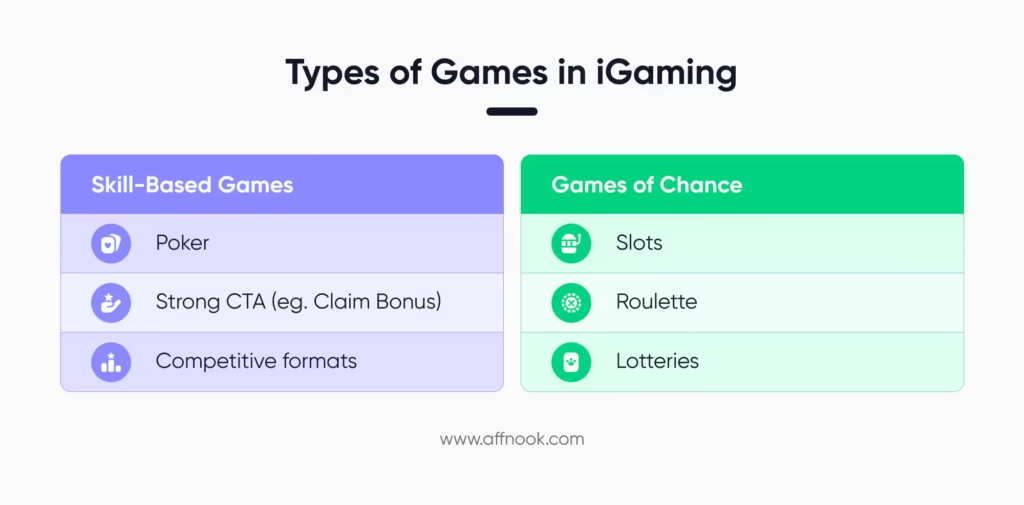
iGaming, or online gambling is a blanket term for all kinds of betting, casino and gambling-oriented activities conducted using digital platforms and technology. This is usually divided into two types of ‘games’:
- Skill-based games
- Games of chance
All kinds of gameplay under online casinos, sportsbooks, poker rooms, live dealer games, secondary lotteries and so on feature in this industry.
Due to the manner of its functioning, iGaming (unlike traditional gambling) relies heavily on technology and software infrastructure for all kinds of applications — from platform creation and maintenance to compliance, KYC and payment processing.
Within this industry some of the key iGaming terminology that everyone must know is as follows.
Gross Gaming Revenue (GGR)
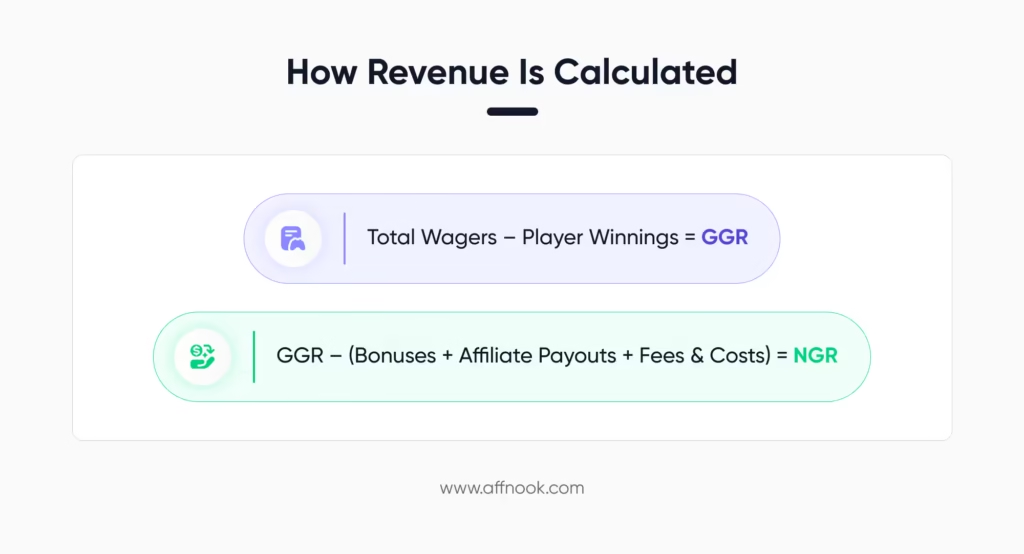
The broadest financial metric in iGaming is referred to as the GGR or gross gaming revenue. It is the sum total of all the currency amount wagered by all players on a given gaming platform, after removing all the winnings in the same time frame.
Let’s understand how GGR is calculated.
Suppose $10,000 is wagered on a given day across all the regions where a platform is visible, and $4700 is won in total by all the wagering players, the GGR would be $5300.
Net Gaming Revenue (NGR)
The true income generated by an operator or brand is visible through the net gaming revenue or NGR.
When each one of the various deductions, such as affiliate payouts, chargebacks, operational costs, employee salaries, miscellaneous fees and so on, is complete from the gross gaming revenue or GGR. The amount leftover is the profit gained through the entire promulgation of the business activity.
If GGR is $50,000 and total deductions amount to $20,000, the NGR is $30,000. Many affiliate commissions are calculated using NGR rather than GGR.
Adjustments
All the manual or automatic corrections carried out within a player’s account in financial terms are known as adjustments. They include bonus recalculations, winning corrections, fraud-related balance changes and so on.
Chargebacks
When a player disputes a charge or a deposit with their payment provider, e-wallet or bank account, a chargeback is carried out by them.
In simple terms, it is a kind of refund which is initiated by the user against their iGaming operator or brand account when they haven’t conducted the disputed financial transaction.
This is a tricky zone for business operators to be in, since chargebacks come with administrative or processing costs. Repeated chargebacks on the same account can also lead to a ban from the given financial provider to the operator or brand account.
Withdrawals
When players cash out all or a part of their winnings, a withdrawal is said to have occurred.
Payout
When operators or brands make the use of affiliate programs or networks to promote their products, each conversion or event (i.e., first-time deposit or registration or first gameplay) comes at a price.
This cost of conversion paid out per event, within iGaming affiliate marketing, to affiliates is known as a payout.
Beyond these financial measurements, there is also iGaming terminology that refers to various aspects of player acquisition and marketing. Here are some of them.
Lead
A lead within iGaming doesn’t vary with the concept of a lead in general marketing terms. It is simply a prospect or an interested player, who is yet to register or add their first-time deposit.
First-time Deposit (FTD)
When a lead finally converts, they make a deposit for the very first time after creating their account on the platform. This first deposit is referred to as a first-time deposit in iGaming, and usually is one of the key events signalling a conversion.
New Depositing Customer
A new depositing customer is someone who signs-up and deposits within the same marketing funnel. The registrations that end without a deposit do not come under this.
Recurring Deposit
All the deposits from the same player beyond the first-time deposit or FTD come under the umbrella of recurring deposits. These deposits indicate the long-term value of a player.
Wagering Customers
Any players actively placing bets or spins on the platform are known commonly as wagering customers. Their activity directly influences GGR and NGR within a given time frame when they are active.
Cost per Lead (CPL)
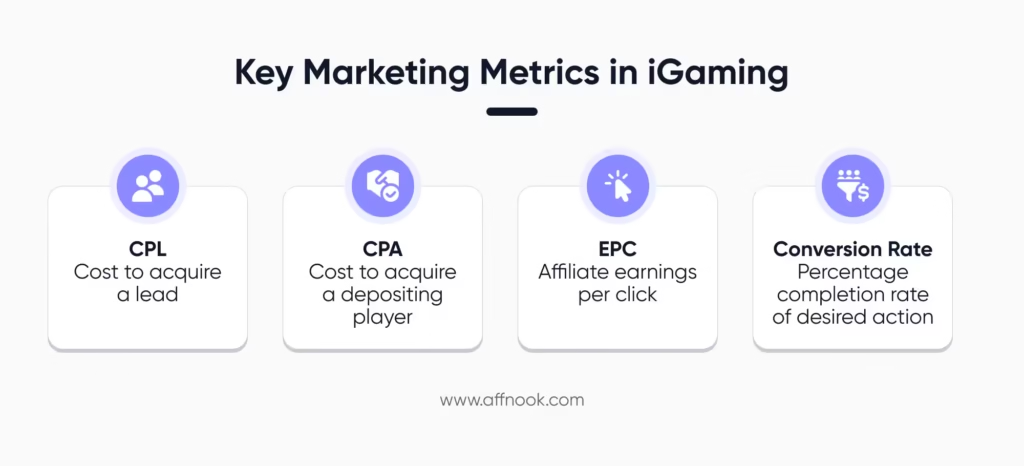
Akin to the regular marketing term, this iGaming terminology reflects the cost to the business to acquire a new lead or prospect across all marketing channels employed. The CPL is paid out to affiliates or ad serving platforms for each qualified lead delivered, irrespective of later conversion or lack thereof.
Cost per Acquisition (CPA)
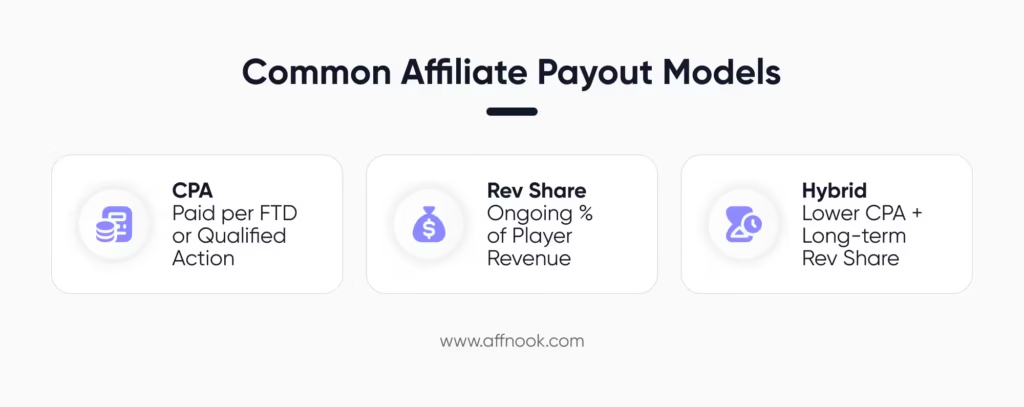
The next action beyond CPL that comes from a secondary event in the same conversion cycle is known as CPA. The cost of acquiring a player — through the completion of a desired action or set of actions like registration and/or FTD — is referred to as the cost of acquisition.
Again, this cost is the one paid out to third-party publishers or ad serving platforms like Meta and Google for player acquisition.
The cost in acquiring each player here is also referred to as customer acquisition cost or CAC.
Earnings per Click (EPC)
EPC is a metric which is specifically relevant to affiliates when it comes to picking programs and networks they wish to work with.
The total earnings from affiliate link clicks divided by the total number of affiliate link clicks during a given period of time tells us what the potential earnings per click is. At the business level, it helps operators and brands measure whether campaigns are working or not.
Conversion Rate
The percentage of users who complete a desired action, such as registration or FTD, after clicking a campaign link.
Revenue Sharing or Rev Share
When it comes to payouts, some affiliates prefer to form long-term financial relationships, wherein they are rewarded for each revenue-driving player action beyond the first conversion. This model of commission is known as revenue share, since the payout carries on across time for high-value publishers bringing in whales.
Lifetime Value (LTV)
The overall value created for the platform in the entire duration of engagement across a given player’s lifecycle is known as lifetime value. For operators and brands, this metric is of critical value since it reflects the effectiveness of marketing efforts towards improving revenue outcomes.
Considering the manner in which this industry runs, there are terms that deal specifically into the technical side of operations. Let’s take a look at iGaming terminology dealing with software and infrastructure.
iGaming Software Provider
An iGaming software provider develops the core technology behind online gambling platforms. This includes casino games (slots, live dealer games, table games), sportsbook engines, RNG systems, and back-office tools.
Operators license games and systems from software providers, rather than building them from scratch every single time. It cuts down on development costs considering the variety and experience users seek when they engage on an operator’s platform.
The quality of a software provider directly impacts gameplay experience, fairness, and scalability.
Casino Game Aggregator
They act as a single integration function, connecting operators and brands to multiple iGaming software providers through a single API.
Instead of integrating 30 individual game studios separately, an operator can access thousands of games via one aggregator. This enables faster entry into multiple markets and centralizes game management.
Random Number Generator (RNG)
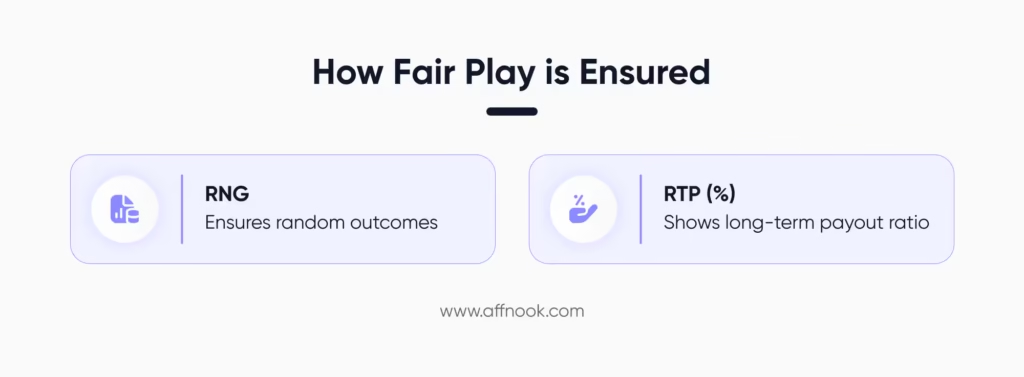
An RNG is a software that ensures game outcomes are fair, unbiased and truly random. This is a critical piece of the entire casino system, since it ensures players don’t feel cheated or tricked into losing.
More importantly, having a certified RNG is compulsory in regulated markets.
Return to Player (RTP)
The percentage of money wagered in a game to what the player can win back over a given period of time is known as return to player. This is another fairness-relevant factor in the iGaming business, which lends credibility to any operation.
Due to the nature of the online casino and gambling industry, there are several security risks associated with it. This makes regulatory compliance a critical measure of business functioning. Let’s understand the various iGaming terminology that form the framework for security and compliance.
Know Your Customer (KYC)
It refers to identity verification procedures used to prevent online gambling fraud, underage gambling, and money laundering.
KYC is an important step that occurs during the sign-up process to validate whether a given player is authentic, real and using their own identity for the purpose of gameplay.
AML (Anti-Money Laundering)
AML policies are programmed to help detect suspicious financial behavior and ensure regulatory compliance. Having such a measure is crucial in iGaming, since the industry is often seen as a source and medium for this illegal activity.
Geo-blocking
This restricts platform access based on a player’s location, ensuring compliance with regional gambling laws. Often geo-blocking is also referred to as geo-fencing.
Summing Up
Understanding the most relevant iGaming terminology is critical for anyone involved in the online gambling ecosystem. Whether you’re building platforms, running affiliate campaigns, or optimizing player experiences, having a good understanding of the industry is vital for success.