
When we are about to try something new, be it a product or a service, the first thing that we look for is reviews. This activity is prevalent in every niche, including iGaming and online casinos as well.
Potential players are curious about the types of bonuses and games that a casino offers, but also whether the online casino platform is reputable and trustworthy. This depth of research is necessary too because it is their money that is on the line after all.
In fact, reports suggest that 47% of consumers rely heavily on affiliate reviews and recommendations before making a purchase.
Online casino reviews hence hold a valuable position in the iGaming affiliate space. While media and iGaming influencer campaigns generate demand, reviews capture the demand that already exists. The person who is searching for “best casino for fast withdrawals” or “safest crypto casino 2026” knows that they have to gamble, they just do not know what the correct platform is. This is because the consumer is already almost at the bottom of the funnel when they go to a review site, and that makes it a higher-converting traffic-generation source.
What Do Affiliate Casino Reviews Do?
A review site pulls a consumer towards the platform that they are expected to promote. While they are editorially independent, there are certain unsaid rules they abide by –
- Comparing the casino platform against competitors on the same page.
- They live and die by reader trust.
- A single outdated bonus term or misleading claim on their site becomes a compliance problem on the platform’s iGaming license, not theirs.
Hence, they must not be treated like generic affiliates who are provided with an affiliate link, timely payout, and rare, occasional check-ins. This keeps the enormous value of an online casino at stake and real risk unmanaged.
This guide walks through how to actually orchestrate that relationship: from choosing the right reviewers to structuring deals that reward the right behavior, to keeping the whole channel compliant and measurable as it scales.
Why Do Online Casino Reviews Deserve a Different Playbook?
Most affiliate channels are focused on reach. They want to get in front of as many eyes as possible and then leave the rest to the conversion rate. Online casino reviews go against this logic because what holds value for them is pre-qualified intent. Someone reading a comparison table of withdrawal speeds is three clicks from making a deposit.
This changes how the relations should be managed between the two entities. A brand negotiates price and creatives with a media buyer. With an online casino reviewer, on the other hand, the iGaming brand negotiates something closer to the editorial placement, and that is –
- Where the casino sits on the comparison table
- How the bonus is framed next to the competitors
- Whether the casino platform will get the “Editor’s pick” badge in the quarter
It is the relationship and the data that become the accelerator in this scenario. This is also why review site partnerships tend to compound. A reviewer will keep giving a prominent placement to a casino site if they –
- Trust the data feed
- Get paid accurately and on time
- See that the offers actually convert their readers
On the other hand, if the reviewer gets stale bonus information and delayed payouts, they would move the casino either down the page or might even completely remove it off the page. This is a channel where operational reliability becomes the real marketing strategy.
Let us look at some of the to-dos that must be considered when working on online casino reviews.
Vet Reviewers like Business Partners, Not Ad Slots
The temptation with affiliate recruitment is to say yes to anyone who applies. This would be a mistake with review sites and might even cost twice. Once, in wasted commission on low-quality traffic, and the second time in reputational exposure if the site is non-compliant or glitchy.
Hence, a few things must be checked before onboarding.
Traffic Quality Over Traffic Size
A site ranking for “casino reviews Brazil” with 20,000 monthly visitors from organic search is usually worth more than a site claiming 200,000 visitors from undisclosed paid traffic or incentivized clicks. This is why it is necessary to focus on traffic quality scoring, analytics, and not just what is being claimed.
Editorial Standards
One question that must be asked is: Does the site actually review casinos, or does it just republish bonus copy operators hand it?
A site must have a real editorial process like –
- Testing withdrawal times
- Checking licensing
- Updating terms and conditions
These online casino reviews tend to build reader trust that eventually leads to higher-quality sign-ups.
Jurisdictional Focus
A reviewer who targets exactly the markets that the casino license covers is worth more than a generalist site sending the platform traffic from regions that cannot be legally accepted.
Compliance History
Check whether the website has been flagged before for misleading claims, unlicensed operator listings, or missing responsible gambling messaging. This must be evaluated directly because any compliance failure from the review site’s end will be attributable to the casino platform.
Structure Deals That Reward the Right Outcome
A lot of operators get their incentives wrong, especially when it comes to online casino review sites. In this scenario, they either undersell the relationship or overpay for the traffic that might not even stay. This is why it is important to understand the scope of different commission models that are commonly used.
- Cost per acquisition (CPA) suits review sites that aim to pull high-intent traffic. This traffic includes qualified first-time depositors and is not casual browsers who need to be nurtured over months. A predictable payout per FTD gives clarity to both sides.
- Revenue Share is meant for those online casino reviews and reviewers who are trustworthy enough to bring a user back for updated recommendations and not just bonus hunting. Hence, this commission model makes more sense when the reviewer brings in more genuine, loyal, and long-term players.
- A hybrid model is a combination of CPA with a trailing revenue share model. It works best for the highest-performing review sites as they are rewarded for both the initial acquisition and the ongoing player value. Here, the reviewers are not asked to bring a lifetime retention of players that they don’t and can’t control.
- Tiered incentives should not be negotiated later in a reactive manner. Instead, they should be built in from the start. If a reviewer’s placement moves a casino brand from position five to position one on their comparison table, their payout terms should reflect that shift in performance. The last thing it should be is static because no one revisited the contract.
One structure here that is worth watching for is the reviewers who run their own network of contributing writers or smaller niche sites underneath them. In these cases, the multi-commission structure is one where the head reviewer earns a share of what their sub-affiliates generate.
This structure keeps everyone aligned and gives the online casino review platform a reason to dedicatedly grow their own network on the casino or brand’s behalf instead of just maintaining the page.
Give Online Casino Reviews What They Really Need
A review site’s comparison table is only as good as the data feeding it.
- Outdated wagering requirements
- Expired bonus codes
- Wrong withdrawal time claims
All of this erodes the one asset that the casino reviewer is trying to sell, and that is the reader’s trust. Once this trust is gone, it cannot be regained even through an email.
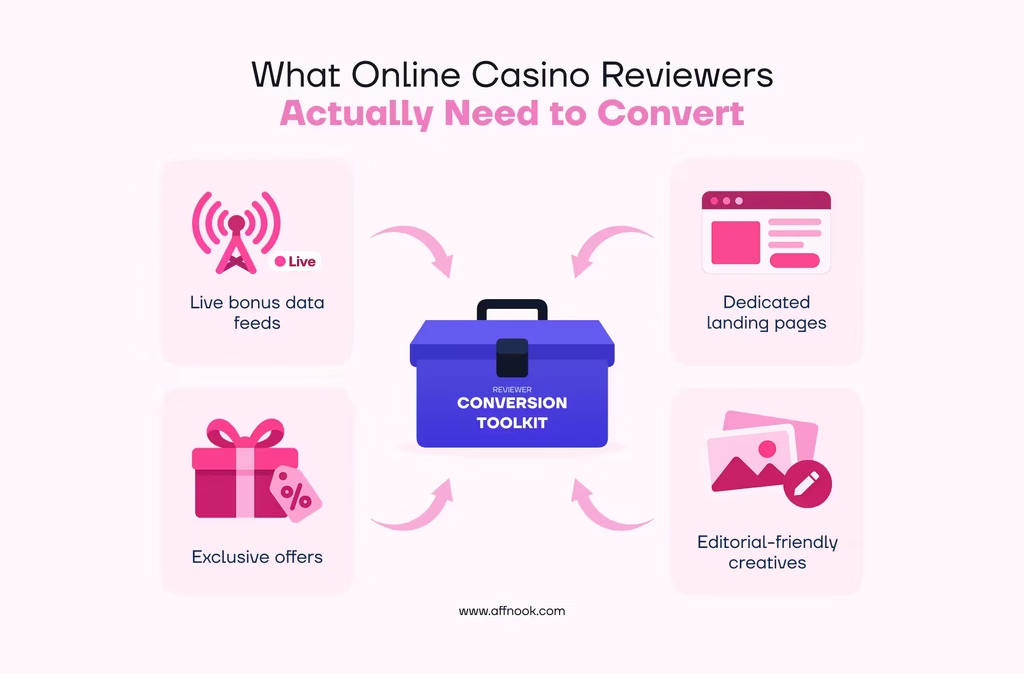
The operators who win this channel should treat their reviewers less like ad space and more like a distribution partner who needs real-time infrastructure such as –
- Live data feeds for bonus terms so that the reviewer’s table updates automatically, even days after the promotion has changed.
- A dedicated landing page should be tailored for that particular casino reviewer’s audience or should be similar to the niche that the site talks about. For instance, a crypto-focused review site should land readers on a page that leads with crypto payment options, not a generic homepage.
- Exclusive codes or enhanced offers should be provided to the top-performing online casino reviews. By having something differentiated and unique to write about, casino reviewers will be able to stand out and catch attention rather than showing the same old gambling bonuses that every other competitor also offers.
- Creative assets like banners and comparison table graphics should be built for editorial context. They should look native to a review site’s design and not like a generic ad unit that can be very easily ignored.
How Do You Track Attribution Honestly Across the Review-Site Channel?
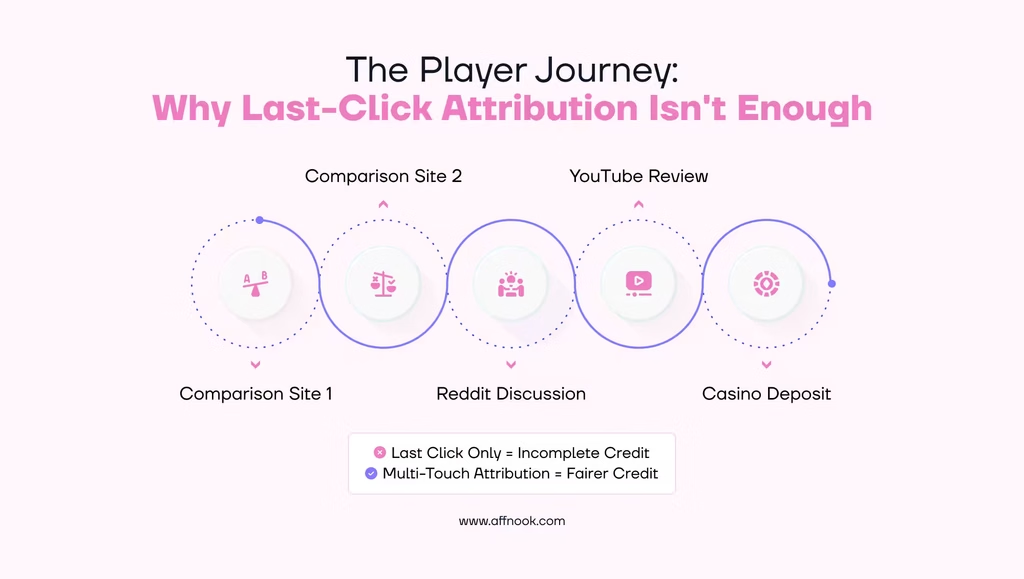
It is rare for a player to convert after reading just one review when it is just a part of their research. A more realistic player path spread across the week looks something like this –
- Three comparison sites
- A Reddit thread
- A YouTube review
It is after a proper exploration that they finally make a decision and a deposit is made. If a platform’s attribution model just credits whoever holds the “last click”, then they are just systematically underpaying the online casino review sites that actually played a major role in building the player’s trust earlier in their journey.
It is necessary to understand that it will eventually come to the site’s notice that their conversion numbers don’t match what the platform’s dashboard is actually crediting them. This breaks the sense of trust between the two entities.
What must be done to avoid such situations?
This is where FTD and qualified-FTD tracking matter more than they get credit for. Being able to differentiate a first-time deposit from a qualified one (a real player who clears basic fraud and quality checks, not a bonus-abuse account) protects the payout budget from swindling by honest affiliates.
When the custom GGR and NGR formulas are in sync with the actual revenue data instead of the estimated one, the revenue share deals remain fair for both parties. This especially matters when it comes to the retention of the best reviewers because nothing kills a partnership faster than an affiliate suspecting that they are being shortened.
It’s hard to perfect multi-touch attribution in the iGaming affiliate industry, but even directionally acknowledging it by giving partial credit to assist touchpoints rather than 100% to the last click is necessary. This tends to keep review-site relationships healthier than a strict last-click model.
Why Is Compliance a Shared Responsibility Between Operators and Reviewers?
One may think that online casino reviews content is the reviewer’s own liability, not the casino platforms’. But this is not what regulators believe because if something is lacking or questionable about the content, such as –
- Inflated bonus claims
- Missing responsible gambling messaging
- Targeting the jurisdiction the casino’s license doesn’t cover
The exposure will ultimately land on the casino brand itself. Hence, a few practices that keep this manageable at scale and should also be clarified in the iGaming affiliate contract as well.
Periodic Content Audits
There should be timely content audits of how the online casino brand is being represented in the top-performing reviewer pages. This should not be limited to onboarding; it should be checked quarterly. This is because junior content writers may be unaware of the online casino’s current terms and conditions.
Clear Onboarding Requirements
There should be full clarity around responsible gambling disclosures, age verification messaging, and accurate bonus terms that should be built into the affiliate agreement itself instead of just being assumed.
Geo Targeting Alignment
It is important to keep a check of the online casino reviews and confirm that the reviewers are not sending traffic from jurisdictions that are outside the casino platform’s licensed markets. This is something that can be easily
The purpose of this is to not just manage risks but also filter for quality. Reviewers who push back on sloppy compliance requests, or who proactively flag outdated terms on their own page, are usually the ones running a genuinely trustworthy site. The correlation here is worth paying attention to.
Watch for Fraud Without Treating Every Reviewer like a Suspect
Review-site channels see less blatant fraud than incentivized traffic networks, but it’s not immune.
Fraudulent activities like cookie stuffing and fake or incentivized sign-ups that look like organic sign-ups both show up here. Another prominent type of fraud here is click fraud, where bad actors try to drain a reviewer’s CPA budget to make the competitor’s numbers look much worse.
If a fraud detection feature is built into an affiliate platform, then the operator is alerted about the –
- Unusual conversion spikes
- Suspicious click-to-deposit ratio
- Geographic mismatches
This further protects the payout integrity of the brand without requiring the operator to manually audit every reviewer. This does not mean that one must always stay suspicious by default. The idea is to catch the small fraudsters or bad actors early enough that their actions do not distort the casino’s data or its budget.
Manage the Relationships Rather than Just Metrics
The operators who get the most out of this channel in the longer term tend to do one thing consistently. They treat their top reviewer as a relationship that they should invest in, instead of thinking of it as a mere item that should be tracked from the monitor. Regular check-ins beyond the automated dashboards become a necessity here. This is handled by a dedicated affiliate manager who knows –
- What content the reviewer is planning next quarter.
- Who flags upcoming promotions before they go live rather than after.
- Who genuinely helps the reviewer improve their conversion rate rather than just collecting the reports.
Apart from regular check-ins, A/B testing is also an important activity. A/B testing landing pages and offers by reviewers, instead of running one generic funnel for everyone, brings a meaningful lift. For instance, a crypto-first audience and a live-dealer-focused audience convert on different messaging, even for the same casino brand.
This helps in evaluation and comparison of performance, and through this, iGaming brands pay top online casino reviews more and let go of the underperforming ones. This keeps operations lean and prevents teams from getting bogged down by dozens of stagnant partnerships.
What Should Be Measured?
Vanity metrics like clicks and impressions do not matter as much in this channel of affiliate marketing because they tell almost nothing about an online casino review site partnership’s real value.
Then what are the metrics that actually matter?
- The conversion rate of an individual reviewer should be prioritised instead of channel-wide averages. This is because an average masks the extreme performance gaps and hides who the highest revenue drivers are and what their biggest liabilities are. The performance will, in fact, vary enormously from page to page.
- There should be a differentiating section for average FTD value and qualified-FTD rate. This way, the reviewers sending genuine depositors will be separated from those online casino reviews that send bonus-abuse traffic.
- Player lifetime value from review-site traffic versus other channels must also be taken into consideration. This is because it might reflect on the single most useful number for deciding where to reinvest the budget.
- The placement of the casino on the review site’s comparison table matters the most. Knowing whether the brand is moving up or if it is going down is necessary to understand what changed and what work is required on the product.
A dashboard that shows all this at the reviewer’s level instead of burying the necessary data in aggregate channel reporting is what makes the casino brand actually act. This could mean –
- Negotiating the terms
- Doubling down on what is working
- Cutting out what is not working
All of this can be figured out before a quarter’s worth of budget goes to a partnership that has actually stopped performing.
Conclusion
Online casino reviews are like trust brokers that stand in between a brand and a player who is already halfway to a decision. The operators who are able to understand the workings of this affiliate marketing channel should understand that just increasing the commission does not work here.
Swapping out text for live data feeds, crediting the reviewers who build early player confidence, and handling compliance together actually keeps the relationship running and valuable.
Scaling successfully means auditing performance reviewer by reviewer. By tracking individual pages, operators can reinvest in what actually converts before wasting a whole quarter’s budget on dead weight.
Help Centre
Online casino reviews give affiliates a fast way to assess licensing, payout reliability, and player trust before committing to a partnership. Independent professionals rely on this information because one of their aims is also to protect their audience’s trust and avoid promoting operators with poor reputations or compliance issues.
A trustworthy review verifies licensing, tests real withdrawal times, and discloses affiliate relationships transparently. Credibility matters more than flashy bonuses to those who build relationships and connect brands with audiences.
Reviews should be refreshed whenever bonus terms, licensing status, or payout policies change, often quarterly. Outdated reviews mislead readers and damage the reviewer’s credibility, which directly affects an affiliate’s ability to maintain trust-based relationships with their audience.
Yes, reviews anchored around specific events like tournaments, seasonal bonuses, and new launches help time-sensitive promotions land credibly. Connectors coordinating campaigns around live events use up-to-date reviews to ensure the offers they promote are accurate at the moment their audience sees them.