For years, affiliate marketing in iGaming was a tried and tested recipe. Collaborate with sports publishers, conduct CPA negotiations, monitor deposits of new players, and fine-tune on traditional acquisition paths for players. That’s because the audience was predictable.
Esports has altered the rules.
Esports bettors are far from being just younger versions of the classic sports bettors. They’re digital-native, community-driven, mobile-first, and creator and peer network-enabled. Unlike traditional sports sites, they find brands on Twitch streams, on Discord servers, via YouTube creators, and in niche gaming communities.
It is a huge opportunity and an immense challenge.
Global esports viewers are projected to hit 640 million by 2026, and the industry is rapidly developing into one of the largest segments in the online betting market, reports said. However, many operators are still implementing traditional affiliate programs for audiences that are quite different.
The result? Missing or incorrect commission splits, recruitment tactics, attribution, and a lack of player value understanding.
Adding esports markets to an existing sportsbook isn’t enough to win in esports. It requires a fresh affiliate strategy, combined with community trust, flex partnerships, cross-device tracking, and measuring long-term value.
This guide covers how operators, affiliate networks, and iGaming brands can create profitable esports betting affiliate programs tailored right for the next generation of bettors.
Understanding the Esports Betting Audience
Understanding the audience is the key to the success of esports betting affiliate programs.
The esports community is not your typical sports bettor, but rather a group of people who have grown up online. They read differently, engage in communities differently, and value authenticity over advertising.
This segment is characterized by:
- Younger generations, especially Gen Z and younger Millennials.
- Mobile-first browsing and betting behaviour.
- Active membership in online communities.
- Very high levels of trust in creators and peer recommendations.
- More interest in promotion and special offers.
Esports bettors can wager less than certain traditional sports bettors, but they tend to be very active and engaged in the betting process.
This distinction is significant because if optimization is only for acquisition costs, then the operators will risk a lot of missed LTV.
The Affiliate Ecosystem Looks Different in Esports
Traditional sports affiliate programs often utilize odds comparison sites and SEO publishers.
Esports has a much larger ecosystem that is much more decentralized than it is.
Streamers: The Trust Economy in Action
It’s created highly engaged communities on platforms like Twitch, YouTube, and Kick. Their suggestions can actually appear like a friend’s advice instead of commercials.
The trust levels may be much higher than those in traditional display ads due to the daily relationship that audiences have with creators through live chats and broadcasts.
But balance is important in partnerships.
Promotional campaigns can backfire on authenticity, whereas community-based integrations may work better.
Discord Communities
Discord has become much more than just a message board.
It is also a place where the gaming community can discuss tournament information, strategies, team performance, and betting opportunities.
Many server moderators and community administrators act as small-time “affiliates” that can shape very niche and specific audiences.
Operators that engage in these communities respectfully and in a value-added partnership are more likely to succeed in achieving sustainable growth.
Esports Publishers and Media Sites
SEO remains important.
Esports-specific news sites and blogs bring in well-informed traffic as they provide previews of the tournaments, betting tips, post-game evaluations, and team news.
Such publishers connect educational content and conversion opportunities.
Emerging Affiliate Categories
The affiliate landscape keeps on growing, which includes:
- Betting tipster communities
- Fantasy esports influencers
- Tournament organizers
- Gaming newsletters
- Esports podcasts
Across partner types, variety reduces the risk in the acquisition process and enhances resilience in the longer term.
Recruiting Affiliates That Actually Deliver Results
Recruitment is not just about bringing in affiliates.
It’s all about partnering with people who fit with your audience and goals.
Understand What Affiliates Want
When it comes to esports betting affiliate programs, affiliates prioritize:
- Transparent communication
- Fast onboarding processes
- Reliable payments
- Access to creative materials
- Flexibility in commission structures
- Exclusive promotions
Most creators love their community. When hiring decisions are made with the true intention of partnership rather than transaction, the performance results are greatly enhanced.
Focus on Audience Fit
While large audiences often lead to a large profit, it is certainly not a rule.
Some questions operators should consider asking are:
- Are conversations about esports betting genuine and interactive?
- Does traffic geographically target markets?
- Is the creator trustworthy?
- Is it up to code?
Quality is always better than scale.
Build Relationships, Not Transactions
Collaboration and regular check-ins, performance reviews, and campaign planning are effective in building overall collaboration.
Effective esports betting affiliate programs tend to be more of an alliance than merely a simple marketing contract.
CPA vs. Revenue Share: Rethinking Commission Models
Traditional sportsbook commission models often don’t work for the esports audience.
Understanding bettor behavior is important for deciding on the proper model.
The Case for CPA
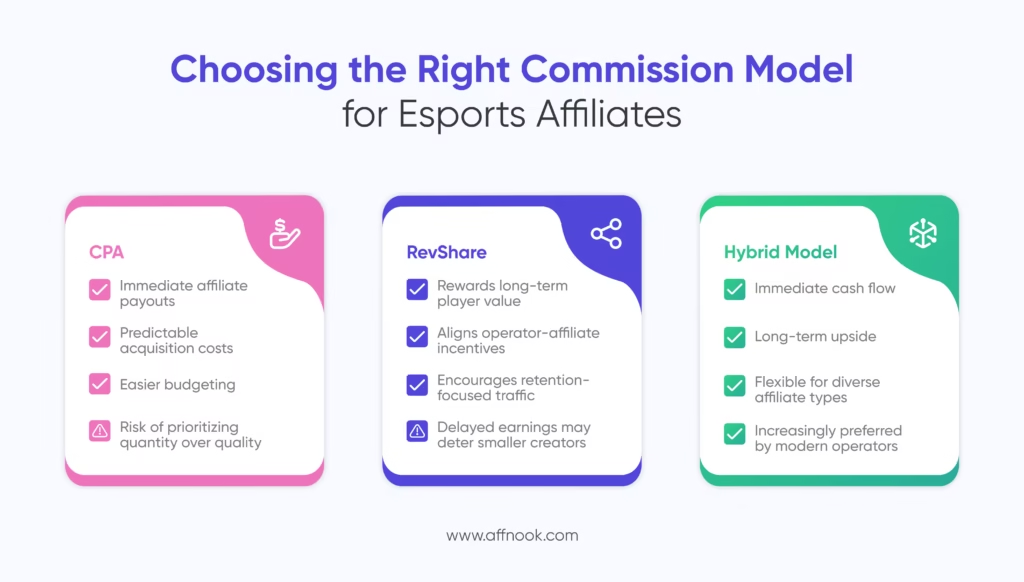
Cost Per Acquisition (CPA) gives affiliates guaranteed income.
Advantages include:
- Immediate rewards.
- Easier budgeting for operators.
- Simpler performance evaluation.
But CPA may induce short-term acquisition behaviour based on quantity rather than quality.
The Strength of Revenue Sharing
Revenue sharing incentivizes the affiliates to join on a long-term basis.
Benefits include:
- Shared focus on retention
- Greater upside potential
- Improved acquisition quality
The trick comes when earnings are delayed, and that could deter smaller creators wanting to make quick returns.
The Reality of Lower-AOV, High-Volume Audiences
Esports bettors may bet smaller amounts, but with more frequency.
That does change commission economics.
High-value esports affiliates can earn:
- Moderate first deposits
- Consistent activity
- Strong retention patterns
- Increased lifetime profitability
Assessing affiliation value solely on first-time deposits is not the best approach.
Hybrid Models Offer Flexibility
Some of the modern operators are following a mixed CPA-Revenue sharing model.
Examples include:
- Fixed CPA + Recurring revenue sharing
- Revenue sharing based on progressive tier schedules
- Retention bonuses and extra pay
These methods align incentives as well as cater to different affiliate choices in esports betting affiliate programs.
Designing Commission Tiers That Drive Growth
Not every affiliate is the same.
The commission scheme is designed to incentivize operators for their efforts.
Volume-Based Incentives
With greater volume in leads, affiliates can access higher payouts.
For example:
- 1–25 players: Base CPA
- 26–75 players: Enhanced CPA
- 76+ players: Premium rates
There is consistent effort when there is clear progression.
Quality-Based Rewards
Larger doesn’t necessarily mean better.
Examples of quality indicators are:
- Retention rates
- Repeat deposits
- Net gaming revenue
- Fraud-adjusted performance
An incentive for quality opens the door to low-value acquisition processes.
Tournament-Based Bonuses
Esports events are great for promotion as they are natural events.
Examples include:
- League of Legends World Championship
- Counter-Strike Majors
- The International
- Valorant Champions
Short-term incentives help affiliates to engage during peak times.
Promo-Level Incentives
Calling out performance based on promotional offers is helpful for insight.
Operators can identify:
- Which bonuses are worth more?
- Which creatives resonate?
- Which campaigns have long-term value?
Many static commission plans do not reflect these details.
Why Cross-Device Tracking Is No Longer Optional
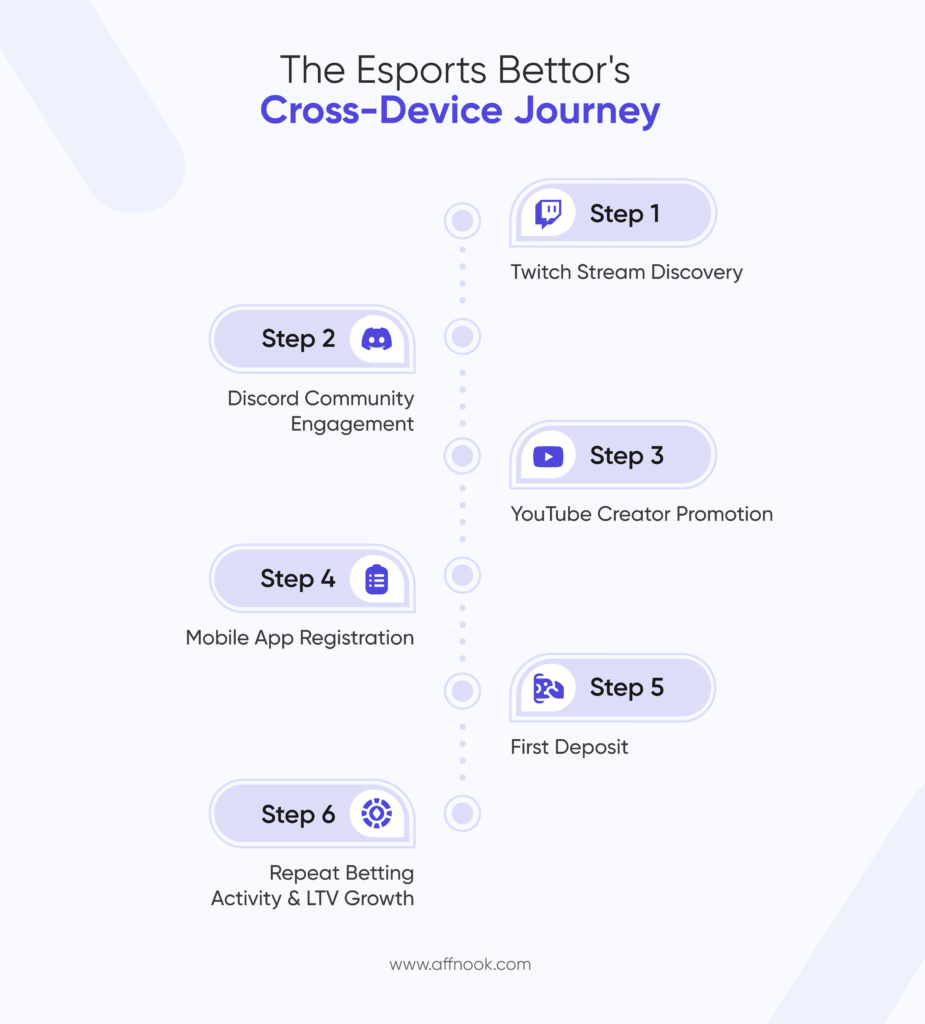
The customer journey has been digitized into numerous small pieces.
A bettor might:
- Find a Streamer via Twitch on Desktop.
- Join Discord on mobile.
- Follow a promotional link from YouTube.
- Fill in registration via an app.
If conversions are not attributed, operators have no idea what really contributes to conversion.
Common Tracking Challenges
The attribution of esports is complex for several reasons:
- Cookie limitations
- App-to-web transitions
- Cross-device behavior
- Multiple touchpoints before conversion
Such gaps result in mismatches in the reporting process and restrict optimization.
Building a Unified View
Operators should have infrastructure that supports:
- Affiliate activity
- Promotional campaigns
- Player acquisition
- Revenue generation
Granular reporting turns speculation into insight.
Measuring Lifetime Value in Esports Player Cohorts
The information about first-time deposits is only part of the picture.
Lifetime value is crucial for understanding long-term profitability.
Why LTV Matters
A moderate player who deposits small amounts regularly can outperform a larger depositor who churns from the get-go.
The LTV analysis is a reorientation from the purchase price to profitability over time.
Key Metrics to Track
These are the key elements of effective LTV in esports:
- Average revenue per user
- Retention rates
- Betting frequency
- Deposit recurrence
- Net gaming revenue
- Time to profitability
Cohort Analysis Creates Clarity
Player segmentation by cohort reveals useful patterns.
The following are some helpful cohort categories:
- Affiliate source
- Geography
- Tournament periods
- Promotional campaigns
- Acquisition channels
They give organizations better guidance when making their budget decisions.
Hidden Value Often Emerges Later
Some looked ‘average’ in the first reporting periods.
But their referred players can show extra high retention and engagement over several months.
To only consider short-term KPIs can result in the loss of their most valuable partners.
The Importance of Geo-Targeting
No matter how global sports might be, player preferences are always local.
Regional differences influence:
- Popular game titles
- Regulatory environments
- Language requirements
- Bonus expectations
For instance, Counter-Strike might be the game that plays the lead role in one area while the League or Valorant is the one that does so in another.
A localized campaign that communicates a specific message always beats the one with a blanket message.
Effective Geo-Targeting Strategies
Operators should:
- Translate creative assets
- Adapt promotions regionally
- Prioritize relevant tournaments
- Test emerging markets before scaling
Precision improves efficiency.
Operational Challenges That Limit Profitability
The growth of esports betting affiliate programs makes it more complicated.
Operators often have to deal with:
Multi-Brand Management
When there is no consistency across brands, campaigns can get misaligned and end up being done over.
Data Silos
Seamless reporting delivers insights and supports decision-making in real-time.
Compliance Monitoring
There are new compliance considerations when implementing creator-led marketing.
It is necessary to control and supervise without becoming immobilizing and untrue to the source.
Scalability Constraints
At high growth rates, manual operations work well at small volumes but are not sustainable.
Operational infrastructure can make or break profitability and accelerate or amplify inefficiency.
Building Infrastructure for Sustainable Growth
New technology is the dividing line between effective esports betting affiliate programs and low-performing programs.
Operators must find solutions that can enable their modern affiliate needs while maintaining control.
These challenges can be addressed by using features such as multi-brand campaign management, geo-targeting, promo-level monitoring, and consolidated reporting that platforms like Affnook offer.
The goal is not just to deal with more affiliates.
It’s providing greater visibility and enabling smarter decision-making.
With the fundamental understanding of which partners are introducing valuable players, which promotions are keeping customers, and which regions are rewarding investments, profitability can be achieved and scaled more readily.
Conclusion
One of the most promising avenues for the future of iGaming is esports betting affiliate programs.
Getting to success in this space involves letting go of dated notions.
The esports fans appreciate authenticity, community, and experiences online that’re really different from what traditional sports betting fans enjoy. However, to move past SEO publishers, recruitment strategies need to change. Commission models should mirror the player behaviors of lower-AOV but higher-engaging players.
Customer journeys should be addressed in attribution systems. Performance must be measured not just on deposits at the beginning of a prospect’s journey, but actual LTV.
The operators who are ready to accept such realities can obtain a substantial competitive edge.
It is not the ones with the biggest budgets who will own the future of affiliate marketing in iGaming.
It will be the people who know their audiences, show them the value of their contributions in the smartest way possible, and have implemented the business architecture to sustain long-term profits from community investment.
The esports opportunity has already arrived.
The question is, are you prepared for your affiliate program?
Help Centre
What are esports betting affiliate programs?
Esports betting affiliate programs enable affiliates to represent esports betting operators and receive affiliate commissions via player referral, CPA, or a mix of both payment structures.
How do esports betting affiliate programs differ from traditional sportsbook programs?
Esports betting affiliate programs are more reliant on creators, Discord communities, and mobile audiences, thus needing unique recruitment, tracking, and commission approaches.
What commission model works best for esports betting affiliate programs?
Hybrid models that incorporate a mix of CPA and RevShare can be effective, as they provide a balance of immediate affiliate payouts and continued player value and retention.
Why is LTV important in esports betting affiliate programs?
LTV lets operators discern which players are profitable and which are retained, not just based on initial deposits.
How can operators improve performance in esports betting affiliate programs?
Operators can enhance performance by implementing a variety of strategies for affiliate recruitment, tracking campaign levels, geo-targeting, cross-device attribution, and optimizing commissions with data.