The global interactive gambling market is projected to reach $717.06 billion by 2030, according to Statista Reports. Latin American and Central American Countries play a massive role in this. According to Sigma and LegalBison, Costa Rica is like a legal engine, corporate home, and launchpad for thousands of gambling sites servicing millions of players worldwide.
Costa Rica is always mentioned in the same breath as Malta and Curaçao when gambling is being talked about, even though it does not belong to the lineup of gambling jurisdictions. This is the most primary information that anyone who searches for “Costa Rica Gambling License” should know.
This guide breaks down what a Costa Rica gambling license actually is, what it isn’t, the real steps to set up an operation there, what it costs, and where the model works and where it doesn’t.
What People Mean When They Say “Costa Rica Gambling License”?
It is important to understand what people mean when they use the phrase. Despite having more than 400 online casinos and bookmakers, what the market calls a Costa Rica gambling license is actually a “business operating structure.”
Regulated United Europe defines it clearly: A Costa Rica gambling license is usually a market term for an offshore operating structure built around a –
- Local company
- Tax registration
- Municipal business authorization
- Compliance stack
It is not the same as a national remote gaming license issued by a specialist regulator such as the UK Gambling Commission, Malta Gaming Authority, or Curaçao Gaming Control Board.
The reason why the market keeps using the phrase is that the founders aim to search for a workable legal setup that Costa Rica genuinely offers, it is not just in the form that is normally expected.
The Legal Skeleton Behind a Costa Rica Gambling License
Four layers make up what functions as a Costa Rica gambling license in practice. It must be noted that they are not just restricted to gambling.
Corporate Registration
Operators form a private limited company, which is generally a Sociedad Anónima (S.A.) or Sociedad de Responsabilidad Limitada (S.R.L.), through the Registro Nacional portal or the World Intellectual Property Organization.
This is identical to registering any ordinary business. Company Formation Costa Rica confirms there is no special registration authority for casinos. Gambling companies are expected to register the same way as any other business does.
Tax Registration
The company registers with the Ministerio de Hacienda for a fiscal ID. As Costa Rica taxes on a territorial basis, foreign-sourced gambling revenue generally remains outside the local tax net. It must be noted that filing and bookkeeping obligations continue nevertheless.
Data Processing License
This is the piece most often mistaken for an actual Costa Rica gambling license, and it’s worth separating clearly. A data protection license is a municipal-level permit that authorizes the company to host and run servers in Costa Rica for data processing. This includes gambling data as well.
Company Formation Costa Rica describes two versions –
- A temporary license that is valid for six months and is useful for testing the market.
- A permanent license that enables continuous operation against an annual fee.
This license is, hence, like a permission to run servers with broader coverage, which also includes gambling platforms.
It is relevant to a wide range of businesses beyond casino operators themselves this includes –
- Bookmakers
- Online sports betting operators
- Esports betting platforms
- Online game developers
- Lottery and sweepstake organizers
- Hosting and payment service providers
- Affiliates
- Consultants and auditors working in the space all typically fall under its scope.
Employment and Social Security Registrations
If the operator hires locally, obligations get triggered with the CCSS (social security) and INS (occupational risk insurance), same as any Costa Rican employer.
There is no mandatory testing of game software by government authorities in Costa Rica. That regulatory space simply doesn’t exist, which is exactly why the concept of a “Costa Rica gambling license” causes so much confusion among founders new to the jurisdiction.
Why Do Operators Still Choose Costa Rica in 2026?
That is a fair question to ask when the licensing scenario causes so much confusion. There are a few real advantages to it that keep it on the operators’ shortlists –
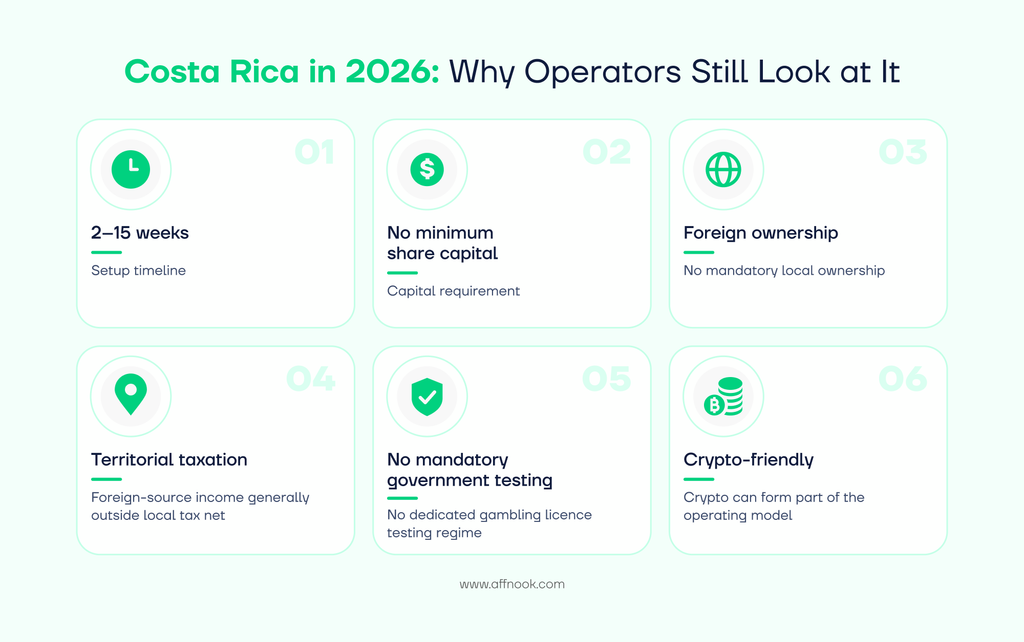
- Speed and simplicity – Setting up a gambling operation in Costa Rica takes about 2 to 15 weeks total, depending on whether you only need a basic corporate registration or a full municipal data processing permit.
- No minimum capital requirement – There’s no minimum share capital requirement, but you’ll need a business plan and proof of sufficient operating capital.
- Full foreign ownership – The business can be entirely owned by one or more foreign shareholders, without any mandatory local ownership.
- Territorial taxation – Costa Rica taxes on a territorial basis, meaning income earned outside Costa Rica is generally not taxed locally. However, it is necessary to be cautious of the fact that this is not the same as “tax-free,” since accounting, filing, and municipal obligations continue regardless.
- No mandatory testing – No mandatory government testing of iGaming software, and no annual fees tied to a gambling-specific license, since none exists.
- Crypto-friendly – Launching a crypto-accepting online casino is possible, since Costa Rican legislation does not restrict such activity.
The Core Rule Behind Every Costa Rica Gambling License Setup: Offshore-Only
The entire model rests on one non-negotiable condition: a Costa Rica gambling license setup cannot legally target Costa Rican residents. In fact, after obtaining the Data Processing License, the casino can only operate offshore, not within Costa Rica.
Operators build geo-blocking directly into the product, not just into the terms and conditions.
- IP-based geofencing blocks registration and login attempts from Costa Rican IP ranges) automatically.
- Billing-country and KYC-country checks cross-reference payment methods and identity documents against the restricted list, catching users trying to route around IP blocks with a VPN.
- Device and session-level rechecks verify location again at deposit and withdrawal since location can change mid-session.
Who Does a Costa Rica Gambling License Structure Actually Suit?
The model works best for specific use cases rather than as a universal solution –
- Offshore sportsbooks and casinos targeting markets with no local licensing requirement, run with disciplined geo-blocking
- For B2B and back-office functions, software development, customer support, affiliate and marketing operations, risk and fraud teams. It is generally easier to defend to banks than a direct-to-consumer model
- Crypto-first operators, where fiat card processing is a smaller share of the business
- Early-stage market testing, using the six-month temporary data processing license to validate a concept before committing to the permanent structure
It’s less suited to operators who need formal regulatory recognition. It is for advertising partnerships, institutional investment, or entry into tightly regulated consumer markets like the UK, Germany, or Ontario, where a Costa Rica gambling license setup carries no license-equivalent weight at all.
Compliance Obligations that Cannot be Skipped
This is the part that trips up newcomers who assume “no gambling license, no regulator” means a lighter compliance load. It is actually the opposite. With no state inspector checking the iGaming operator’s work, the business has to build and prove its own compliance stack to survive contact with the outside financial system.
Company Formation Costa Rica lists the general laws still binding on any Costa Rica gambling license structure –
- Anti-money laundering regulations
- Unusual transaction law
- Counter terrorism financing regulations
- KYC policies
- General commercial law
- Criminal law
All this includes but is not limited to gambling, and all of them are enforceable.
Day to day, this translates into a control stack that is similar to what a formally licensed operator would run anyway:
- Identity verification at onboarding, scaled to risk.
- Sanctions, PEP, and adverse-media screening for customers and for the operator’s own directors and UBOs during bank onboarding.
- Ongoing transaction monitoring for fraud, bonus abuse, and payout anomalies.
- Responsible-gambling tools (self-exclusion, deposit limits, cooling-off periods). These are not government-mandated, but are expected by PSPs (Payment service providers) before they approve processing.
- Audit logging of KYC decisions, payments, withdrawals, and admin actions, retained as evidence if a bank ever asks.
In effect, the market has replaced regulatory enforcement with commercial enforcement. Banks and PSPs act as the gatekeepers a gambling commission would normally be. They take control of the one thing the business actually needs, and that is the ability to move money until the operator proves it’s under control.
The Real Bottleneck for Every Costa Rica Gambling License Operation: Banking
For founders, the real bottleneck in 2026 is usually not incorporation but banking, PSP onboarding, geo-blocking, AML/KYC controls, and target-market legality. Without a gambling regulator vouching for the business, banks and payment service providers (PSPs) have to run their own risk assessment from scratch. Practically, this means –
- A full KYB file – Incorporation documents, beneficial ownership charts, source-of-funds evidence for founders, and a business model summary consistent across every document.
- A self-built AML/KYC program – Customer risk scoring, sanctions and PEP screening, transaction monitoring for unusual velocity or structuring, and a suspicious-activity escalation process with a named compliance owner.
- A consistent paper trail – RUE flags mismatched documentation as one of the fastest ways to stall onboarding. Municipal filing, the website, and the PSP questionnaire each describe the business differently, approval slows or stops.
Local Costa Rican banking is often reluctant to serve gambling-linked entities, many operators route payments through offshore banking relationships, EMIs, specialist high-risk PSPs, or increasingly cryptocurrency rails, which sidestep some card-network friction entirely.
Conclusion
Costa Rica remains one of the fastest, cheapest ways to stand up a company for an offshore gambling business. But it’s a business registration path, not a licensing path. Anyone selling a “Costa Rica gambling license” as equivalent to an MGA or UKGC license is misrepresenting what they’re offering.
The real value of Costa Rica in 2026 is speed, low friction, and a workable legal base for offshore or B2B operations, provided one goes in clear-eyed about what it doesn’t give: no market access authorization, no regulatory seal of approval, and no shortcut around the AML, KYC, and banking work that ultimately determines whether the business can actually operate.
Help Centre
Costa Rica does not have a dedicated licensing framework for online gambling comparable to jurisdictions such as the UK or Malta. The country’s framework distinguishes between gambling activities that are specifically authorised domestically and companies that provide data-processing or related services for betting operations serving international markets.
For an operator, this means that being incorporated in Costa Rica does not automatically make its gambling activity authorised in every market where it accepts players. The legality of the customer-facing gambling operation still depends on the laws of the countries being targeted
A Costa Rican company can be used as the corporate base for an offshore-facing gambling operation, but incorporation alone does not grant gambling-market access. Operators using this structure need to assess the laws of every jurisdiction they target and prevent access from restricted markets where required.
This distinction is important because company location and gambling authorisation are two separate questions. A Costa Rican corporate structure answers where the business is established. It does not answer where the operator is legally permitted to offer gambling services.
Not automatically. US gambling regulation is primarily determined at the state level, so an operator cannot rely on a Costa Rican corporate structure as permission to serve American customers.
Before accepting US traffic, an operator needs to assess the applicable federal requirements, individual state laws, payment restrictions, and licensing requirements. The operator’s Costa Rican status does not replace those checks.
Cryptocurrency can form part of an offshore gambling business based in Costa Rica, but using crypto does not remove the operator’s other legal and compliance responsibilities.
There is also an important distinction between the gambling operator and the crypto/payment infrastructure around it. If a Costa Rican entity, exchange, payment provider or virtual-asset service provider is involved in moving customer funds, additional AML/CFT requirements may apply to the relevant entity.
There is no conventional public register of Costa Rican online gambling licences comparable to the operator registers maintained by established gambling regulators.
This creates an important due-diligence issue: if a website claims to hold a “Costa Rica gambling licence,” the operator, payment provider or business partner should identify the actual Costa Rican company, the municipal authorisation it holds, and the authority that issued it, rather than relying on the phrase “Costa Rica licensed” alone.